The Constant Pressure of the Blank Screen: Why Content Research is Your Secret Weapon
Sitting there, staring at the blinking cursor, with absolutely no idea what to post. You scroll through your camera roll hoping a random photo will spark a brilliant caption. It rarely does. This is the reality for most creators who rely on the "wait for inspiration" model.
Jump to a section:
- The Constant Pressure of the Blank Screen: Why Content Research is Your Secret Weapon
- How to Research Instagram Content Ideas Quickly
- Why Finding Fresh Instagram Ideas Feels Like a Full-Time Job
- Strategy 1: Reverse-Engineering Top-Tier Competitor Performance
- Strategy 2: Cross-Platform Mining for 'Proven' Topics
- Strategy 3: Using Native Instagram Intelligence
- The 14-Day Idea Testing Framework
- Why Most People Still Don't Get Results
- From Manual Scavenging to a Repeatable Ideation Workflow
- Instagram Content Research FAQs
- Turning Insights into Action
Inspiration is incredibly fickle. Systems are reliable.
If you constantly feel like you are on a content treadmill, it is because you are creating from scratch every single day instead of building a database of proven concepts. What nobody tells you is that the biggest accounts do not just have better ideas. They have better research habits.
Learning how to research instagram content ideas changes the entire dynamic of your creator business. You stop guessing what your audience wants and start delivering exactly what they are already asking for. This takes the emotion out of the process and replaces it with data.
How to Research Instagram Content Ideas Quickly
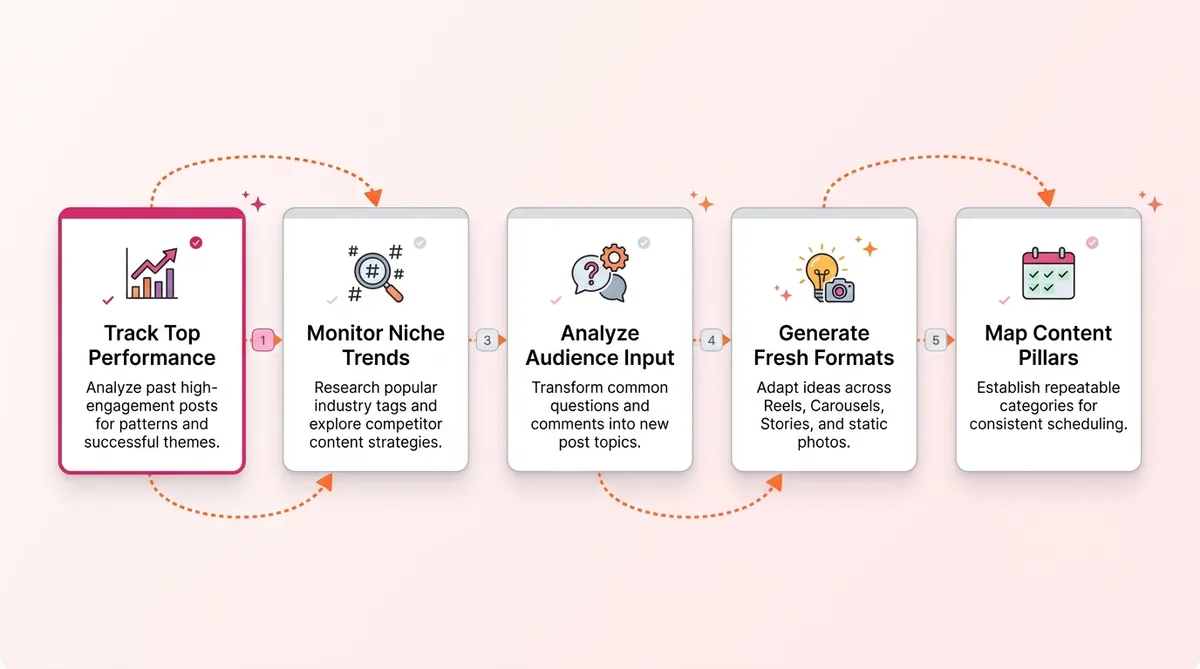
To research Instagram content ideas quickly, audit top competitors for high comment-to-view ratios, scan YouTube and Reddit for high-intent questions, and analyze Instagram's search autocomplete for trending keywords. Finally, test these concepts using your own audience's "Save" metrics to validate long-term interest.
The nuance here is intent. You are not just looking for what is popular; you are looking for what makes your specific target audience stop, read, and take action.
Why Finding Fresh Instagram Ideas Feels Like a Full-Time Job
Creator burnout is real, and it usually starts with research fatigue.
You spend hours scrolling your Explore page, trying to figure out what the algorithm wants today. You fall into the perfectionist trap, convinced that every single post needs to be a groundbreaking, original masterpiece. This pressure is unsustainable.
The landscape shifts constantly. Audio trends die in a week. Formats that worked last month suddenly tank. When you lack a structured way to gather ideas, you end up reacting to trends instead of anticipating them. You find yourself creating generic filler just to maintain your daily posting streak.
Sound familiar?
The fix is to stop relying on random scrolling and start treating your research like an investigator looking for clues. Let's break down exactly how to do that.
Strategy 1: Reverse-Engineering Top-Tier Competitor Performance
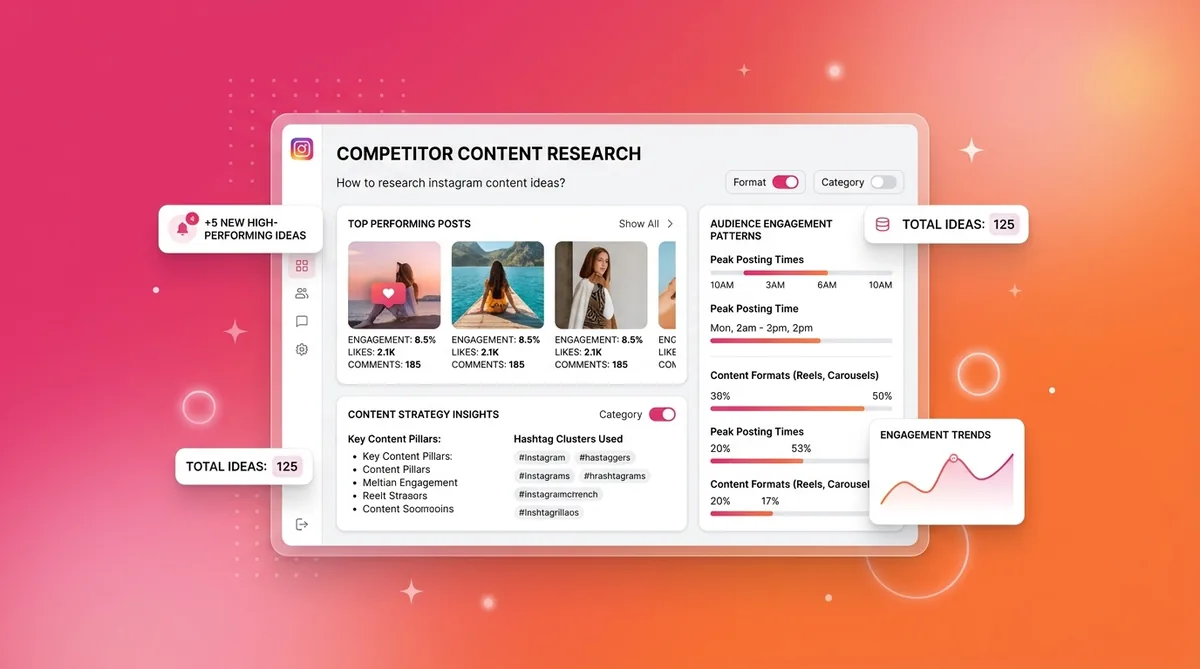
Social proof is the most reliable indicator of future performance. If a topic resonates heavily with a competitor's audience, it proves the market demand exists. You are not looking to plagiarize. You are looking to validate the underlying premise.
Identify High-Signal Posts Through Engagement Ratios
Most creators make this mistake: they look at a competitor's view count and assume the video was a success. Views are a top-of-funnel metric heavily influenced by the algorithm. Instead, you need to look at the comment-to-view ratio.
A post with 10,000 views and 300 comments is far more valuable to study than a post with 100,000 views and 12 comments.
The mechanism behind this is friction. Liking a post is passive. Writing a comment requires stopping the scroll, thinking, and typing. If an audience goes through that friction, the topic struck a deep psychological nerve. Look for posts that trigger debates, questions, or shared experiences.
Deconstruct Viral Reels to Extract Core Templates
When you find those high-signal posts, break them down to their studs. Ignore the specific niche for a second and look at the structure. What is the hook? When does the first visual transition happen? How does the creator build the curiosity gap?
By stripping away the content, you are left with a proven framework you can apply to your own niche.
Template 1
How I solved [pain point] in [timeframe] without [common objection].
Template 2
Stop doing [common industry practice]. Do this [unconventional method] instead.
Template 3
The harsh truth about [industry goal] that nobody wants to admit.
You take the structural rhythm that holds attention and inject your own expertise into it.
Strategy 2: Cross-Platform Mining for 'Proven' Topics
Human psychology does not change just because a user opens a different app. If a topic performs incredibly well on a long-form platform, it has immense potential to be condensed into short-form Instagram content.
Using Pinterest Trends to Predict Visual Aesthetics
Instagram is inherently visual, but it is often reactive. Pinterest is predictive. People use Pinterest to plan their future—weddings, home renovations, wardrobes. Because of this search intent, you can use the Pinterest Predicts report to spot visual trends and color palettes months before they saturate the Instagram Explore page.
If "moody maximalism" is spiking in Pinterest searches, you can adopt those aesthetic cues for your Instagram graphics and B-roll, keeping your visual identity ahead of the curve.
Mining YouTube and Reddit for High-Intent Pain Points
Reddit is a goldmine for unfiltered human problems. People go to Reddit to complain, ask for help, and seek incredibly specific advice. Search for your niche on Reddit and sort by "Top - This Month."
Look at the exact phrasing people use to describe their struggles. This is how you generate endless content ideas for your Instagram that actually hit home. If you see a long Reddit thread debating the best way to meal prep on a budget, that is your next 5-slide carousel.
The same applies to YouTube. Do not watch the competitor's video—read their comments. The questions left unanswered in the comments section are the exact topics you should be covering on Instagram.
Strategy 3: Using Native Instagram Intelligence
You do not always have to leave the app to figure out what the algorithm wants. Meta actually hands you this data if you know where to look.
Extracting Keywords from the Instagram Search Bar
The Instagram search bar is essentially a real-time behavioral map. When you type a broad word like "fitness" or "marketing," the auto-complete suggestions that populate are not random. They are the exact long-tail keywords that thousands of users are currently searching for.
This works because the algorithm wants to keep users on the app. It suggests topics with high retention rates. If "marketing strategy for small business 2024" pops up, you know exactly what phrase to put in your on-screen text and caption.
Turning Direct Audience Feedback into Content Loops
Most creators treat the "Ask Me Anything" (AMA) sticker as a fun weekend engagement tool. In practice, it is a structured research database.
When someone asks you a question on your Story, answering it there is just step one. Step two is cataloging that exact question. If one person took the time to ask it, fifty others are silently wondering the same thing. You can refer to the official Instagram Creators page to see how heavily Meta pushes interactive stickers for community building. Save these questions and turn them into dedicated Reels the following week.
The 14-Day Idea Testing Framework
Research means nothing if you do not test it. You need a systematic way to see which ideas actually stick with your audience.
Spend one day gathering 10 new ideas based on your research. Over the next 14 days, weave four of these new concepts into your regular posting schedule. Watch two specific metrics: Reach among non-followers, and total Saves.
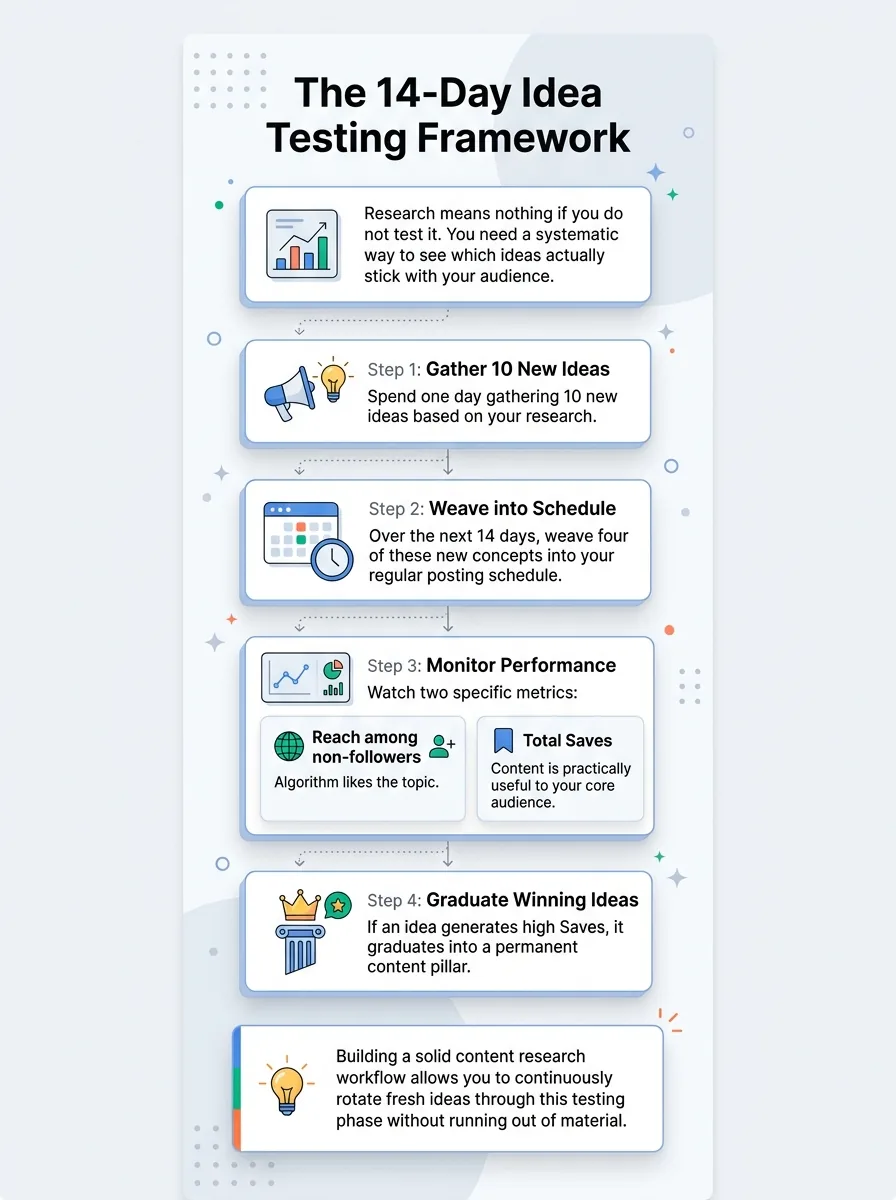
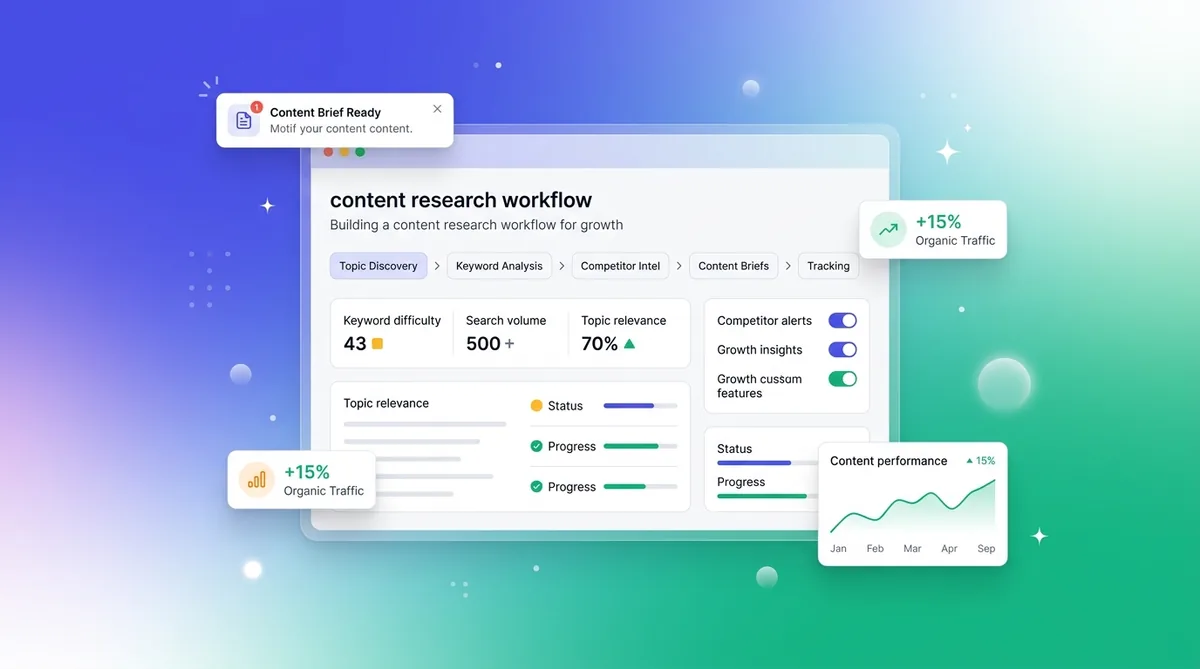
Reach tells you if the broader algorithm likes the topic. Saves tell you if the content is practically useful to your core audience. If an idea generates high Saves, it graduates into a permanent content pillar. Building a solid content research workflow allows you to continuously rotate fresh ideas through this testing phase without running out of material.
Why Most People Still Don't Get Results
Even with a solid research strategy, many creators sabotage their own growth by making easily avoidable mistakes. Check your current process against these common traps.
- Copying viral hooks without matching audience intent
Grabbing a trending hook like "The 3 things I wish I knew sooner" will flop if the actual topic you attach to it is boring or irrelevant to your followers. The hook must match the payoff.
- Stacking three different ideas into one opening line
Confusion kills reach. If your hook tries to solve three problems at once, the brain's scanning behavior rejects it. Keep it to one specific, singular promise per post.
- Using "likes" as your primary validation metric
Likes are cheap dopamine. They do not indicate that a topic is worth repeating. Researching based on likes leads to fluffy, generic content. Optimize for Saves and Shares instead.
- Researching exclusively inside your own narrow niche
If you only study other fitness coaches, you will just sound like another fitness coach. Look at financial advisors, real estate agents, or chefs to find fresh structural formats to bring back to your niche.
- Using vague claims instead of specific outcomes
Words like "this simple trick" get scrolled past. Specificity triggers the brain's pattern-recognition system. Say "this 5-minute morning routine" instead.
From Manual Scavenging to a Repeatable Ideation Workflow
The real problem is not knowing what a good topic looks like. It is producing enough quality variations consistently without spending an hour per post. You can absolutely scour Reddit, analyze competitor comment sections, and track Pinterest trends manually.
But eventually, you hit a wall.
Consistent, repeatable output is the real challenge. You need volume to test, and manual scavenging throttles your volume. That is why smart creators use dedicated systems to handle the heavy lifting of trend analysis.
If you want to speed this entire process up, a research generator takes your specific niche, target audience, and content type preferences, and outputs curated trend reports. It scans top-performing content across platforms to find what is working right now, giving you proven post ideas and angles. You stop spending three hours looking for one idea and start spending your time actually creating content that rides the wave.
Start creating viral content today
Join other creators who've transformed their social media presence with AI-powered content.
Start creating nowInstagram Content Research FAQs
How often should I research Instagram content ideas?
Set aside 30 to 60 minutes once a week for dedicated research. This prevents you from scrambling daily and gives you a buffer of validated ideas to pull from when you sit down to create.
Is it okay to copy competitor ideas?
Copying word-for-word is a terrible strategy that harms your brand trust. However, modeling the structural framework of a successful competitor post—like the hook format or pacing—and injecting your own original insights is how the entire industry operates.
How do I find ideas for a boring niche?
Stop focusing on the product and start focusing on the human pain point. A B2B software tool might be boring, but the stress a founder feels when they lose data is highly emotional. Target the emotion and the friction, not the technical specs.
Turning Insights into Action
The best content is never guessed. It is gathered from the existing behaviors, frustrations, and desires of your target audience.
Stop waiting for a spark of inspiration to hit you while you hold your phone. Build a system, listen to the data, and start creating content that your audience is actively waiting for.
Discover What Your Audience Wants
Find trending topics and content ideas that resonate with your followers.
Try Research Generator