Stop Talking to an Empty Room: A Diagnostic Approach to Low Engagement
You spend an hour crafting a post. You hit publish. And nothing. Twelve likes, one bot comment, and a whole lot of silence.
Jump to a section:
- Stop Talking to an Empty Room: A Diagnostic Approach to Low Engagement
- Quick Answer: How to Analyze Low Engagement
- The Diagnosis: Identifying the Root Cause of the Silence
- Fix #1: Master the 'Scroll-Stop' Hook and Visual Hierarchy
- Fix #2: Engineer Social Currency and Low-Friction Participation
- 5 Mistakes That Kill Your Post Engagement
- Scaling Insight: From Manual Audits to Repeatable Growth
- Frequently Asked Questions About Engagement Strategy
- The Core Principle: Engagement Follows Value, Not Frequency
Sound familiar? It is the absolute worst feeling in content creation.
You immediately start questioning everything. Is the algorithm punishing me? Am I shadowbanned? Does my audience just hate my ideas? In practice, none of those are true. You just don't have a diagnostic framework. Figuring out how to analyze why your posts get low engagement isn't about guessing. It is about looking at the cold, hard mechanics of how people consume content on their phones.
Quick Answer: How to Analyze Low Engagement
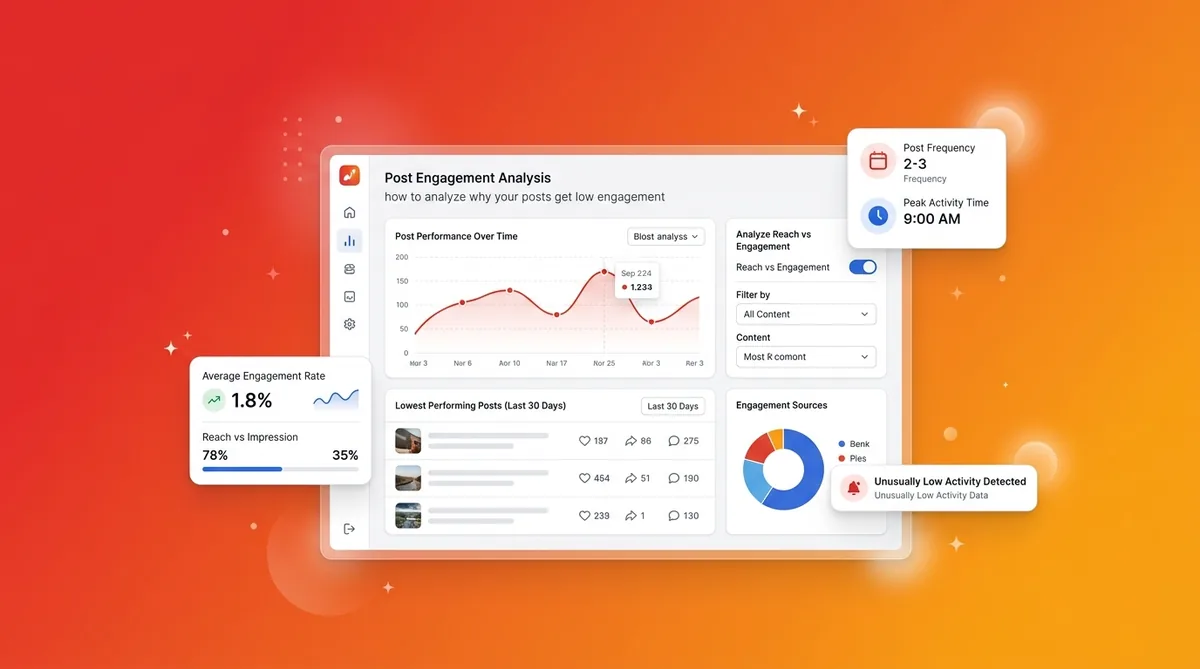
First, check your reach-to-engagement ratio to see if it is a distribution issue or a content quality issue. Next, audit your hook's relevance to your specific target audience and look for visual formatting that causes scrolling friction. The hidden truth is that low engagement rarely means the algorithm hates you; it usually means your structure or call-to-action requires too much mental effort from a casual scroller.
The Diagnosis: Identifying the Root Cause of the Silence
We need to figure out exactly where the drop-off is happening. Think of every post like a micro-funnel. If they don't stop scrolling, they can't read. If they don't read, they can't comment.
Assess Your Reach-to-Engagement Ratio
Look directly at your native analytics. Did 5,000 people see the post, but only 3 engaged? That is a content problem. They saw your post and consciously decided to keep scrolling.
Did only 50 people see it? That is a distribution problem. The platform didn't show it to anyone, likely because the hook failed the initial algorithmic test. If you find yourself constantly wondering why your posts get low engagement across the board, you have to separate these two metrics first before you can fix anything.
Evaluate Content Resonance and Audience Alignment
Are you solving a specific pain point, or just talking into the void?
Saying "marketing is hard" is way too generic for a feed. Saying "why your B2B SaaS onboarding emails are causing week-one churn" targets a specific ideal customer profile. Specificity triggers the brain's pattern-recognition system. Generic statements are inherently skippable.
Analyze the Technical Friction Points
Sometimes you are getting penalized for technical fouls. Keeping users on the platform is the primary directive for every social network. If you put an external link in the main text of a LinkedIn post or an X thread, you are directly fighting the system. The platform will throttle your reach to protect its own retention metrics.
Fix #1: Master the 'Scroll-Stop' Hook and Visual Hierarchy
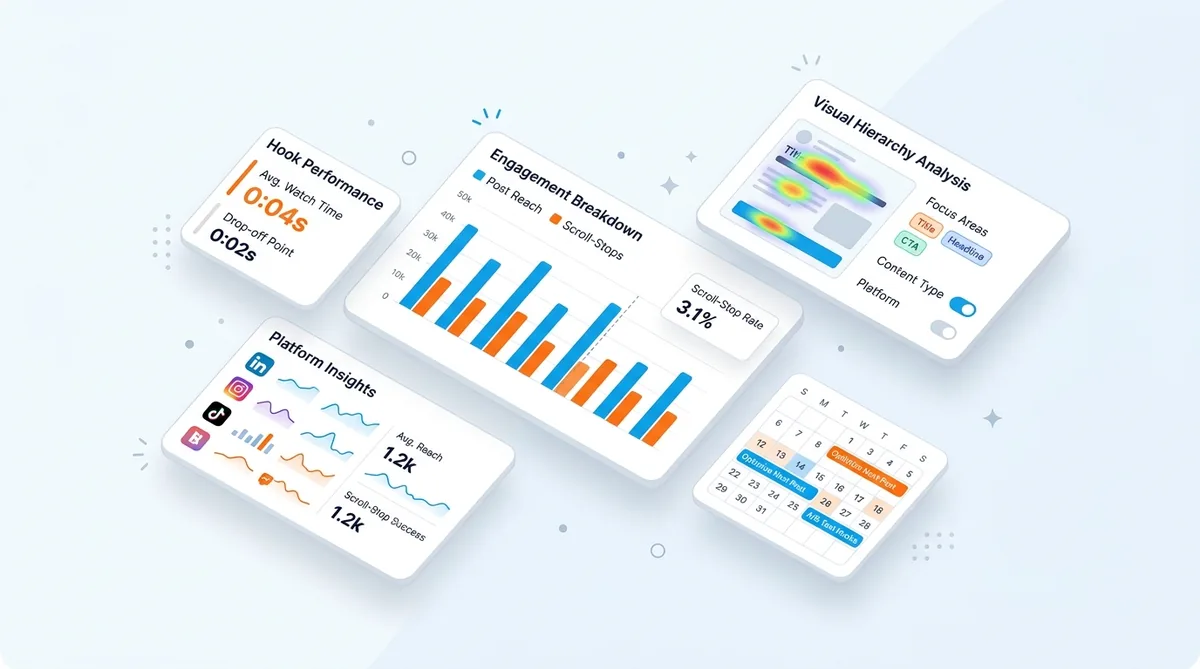
You have roughly three seconds to earn someone's attention. That is the harsh reality of the feed.
Use Negative Constraints to Create Urgency
A hook like "How to grow your podcast" is weak. "Stop making these 3 mistakes with your podcast audio" works significantly better. Why? It utilizes the mechanism of loss aversion. Human brains are hardwired to prioritize avoiding pain over gaining a benefit.
This is especially critical if you are trying to figure out how to repurpose a podcast into social media posts. The short clip you choose needs an on-screen text hook that agitates a specific problem instantly, or the viewer will swipe away.
Format for Scannability and Mobile Consumption
Massive blocks of text cause physical eye strain on a 6-inch phone screen. Scrollers see a wall of text and instinctively swipe past it to reduce their cognitive load.
Use white space aggressively. Keep paragraphs to one or two sentences. Use bullet points when listing items. Make the visual experience absolutely effortless.
Fix #2: Engineer Social Currency and Low-Friction Participation
You want more comments? Stop asking people to write you an essay.
Give High-Value CTAs That Require Low Effort
Most creators end posts with "What are your thoughts?" This is a terrible strategy. It asks a busy, distracted person to stop what they are doing, formulate a unique thesis, type it out on a tiny digital keyboard, and risk public judgment.
Instead, use a binary choice. "Are you team remote work or team office? Drop a 1 or 2." You remove the friction of thinking. The algorithm doesn't care if the comment is a single number or a paragraph; it just reads a positive engagement signal.
Create 'Saveable' Content Through Information Density
Saves are the new super-metric.
Instagram and LinkedIn push highly-saved content to the top of the feed because it signals long-term value to the platform. Frameworks, checklists, and step-by-step guides get saved. Personal opinions just get a fleeting like.
5 Mistakes That Kill Your Post Engagement
If you're still stuck, check your recent posts against these common strategic errors that drive up bounce rates.
- The 'Me-Centric' Narrative Trap
Posting "I am so excited to announce..." Nobody cares about your company update. Reframe it as "What this new feature means for your daily workflow."
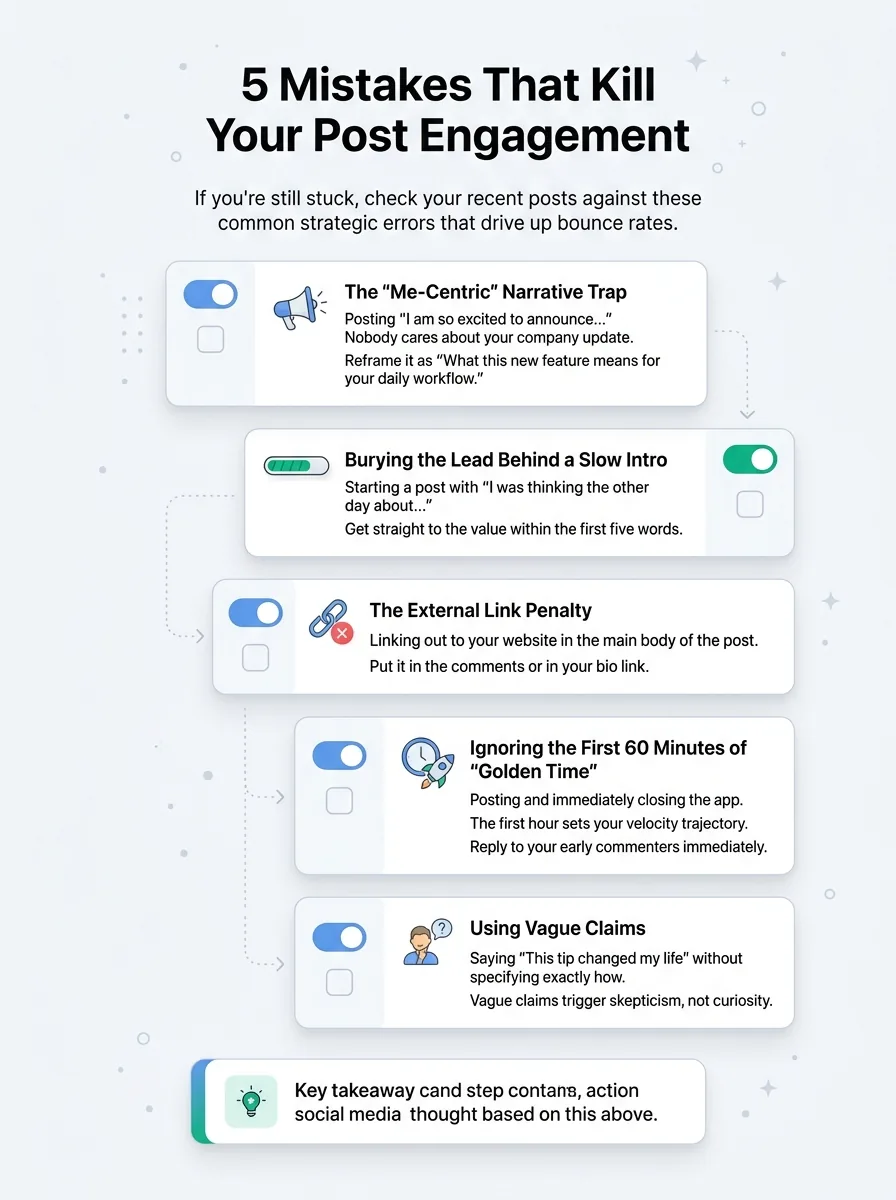
- Burying the Lead Behind a Slow Intro
Starting a post with "I was thinking the other day about..." Get straight to the value within the first five words.
- The External Link Penalty
Linking out to your website in the main body of the post. Put it in the comments or in your bio link.
- Ignoring the First 60 Minutes of 'Golden Time'
Posting and immediately closing the app. The first hour sets your velocity trajectory. Reply to your early commenters immediately.
- Using Vague Claims
Saying "This tip changed my life" without specifying exactly how. Vague claims trigger skepticism, not curiosity.
Scaling Insight: From Manual Audits to Repeatable Growth
The real problem isn't knowing how to spot a bad hook in theory. It is finding the time to do it consistently.
Manual analysis is exhausting. You stare at a draft for twenty minutes wondering if the opening line is punchy enough, if the structure is scannable, or if your call-to-action has too much friction. Doing this manually for every single post takes hours you simply don't have.
Consistent engagement requires a repeatable system. That's why smart creators use dedicated tools to speed up this feedback loop. By pasting your draft into the SocialOrbit Analyze Generator, you get instant, actionable feedback highlighting weak hooks and structural flaws before you even hit publish.
Start creating viral content today
Join other creators who've transformed their social media presence with AI-powered content.
Start creating nowFrequently Asked Questions About Engagement Strategy
Does the time of day really matter?
Yes, but slightly less than it used to. Posting when your specific audience is active gives you a slight initial algorithmic boost, but truly great content will circulate for days regardless of when you hit publish.
How many hashtags should I actually use?
Keep it minimal. Use 3 to 5 highly relevant hashtags. They act as SEO categorization for the algorithm. Stuffing 30 hashtags looks spammy to users and dilutes your core topic signals to the platform.
Why did my engagement suddenly drop overnight?
Usually, this happens because you strayed too far from your core topic, the platform introduced a new format they are heavily prioritizing over your usual format, or your hooks simply became predictable to your core followers.
The Core Principle: Engagement Follows Value, Not Frequency
Get Actionable Feedback on Any Post
AI-powered analysis that tells you exactly how to improve your content.
Try Analyze GeneratorStop obsessing over posting three times a day if you're just adding noise to the timeline. Master how to analyze why your posts get low engagement by studying the friction points in your own drafts. When you actually respect your audience's time and attention, the algorithm will naturally reward you with reach.