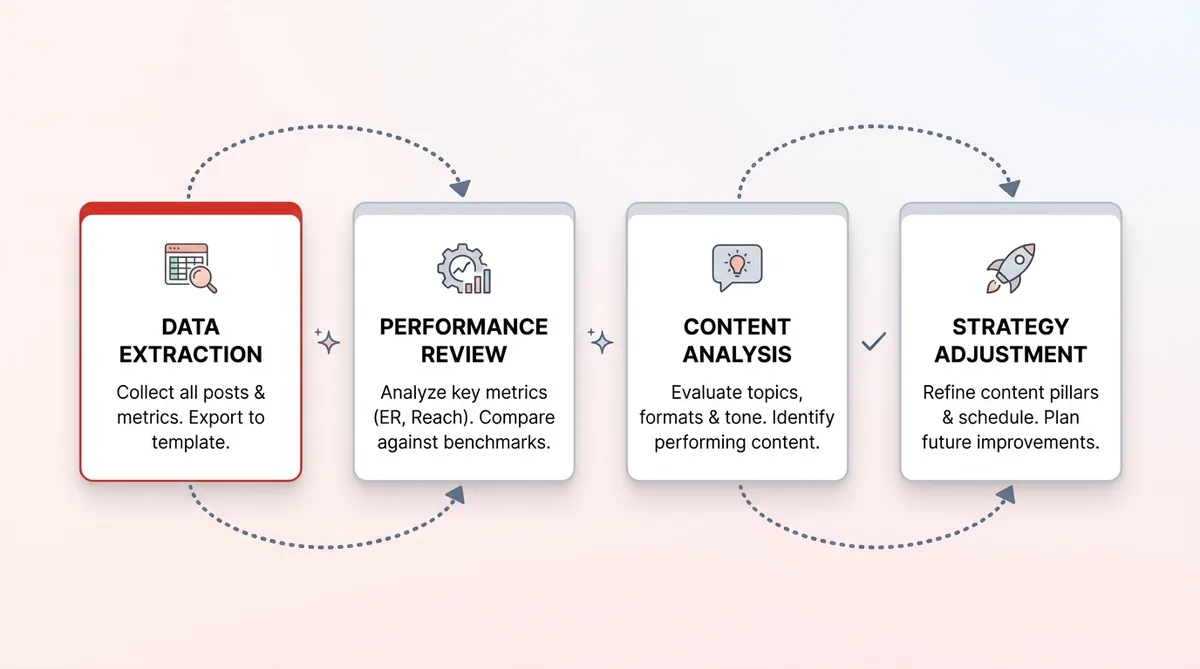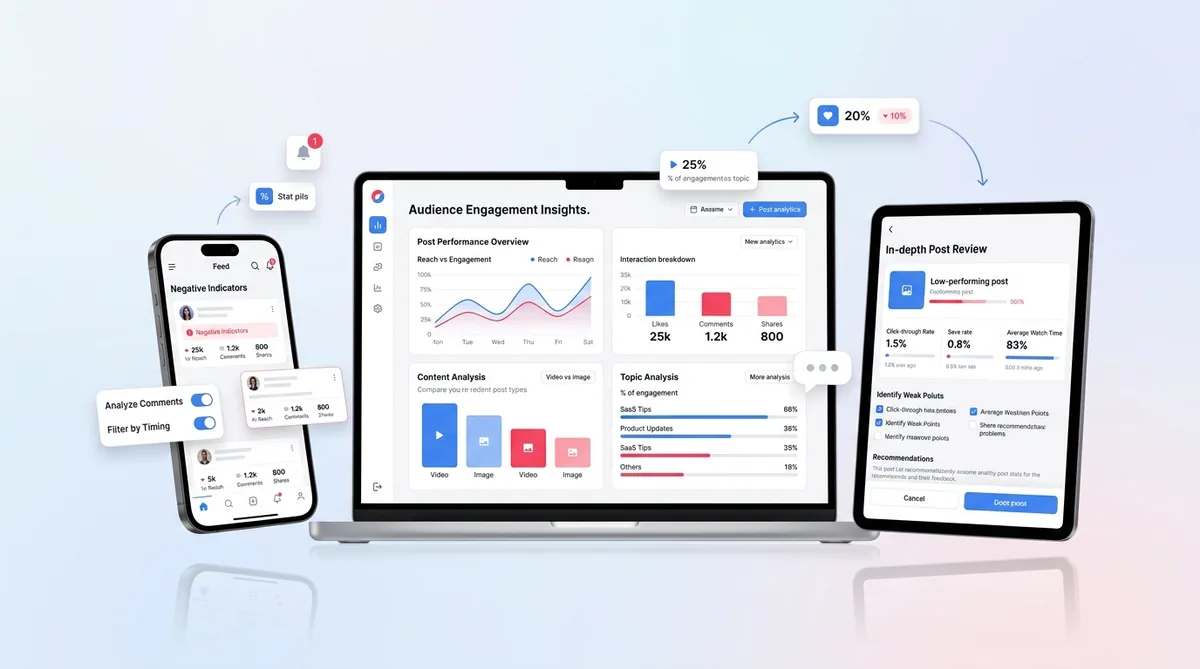
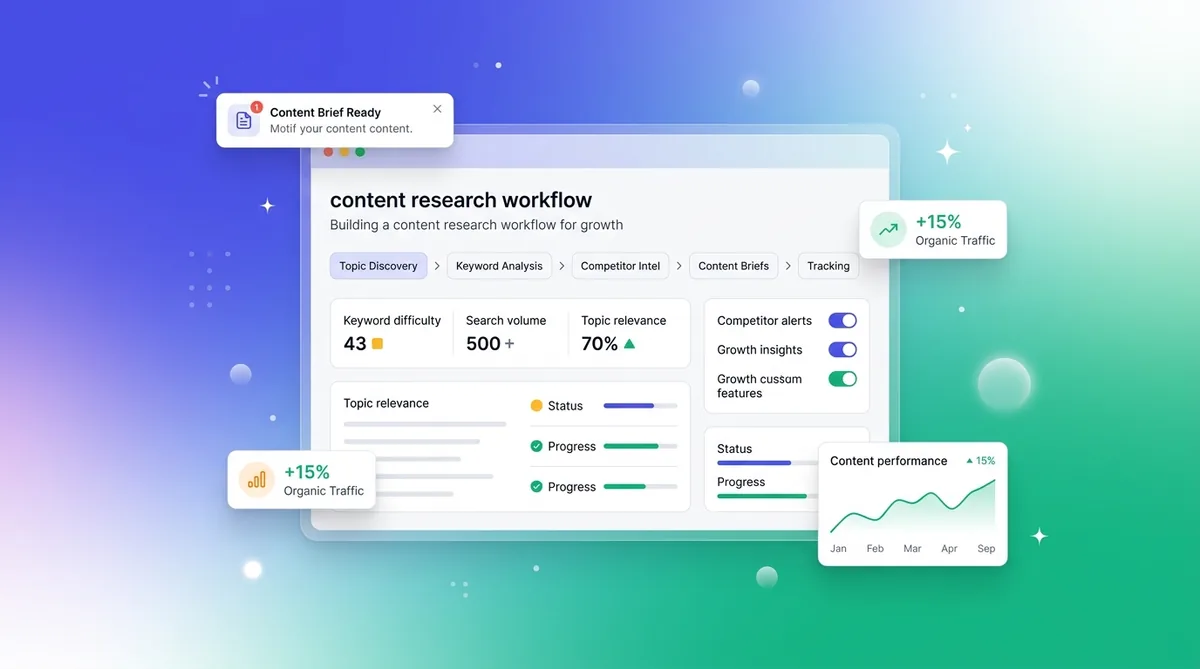
Stop Guessing: Why Your Content Strategy Needs a Scientific Workflow
You stare at the blinking cursor. You just spent four hours outlining an epic, deep-dive post. You meticulously formatted the headers, sourced some decent images, and finally hit publish. You refresh the analytics an hour later. Twelve impressions. Two views. Crickets.
Jump to a section:
- Stop Guessing: Why Your Content Strategy Needs a Scientific Workflow
- What is a Content Research Workflow?
- The Research Paradox: Why Most Growth Content Fails to Scale
- Strategy 1: Data-Driven Topic Discovery and Gap Analysis
- Strategy 2: Intent Mapping and Psychographic Profiling
- Strategy 3: Community Intelligence and Social Listening
- Strategy 4: Semantic SEO and Topical Cluster Building
- Strategy 5: Competitive Intelligence and Reverse Engineering
- Growth Transformations: Content Research Before vs. After
- 5 Research Mistakes That Kill Your Content ROI
- Beyond the Manual Grind: Building a Scalable Research Engine
- The Ultimate Content Research Checklist
- Frequently Asked Questions About Content Workflows
- Summary: Research as a Competitive Moat
Sound familiar?
Most creators assume their content isn't good enough. In reality, the content was fine. The problem is that it answered a question nobody was actually asking. You guessed what your audience wanted instead of knowing for sure.
When you rely on "gut feeling" or copy whatever trend is blowing up your timeline, you are playing the lottery with your time. And time is the one asset creators can't afford to burn. If you want predictable growth, you need a system that forces you to validate your ideas before you write a single sentence. You need a content research workflow.
What is a Content Research Workflow?
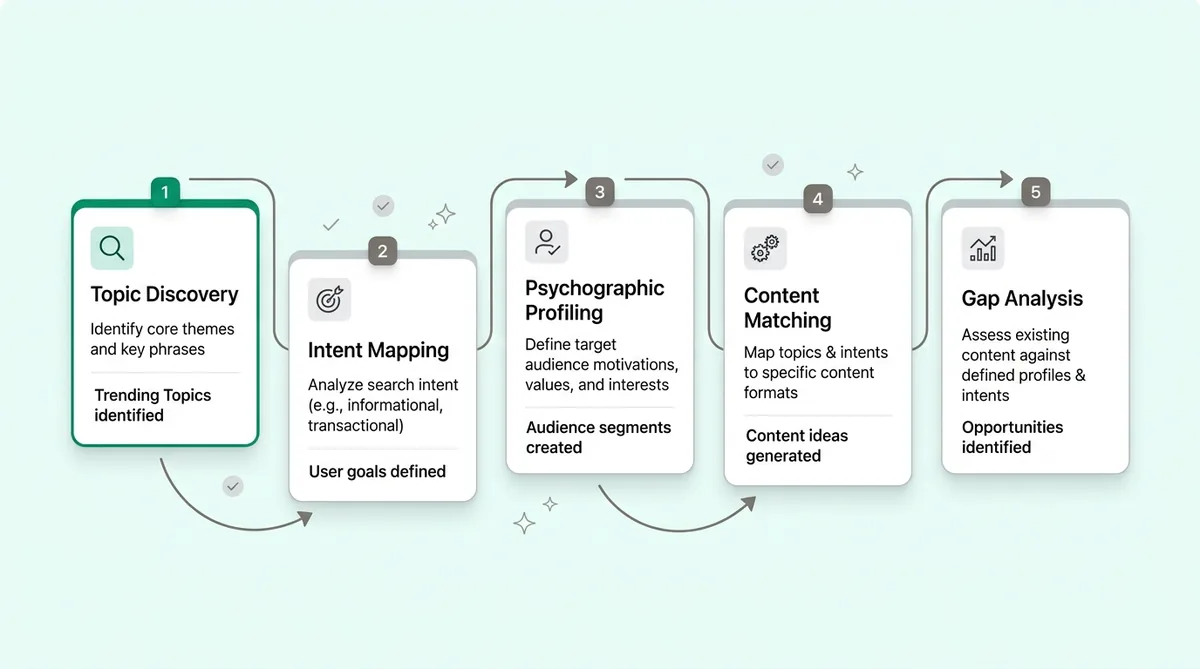
A content research workflow is a repeatable, step-by-step system for identifying high-intent topics, analyzing competitor gaps, and mapping search intent before creation. It transforms random brainstorming into a predictable pipeline for capturing targeted traffic, satisfying audience needs, and securing high-ranking featured snippets with maximum ROI.
It is the firewall between a bad idea and your publishing schedule.
The Research Paradox: Why Most Growth Content Fails to Scale
Here is what nobody tells you about scaling a content operation. The more you consume content in your niche, the worse your intuition gets. You suffer from the curse of knowledge.
You start thinking topics are "too basic" because you already know them, so you write hyper-complex thought pieces that go over your audience's head. Or worse, you fall into the trap of chasing vanity metrics. You see a competitor go viral with a hot take, so you drop your planned content to write your own version. By the time it goes live, the trend is dead.
This is the research paradox. Creators are swimming in data—analytics, comments, trending feeds—but starving for actual insight. Without a structured process to filter the noise, you end up doing reactive research. You look for data to justify an idea you already decided to write about, rather than letting the data tell you what to write.
To fix this, we have to flip the process upside down.
Strategy 1: Data-Driven Topic Discovery and Gap Analysis
Stop looking at what your competitors are doing right. Start looking for what they completely ignored. Topic discovery isn't about finding the highest volume keyword. It is about finding the highest value void in the market.
The Mechanism: How Content Gaps Signal Market Desire
When you identify missing information in your niche, you trigger two powerful forces. First, you satisfy the human curiosity gap. People are actively searching for a specific answer, clicking through multiple results, and leaving unsatisfied. When your piece finally connects those dots, retention skyrockets.
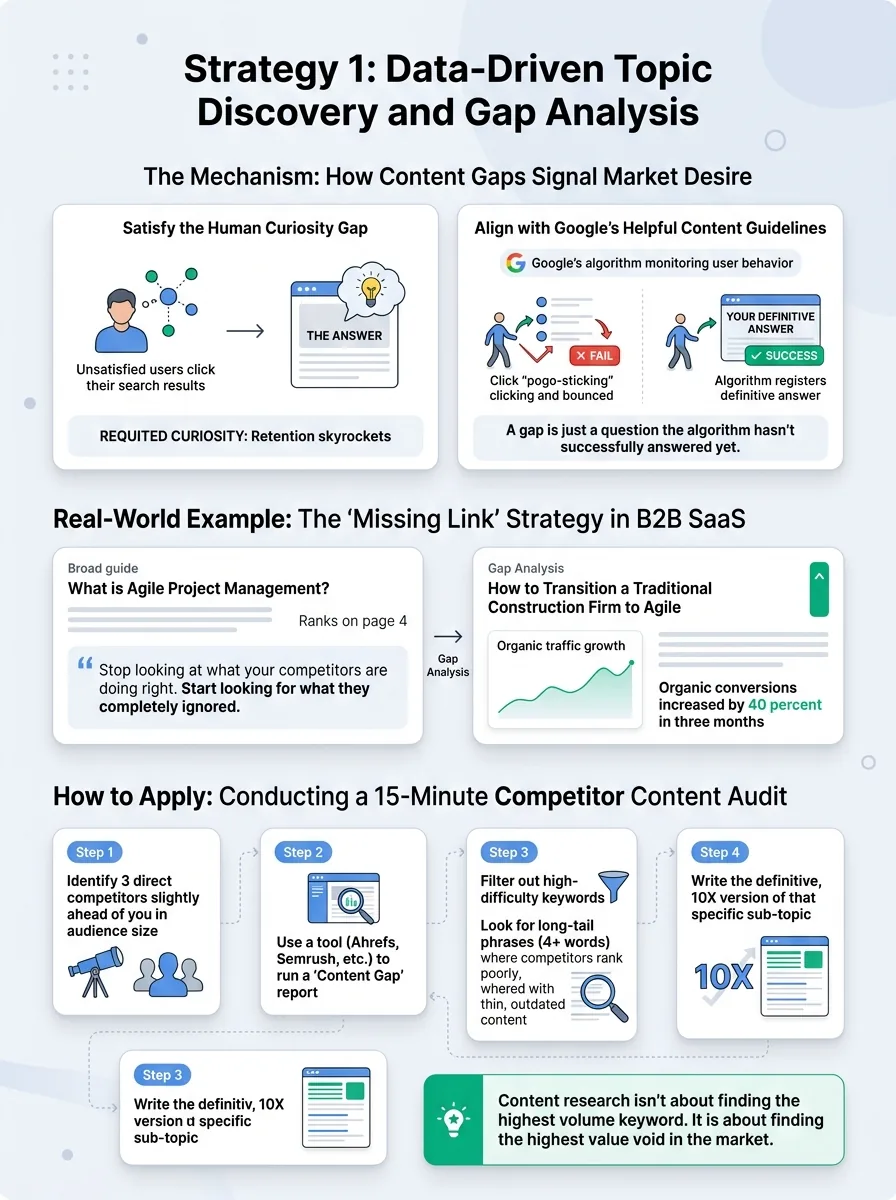
Second, this directly aligns with Google's helpful content guidelines. The algorithm monitors user behavior. If a user searches a phrase, clicks the top three links, and quickly bounces back to the search page (pogo-sticking), it signals those pages failed. If they click your link and stop searching, Google registers your page as the definitive answer. A gap is just a question the algorithm hasn't successfully answered yet.
Real-World Example: The 'Missing Link' Strategy in B2B SaaS
Consider a B2B project management software brand trying to grow organic traffic. They kept writing broad guides like "What is Agile Project Management?" and ranking on page four behind massive enterprise blogs.
They shifted to gap analysis. They realized every competitor was explaining what agile was, but nobody was writing hyper-specific transition guides for legacy industries. They pivoted. They published "How to Transition a Traditional Construction Firm to Agile." They stopped competing on broad volume and started owning high-intent, industry-specific gaps. Organic conversions increased by 40 percent in three months because they answered a question nobody else bothered to touch.
How to Apply: Conducting a 15-Minute Competitor Content Audit
Step 1
Identify three direct competitors who are slightly ahead of you in audience size.
Step 2
Use a tool like Ahrefs, Semrush, or a free alternative to run a "Content Gap" report.
Step 3
Filter out high-difficulty keywords. Look for long-tail phrases (4+ words) where competitors rank on page 2 or 3 with thin, outdated content.
Step 4
Write the definitive, 10X version of that specific sub-topic.
Strategy 2: Intent Mapping and Psychographic Profiling
Keywords give you the "what." Intent gives you the "why." If you misjudge the psychological motivation of the searcher, your brilliant writing will completely flop.
The Mechanism: Aligning Content Format with User Expectations
Search intent generally falls into four buckets: Informational, Navigational, Commercial Investigation, and Transactional. The format of your content must match the intent flawlessly. If someone searches "best email marketing tools for creators," they have Commercial Investigation intent. They want a scannable list, pros and cons, and pricing.
If you give them a 3,000-word philosophical essay on the history of email marketing, they will bounce in three seconds. Bounce rates destroy rankings. Matching the format to the expectation reduces friction, increases dwell time, and signals to algorithms that your content is highly relevant.
Real-World Example: Pivot from Blog Post to Calculator for High ROI
I worked with a personal finance creator who was struggling to rank for "freelance tax deductions." They had a massive, 5,000-word guide. It was comprehensive, well-written, and entirely useless to someone who just wanted a quick number.
We looked at the intent. Searchers didn't want to read. They wanted to calculate. We stripped the guide down to a 500-word summary and embedded a custom "Freelance Tax Calculator" at the very top. By matching the psychographic desire for instant utility, dwell time tripled. The page eventually captured the featured snippet, doubling their email opt-ins.
The Intent Hierarchy Decision Rule: When to Write vs. When to Build
Use this simple framework to decide your content format:
- Query asks "What is..."
> Write a high-level glossary term or short-form educational post.
- Query asks "How to..."
> Write a step-by-step tutorial with screenshots and a clear outcome.
- Query asks "X vs Y..."
> Create a comparison table with clear, opinionated winners for different use cases.
- Query asks "How much..."
> Build a calculator, template, or downloadable spreadsheet.
Strategy 3: Community Intelligence and Social Listening
Traditional keyword tools are lagging indicators. By the time a topic shows high search volume in a tool, your competitors are already writing about it. To get ahead, you have to find the raw questions users ask in communities.
The Mechanism: Capitalizing on Real-Time Audience Pain Points
People use completely different language when they complain on Reddit versus when they type in Google. On Google, they type "marketing automation software." On Reddit, they type "Zapier is too expensive and keeps breaking my Shopify flows, what else can I use?"
That raw, emotional language is your goldmine. Forums are the best places to understand how to research audience pain points because users bypass the polish and go straight to the friction. By scraping these complaints, you get a first-mover advantage on emerging trends and highly-converting long-tail phrases before they ever hit mainstream SEO tools.
Real-World Example: Solving the 'How Do I Actually...' Question
A boutique Facebook ads agency wanted to build authority. Instead of writing generic "How to run FB ads" posts, they spent a week in the r/FacebookAds subreddit. They noticed a recurring, highly upvoted question: "How do I actually structure my campaign when iOS updates destroy my tracking?"
The agency didn't write a blog post. They recorded a raw, over-the-shoulder video showing exactly how they structure accounts post-iOS update, using the exact language from the subreddit in their title. It became their highest-converting piece of content for the year because it solved a specific, actively painful problem.
Actionable Step: The Reddit 'Pain Point' Mining Protocol
You can use Reddit's official search operators to bypass the fluff and find real complaints.
Template 1
Type this into Google to find high-value complaints:
site:reddit.com/r/[niche] "how do you" OR "struggling with" OR "annoying"
Template 2
Type this to find tool alternatives:
site:reddit.com/r/[niche] "alternative to [tool]" OR "[tool] is too expensive"
Spend 20 minutes a week doing this. You will never run out of highly relevant content ideas again.
Strategy 4: Semantic SEO and Topical Cluster Building
The days of publishing random, disconnected blog posts are dead. If you want to build authority fast, you have to think in clusters. You don't target a keyword. You target an entire category.
The Mechanism: Establishing Domain Authority through Semantic Breadth
Search engines use semantic networks to understand context. If you write one isolated post about "podcast microphones," Google has no proof you are an audio expert. But if you write a pillar post on "Starting a Podcast," and link it to 15 sub-posts covering "mic arms," "XLR vs USB cables," "acoustic room treatment," and "audio editing software," you build a topical map.
Covering related sub-topics (LSI keywords) signals to algorithms that your site is a comprehensive entity. You aren't just answering one question. You are solving the entire ecosystem of the user's problem. This semantic breadth is what elevates a standard blog into an industry authority.
Real-World Example: Building the 'Ultimate Hub' for Remote Work Tools
A startup wanted to rank for "remote team communication." It is a brutal, highly competitive keyword. Instead of writing one massive 10,000-word post, they built a cluster.
They created one core pillar page called "The Remote Work Communication Hub." Then, they wrote 20 tightly focused supporting articles: "How to run asynchronous standups," "Slack vs Microsoft Teams for Agencies," "Zoom fatigue solutions." They meticulously interlinked every piece back to the core hub. Within six months, that entire cluster dominated page one, not because any single post was magic, but because the combined semantic weight proved they were the ultimate resource.
Decision Rule: When to Add a Sub-Topic to an Existing Pillar
Creators constantly ask: "Should this idea be its own post, or just a new H2 in my existing article?" Here is the rule.
If the sub-topic has its own distinct search volume and requires more than 400 words to adequately explain, it deserves its own standalone piece of content (linked back to the main pillar). If it only takes 150 words to explain and completely overlaps with the main intent, make it an H2. Don't cannibalize your own keywords by making thin, separate posts for minor variations.
Strategy 5: Competitive Intelligence and Reverse Engineering
Originality is great, but predictability pays the bills. If you want to rank for a term, you have to objectively analyze why the current top pages are winning, and then systematically build something better.
The Mechanism: Deconstructing the 'Winner's Formula' for SERP Success
The current top-ranking pages are not there by accident. They represent the "minimum viable quality" that the algorithm requires for that specific topic. By reverse-engineering the top three results, you decode the exact formula the platform wants to see.
You look at word count, media richness (images, video embeds, charts), the freshness of the data, and the specific questions answered in their FAQs. If the top three results all feature a custom infographic, the algorithm has determined that visual learning is critical for this intent. If you just write text, you will lose. You have to meet the baseline, then exceed it.
Actionable Step: The Skyscraper 2.0 Research Framework
Don't just make your content longer. Make it smarter. Identify the fatal flaws in the current #1 result.
- Are their statistics outdated?
Find a study from this year and cite it.
- Is their UX a nightmare of pop-ups?
Build a clean, fast, ad-free reading experience.
- Are they lacking real-world examples?
Inject case studies and expert quotes into your version.
- Is it a wall of text?
Break yours up with custom diagrams, bullet points, and scannable formatting.
Growth Transformations: Content Research Before vs. After
The shift from reactive creating to proactive research changes everything about your business.
Before the workflow: You wake up, panic about what to post, spend an hour staring at competitors, steal an angle, rush the writing, and publish to zero engagement. You feel burnt out and resent the algorithms.
After the workflow: You sit down on Monday with a validated list of 10 high-intent gaps. You know exactly what format each piece requires. You know the exact pain point it solves. You spend your energy on the actual craft of writing because the strategy is already locked in. You publish with confidence, knowing the search volume is there waiting for you.
5 Research Mistakes That Kill Your Content ROI
Why do most people still not get results even when they "do research?" Because they make these specific errors during the planning phase. Check yourself against these five traps.
1. Ignoring 'Negative' Keywords. You research what people are searching for, but forget to exclude what they aren't. If you sell a premium SaaS tool, you need to filter out people searching for "free," "open source," or "cheap." Writing a post that attracts cheap traffic is a waste of server space.
2. Prioritizing Pure Volume Over Intent. A keyword with 10,000 monthly searches and informational intent will make you zero dollars. A keyword with 150 searches and transactional intent ("hire fractional CMO B2B SaaS") will fund your business for a year. Stop chasing big numbers and start chasing high-intent buyers.
3. Failing to Refresh Old Research Data. The SERP from two years ago is not the SERP of today. If you are basing your content updates on an old spreadsheet, you are fighting a ghost. Search intent shifts. What used to require a blog post might now require a YouTube video. Always pull fresh data.
4. Copying the #1 Result Without a Unique Angle. If you just rewrite the top-ranking article using slightly different synonyms, you add zero unique value to the internet. The algorithm has no reason to displace the original. You must inject a proprietary opinion, new data, or a better format.
5. Stacking Disconnected Ideas in One Outline. In an attempt to be "comprehensive," creators often shove three different sub-topics into one post. If a user is searching for "how to format an Instagram reel," they don't want a 1,000-word intro on the history of TikTok. Keep your outlines surgical and tight.
Beyond the Manual Grind: Building a Scalable Research Engine
Look, the manual research process I just outlined is bulletproof. Doing competitor audits, mining subreddits, and mapping intent manually will absolutely make your content better. But the real problem isn't knowing what a good, validated topic looks like. The real problem is producing enough quality variations consistently without spending three hours researching every single post.
Doing this manually eventually becomes the bottleneck to your growth. You can't scale if you are spending more time inside spreadsheets than actually creating.
That is why smart creators move from manual grinding to repeatable systems. By using a dedicated research generator, you can input your specific niche and target audience, and instantly output curated trend reports and post ideas that are currently working across multiple platforms. It takes the heavy lifting out of topic discovery, allowing you to focus your creative energy on executing the angle rather than hunting for the idea.
Start creating viral content today
Join other creators who've transformed their social media presence with AI-powered content.
Start creating nowThe Ultimate Content Research Checklist
Before you commit to writing any new piece of major content, run it through this exact checklist.
- 1. Validate the intent
What does the searcher actually want to accomplish? (Inform, navigate, compare, or buy?)
- 2. Check the SERP formatting
Are the top 3 results listicles, ultimate guides, or tools? Match the format.
- 3. Identify the competitor gap
What specific sub-topic or nuance did the top 3 results completely miss?
- 4. Mine the raw language
Did I check Reddit or relevant forums for the exact phrases the audience uses when complaining about this topic?
- 5. Map the internal links
Which existing pillar post will this link back to? Does this fit my content repurposing checklist so I can turn the research into social posts?
Frequently Asked Questions About Content Workflows
How long should the content research phase actually take?
For a standard, medium-form piece of content, research should take 20 to 30 minutes. For a massive pillar page or ultimate guide, expect to spend 1 to 2 hours validating intent, finding gaps, and outlining the semantic cluster. If it takes longer, your system is too manual.
Do I need expensive enterprise tools to do this properly?
No. While tools like Ahrefs are fantastic, you can build a highly effective workflow using free resources: Google Auto-suggest, Reddit search operators, Google Trends, and a strong understanding of your own audience's pain points.
How often should I update my research on older posts?
Audit your top 20 traffic-driving posts every six months. Check if search intent has shifted or if a competitor has published a better "Skyscraper" version. If your page drops out of the top 3, it is time to refresh the research and update the content.
Summary: Research as a Competitive Moat
Discover What Your Audience Wants
Find trending topics and content ideas that resonate with your followers.
Try Research GeneratorThe depth of your research ultimately determines the height of your growth. Stop viewing topic discovery as a chore and start treating it as the primary firewall that protects your time and energy. When you know exactly what your audience desperately needs to read, the writing practically takes care of itself.