Stop Starting From Scratch: Why You Need a Social Media Content Audit System
Most creators just guess what to post next.
Jump to a section:
- Stop Starting From Scratch: Why You Need a Social Media Content Audit System
- What is a Social Media Content Audit Template?
- How to Customize These Templates for Your Workflow
- Phase 1: The Inventory and Quantitative Baseline
- Phase 2: Qualitative Performance Deconstruction
- Phase 3: Competitive Gap and 'White Space' Analysis
- Phase 4: The Go-Forward Strategy and Action Plan
- 5 Mistakes That Kill Your Content Audit Results
- The Shift from Manual Analysis to Repeatable Output
- Frequently Asked Questions About Content Audits
- Summary: Audit Your Way to Better Reach
They stare at a blank screen, sip cold coffee, and ask themselves what they should talk about today. Sound familiar? The real problem isn't a lack of ideas. The problem is a lack of memory.
You have already published hits. But because you aren't tracking what worked, you are constantly reinventing the wheel and burning yourself out. A solid social media content audit template stops this cycle.
Instead of guessing, an audit forces you to look at the cold, hard data of what your audience actually consumes. It removes the emotion from content creation. Once you know exactly which hooks stop the scroll and which formats drive saves, you just make more of that.
What is a Social Media Content Audit Template?
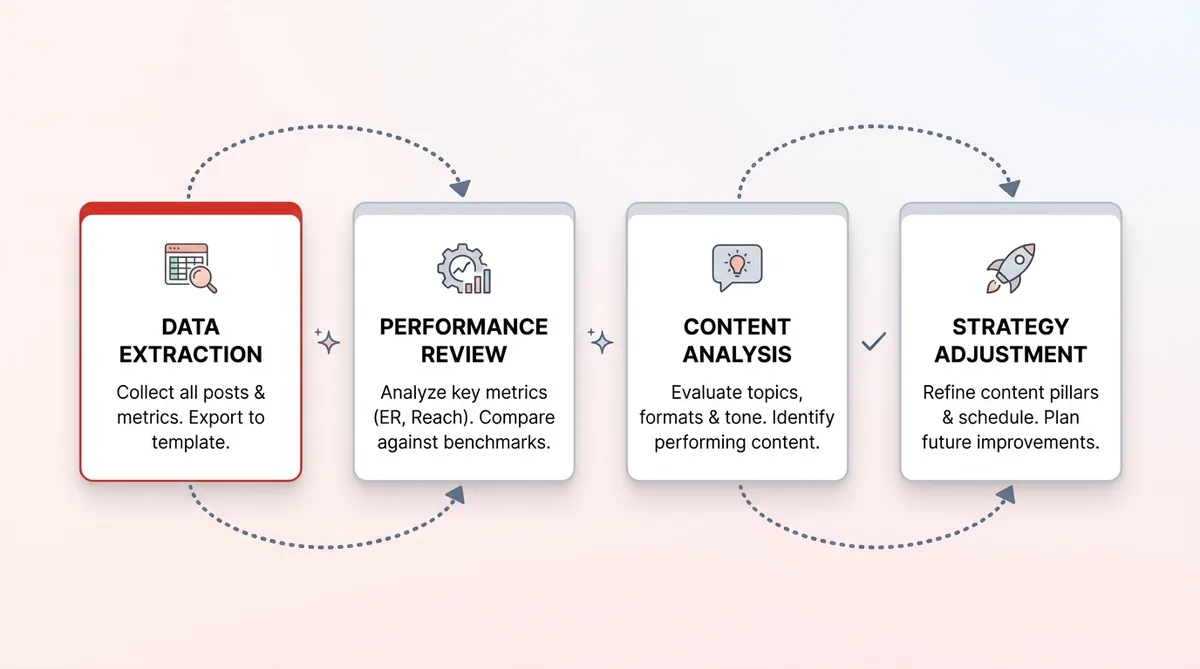
A social media content audit template is a structured framework used to evaluate your past posts' performance to guide your future strategy. It organizes quantitative data like reach and engagement alongside qualitative data like hook effectiveness and audience sentiment. This process eliminates guesswork and tells you exactly what formats, topics, and visual styles your audience actually wants.
How to Customize These Templates for Your Workflow
Not all platforms are the same, and your audit shouldn't treat them like they are.
Before you start pulling numbers, you need to set your parameters. First, decide on your look-back period. For fast-moving platforms like X or TikTok, 30 days is plenty. For evergreen platforms like YouTube or Pinterest, you need to look back 90 days to see real trends.
Second, define your North Star metric for this specific audit. If you are trying to grow your Instagram reach, your North Star is Shares. If you want to build authority on LinkedIn, your North Star is Comments. Pick one. Trying to optimize for everything means you optimize for nothing.
Phase 1: The Inventory and Quantitative Baseline

This is where we gather the hard data.
Humans are terrible at eyeballing performance. We vividly remember the controversial post that got 10 angry comments, but we completely forget the boring carousel that quietly generated 40 saves. You need a baseline to see what is actually happening.
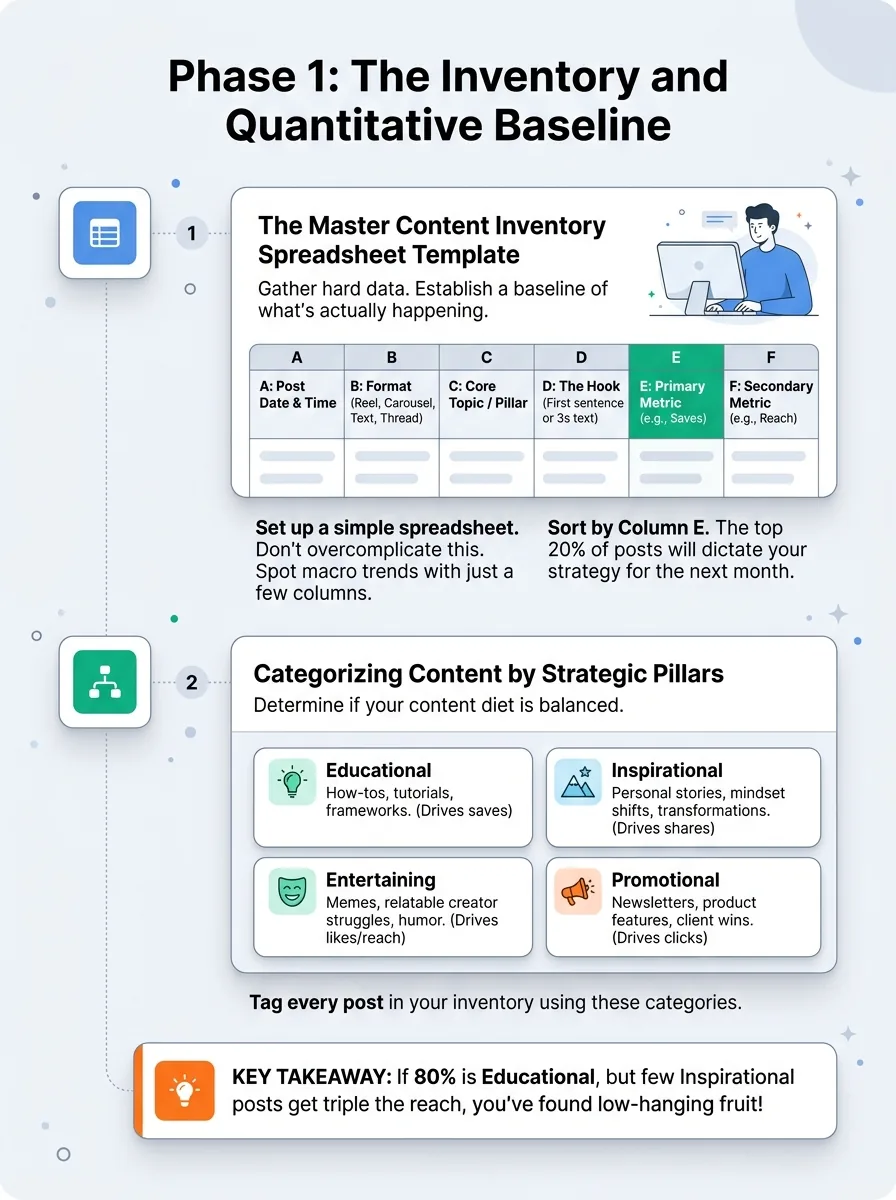
The Master Content Inventory Spreadsheet Template
Set up a simple spreadsheet. Don't overcomplicate this. You only need a few columns to spot the macro trends.
- Column A
Post Date & Time
- Column B
Format (Reel, Carousel, Text, Thread)
- Column C
Core Topic / Pillar
- Column D
The Hook (First sentence or 3 seconds of text)
- Column E
Primary Metric (e.g., Saves)
- Column F
Secondary Metric (e.g., Reach)
Sort by Column E. The top 20% of posts will dictate your strategy for the next month.
Categorizing Content by Strategic Pillars
You need to know if your content diet is balanced.
Tag every post in your inventory using these four categories:
- Educational
How-tos, tutorials, frameworks. (Drives saves)
- Inspirational
Personal stories, mindset shifts, transformations. (Drives shares)
- Entertaining
Memes, relatable creator struggles, humor. (Drives likes/reach)
- Promotional
Newsletters, product features, client wins. (Drives clicks)
If you notice 80% of your posts are Educational, but your few Inspirational posts get triple the reach, you have just found your lowest-hanging fruit.
Phase 2: Qualitative Performance Deconstruction
Numbers tell you what happened. Qualitative analysis tells you why.
This is where you look at the creative elements that resonated with your audience. The algorithm is just a mirror reflecting human behavior. When a post performs well, it means you successfully captured human attention and held it.
The Top-Performer Hook and Creative Analysis
Take your top 5% of posts from Phase 1. Now, reverse-engineer them.
According to official Meta algorithm documentation, the system heavily weighs predicting your likelihood to spend time on a post or save it. This comes down to the first three seconds.
Ask yourself these three questions for every top post:
- Question 1
Did I use a specific number or a vague claim? (e.g., "7 audit steps" vs "Some audit tips"). Specific numbers trigger the brain's pattern-recognition system. They feel scannable and achievable, which increases dwell time.
- Question 2
Was the visual asset native to the platform?
- Question 3
What was the curiosity gap? What information did I withhold in the hook that forced them to keep reading?
Once you figure out your winning hook structures, you can use a content repurposing checklist to spin those proven angles into entirely new formats.
Audience Sentiment and Feedback Log
The comment section is the most valuable real estate on the internet.
Create a second tab in your spreadsheet. Log the recurring questions people ask in your comments. Log their objections. If someone comments, "This sounds great, but I don't have time to do this daily," that is literally your next piece of content. Address the objection directly.
Phase 3: Competitive Gap and 'White Space' Analysis
You do not operate in a vacuum.
Looking at your own data is step one. Step two is looking outward to see what the market leaders are doing, and more importantly, what they are completely ignoring.
The Competitor Performance Comparison Matrix
Pick three competitors. Open their profiles and scroll back a month.
Track their post frequency, their most heavily utilized formats, and their apparent call-to-action strategy. Don't copy them. You are looking for patterns. If all three of your biggest competitors are only posting short-form talking-head videos, the market is saturated with that format.
Identifying Your Unique Content 'White Space'
White space is the gap between what your audience wants and what your competitors are currently providing.
If everyone in your niche is posting high-level inspirational quotes, the white space is deep, tactical execution. Be the person who shows the messy spreadsheet while everyone else shows the polished aesthetic.
Phase 4: The Go-Forward Strategy and Action Plan
Data without action is just trivia.
The entire point of a social media content audit template is to change how you work tomorrow. You need to take your findings and bake them into your actual production timeline.
The Post-Audit Content Mix Redistribution
Based on your findings, set a new percentage breakdown for your content types.
For example:
- Increase
Contrarian text posts by 20% (they drove the most comments).
- Decrease
Highly edited Reels by 30% (they took 5 hours and drove zero saves).
- Maintain
Weekly educational carousels (steady growth).
This simple redistribution is how to plan a week of social media content fast without feeling overwhelmed.
Resource Allocation and Production Timeline
Look at your calendar.
If your audit proved that long-form writing works best for you, you need to block off two hours on Tuesday morning specifically for writing. Do not just say you will do it. Allocate the actual time based on what the audit proved works.
5 Mistakes That Kill Your Content Audit Results
Most creators go through the motions of an audit and still see zero growth. Here is why.
1. Prioritizing likes over intent metrics. Likes are cheap. Saves, shares, and watch-time indicate actual value. If you optimize for likes, you will build an audience of scrollers, not buyers.
2. Stacking three ideas in one opening line. A confused mind scrolls past. When you audit your bad posts, you will almost always find that your hook was trying to say too much. Keep it to one core promise.
3. Using vague claims like "this changed everything." The algorithm hates clickbait because users hate it. If your hook doesn't set a specific expectation that the rest of the post fulfills, your retention graph will drop to zero in two seconds.
4. Copying viral hooks without matching audience intent. A hook that works for a fitness influencer will bomb for a B2B SaaS consultant. Context matters.
5. Not changing the calendar. You spent hours looking at the data, realized your current format isn't working, and then posted the exact same thing the next day out of habit. Stop doing that.
The Shift from Manual Analysis to Repeatable Output
The real problem isn't knowing what a good post looks like.
It's producing enough quality variations consistently without spending an hour per post. Once your audit shows you that punchy, contrarian ideas work best for your audience, you need to make more of them. But manually writing a Reel script, a Twitter thread, and a LinkedIn carousel from one idea takes half your day.
That's why creators use dedicated generators to produce multiple options fast, then choose the best one. For example, if you drop a raw thought into a content generator, you can select your platform and tone, and instantly adapt that single idea into a ready-to-post Reels script or an optimized LinkedIn post. You do the strategic thinking; the system does the heavy lifting.
Start creating viral content today
Join other creators who've transformed their social media presence with AI-powered content.
Start creating nowFrequently Asked Questions About Content Audits
How often should I audit my content?
Every 30 days is the sweet spot for active creators. Anything less frequent, and you miss micro-trends. Anything more frequent, and you don't have enough data to make informed decisions.
What if my data is messy or inconsistent?
Focus on the extremes. Ignore the middle 80% of your content. Look strictly at the top 10% that performed brilliantly and the bottom 10% that completely bombed. The lessons are in the extremes.
Do I need expensive software to do this?
Not at all. A native analytics dashboard and a free spreadsheet are all you need to start. The strategy matters far more than the software.
Summary: Audit Your Way to Better Reach
Get Actionable Feedback on Any Post
AI-powered analysis that tells you exactly how to improve your content.
Try Analyze GeneratorA social media content audit template isn't just administrative homework. It is a literal roadmap of what your audience is begging you to create. Stop guessing, start measuring, and give them exactly what they want.