How to Write a Bio That Converts: Turning Profile Visitors Into Lifelong Leads
Imagine this scenario. You spend hours writing a post, and it goes semi-viral. You are riding the algorithm wave, watching hundreds of thousands of views roll in. You check your analytics and see thousands of people clicked through to your profile.
Jump to a section:
- How to Write a Bio That Converts: Turning Profile Visitors Into Lifelong Leads
- The Short Answer: How to Write a Bio That Converts Profile Visitors
- The Silent Leak: Why Most Social Bios Fail to Convert
- Strategy 1: Lead with the 'Who' and the 'Transformation'
- Strategy 2: Use Authority Signals and Social Proof
- Strategy 3: Optimize Your Call-to-Action (CTA) for Maximum Frictionless Clicks
- The 14-Day Bio Optimization Testing Method
- 5 Critical Mistakes That Kill Your Profile Conversions
- Scaling Your Professional Identity: From Manual Bio Tweaks to Multi-Platform Consistency
- Frequently Asked Questions About Profile Bios
- Summary: Conversion is a Result of Clarity
Then you check your follower count.
It went up by twelve. Your email list got zero new signups. No digital products sold.
Sound familiar? This is what happens when you don't treat your profile like a landing page. High traffic means absolutely nothing if your profile is fundamentally broken. Knowing exactly how to write a bio that converts profile visitors is the only way to stop losing your hard-earned reach. It is the silent leak in your creator business. Let us fix it.
The Short Answer: How to Write a Bio That Converts Profile Visitors
To write a bio that converts profile visitors, use the Who/What/Outcome/CTA formula. Identify exactly who you help, state the specific transformation you provide, back it up with a tangible credibility metric, and end with a single high-intent link. Tailor the character count to fit the specific platform.
The Silent Leak: Why Most Social Bios Fail to Convert
Most bios read like a cryptic riddle. "Lover of coffee. Dreamer. Making things."
That is cute, but it pays zero bills.
The core issue here is what psychologists call the Curse of Knowledge. Because you know exactly what you do, you assume a random stranger clicking your profile will instantly understand it too. They don't. You have roughly two to three seconds to convince a scroller not to hit the back button. Being clever instead of clear is one of those classic bio formatting errors that kills your revenue before a visitor even sees your content.
You have to put your ego aside. Your bio is not actually about you. It is about what you can do for the person reading it.
Strategy 1: Lead with the 'Who' and the 'Transformation'
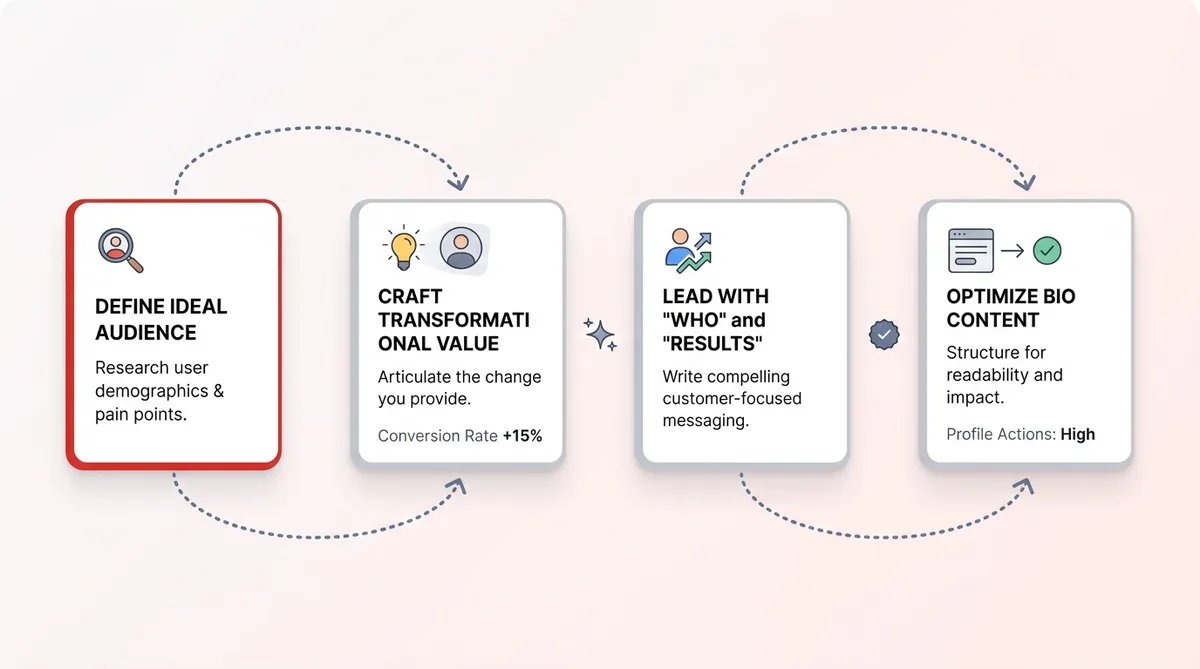
We are going to rely on a psychological mechanism called the cocktail party effect. People naturally filter out noise until they hear their own name or identity. Your bio needs to trigger this exact same response in a digital space.
Define Your Target Audience with Laser Precision
Vague nouns get ignored. If your bio says "I help entrepreneurs," a software founder scrolling by will not feel a connection. But if you write "I help B2B SaaS Founders," that same scroller's brain pattern-recognition system lights up. They immediately think, "Oh, this is for me."
Specificity creates relevance. Relevance creates retention.
Focus on Outcomes Instead of Features
Listings features is a rookie mistake. "I sell Notion templates" is a feature. "Organize your entire content calendar in 10 minutes" is an outcome. People do not follow you for the tool or the service. They follow you for the transformation.
Here is a real-world before and after.
Before: "Digital Marketer. I make videos about growing online."
After: "Helping introverted creators build 6-figure personal brands without dancing on camera."
The second option names the audience, names the outcome, and handles a specific objection. That is how you turn a glance into a follow.
Strategy 2: Use Authority Signals and Social Proof
When a new visitor lands on your profile, their brain is subconsciously calculating risk. Should they trust you? Should they click that link? You need to lower that perceived risk immediately through borrowed authority.
The 'Specific Wins' Technique for Rapid Trust
Numbers speak louder than adjectives. Claiming to be a "marketing expert" means nothing. Stating that you have "managed $2M in ad spend" grounds your claim in reality. According to behavioral research from places like Sprout Social on consumer trust, audiences need immediate, verifiable signals before taking an action off-platform.
Specific metrics trigger trust. If you do not have big revenue numbers, use other metrics. "10k students taught," "5 years in the trenches," or even "Wrote 500+ threads." Give the brain a concrete number to hold onto.
Platform-Specific Authority Markers
Authority looks different depending on the app. On LinkedIn, visitors look for professional milestones and company names. You might drop "Ex-Google" or "Series A Founder." On X or Instagram, community impact carries more weight. Tailor the authority marker to the environment where the user is consuming your content.
Strategy 3: Optimize Your Call-to-Action (CTA) for Maximum Frictionless Clicks
This is where the money is made or lost. You have earned their attention, built the trust, and now you need them to act. Most creators fumble right at the finish line.
The Power of the 'One Link' Rule
Have you ever heard of Hick's Law? It states that the time it takes to make a decision increases with the number of choices available. When you use a generic Linktree with nine different options—your YouTube, a random podcast from 2021, three different courses, and your Twitter account—the visitor gets overwhelmed. So they choose nothing.
Choice overload destroys conversions. Give them one clear, specific path. Direct them to your highest-converting lead magnet or your primary newsletter.
Use High-Intent Action Verbs
Stop using passive phrases. "My website" or "Links below" do not drive behavior.
You need active commands that frame the benefit. Switch out "Newsletter link" for "Steal my weekly growth templates ↓" or "Grab the free email course." Tell them exactly what to do and what they get the second they click.
The 14-Day Bio Optimization Testing Method
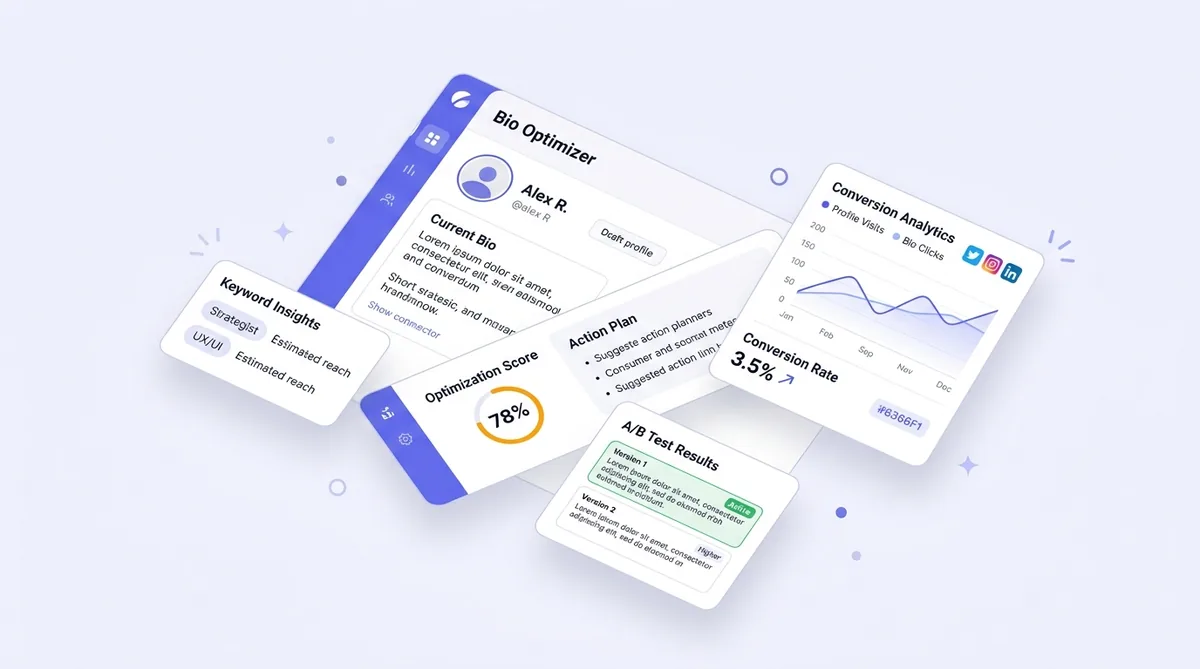
You should never treat your bio as a finished product. It is a living experiment. Set a calendar reminder to test a single variable every 14 days. Do not change the hook, the authority marker, and the link all at once. You will not know what actually moved the needle.
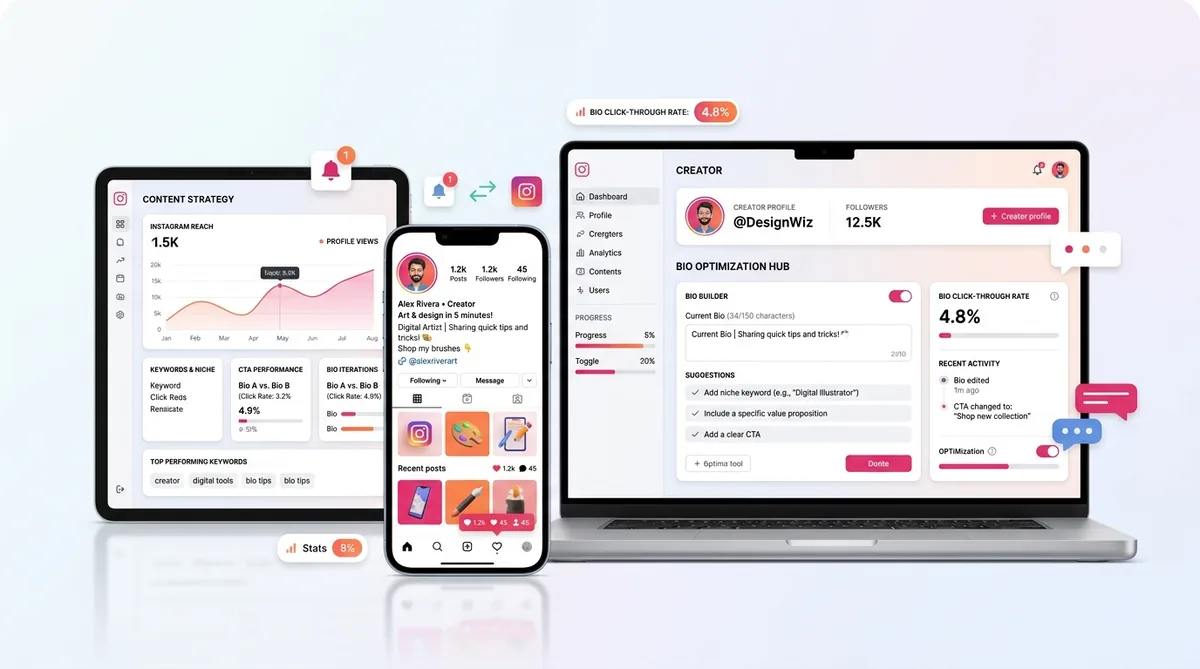
Track your profile views against your link clicks. If views are high but clicks are low, your CTA is weak. If views are high but follower growth is stagnant, your "Who" and "Outcome" statements are not resonating. This is exactly like analyzing how your captions drive engagement; you have to look at the behavioral output, not just the vanity metrics.
5 Critical Mistakes That Kill Your Profile Conversions
Let's run through a quick diagnostic. If you are doing any of these, fix them immediately.
- Stacking three different ideas in the first line.
Confusion is the enemy of conversion. Pick one primary value proposition and own it.
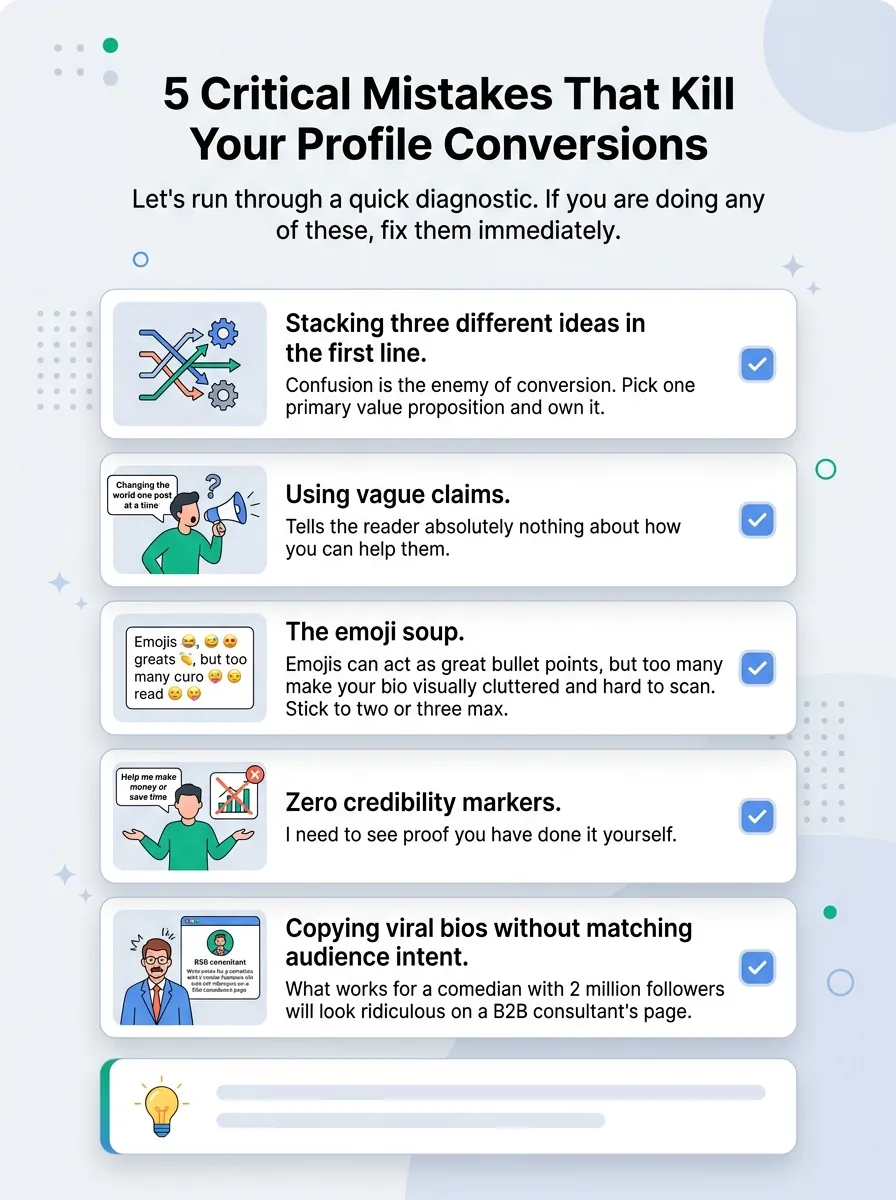
- Using vague claims.
Saying "Changing the world one post at a time" tells the reader absolutely nothing about how you can help them.
- The emoji soup.
Emojis can act as great bullet points, but using seven of them makes your bio visually cluttered and hard to scan. Stick to two or three max.
- Zero credibility markers.
If you promise to help me make money or save time, I need to see proof you have done it yourself.
- Copying viral bios without matching audience intent.
What works for a comedian with 2 million followers will look ridiculous on a B2B consultant's page.
Scaling Your Professional Identity: From Manual Bio Tweaks to Multi-Platform Consistency
Here is the reality. The real problem isn't knowing what a good bio looks like in theory. It is the friction of producing enough quality variations consistently across every app.
Instagram gives you 150 characters. X gives you 160. LinkedIn gives you a 220-character headline and a massive "About" section. TikTok gives you a measly 80 characters. Trying to manually resize, format, and optimize the exact same "Who/What/Outcome" formula for six different platforms takes way too much time.
That is why smart creators use a dedicated bio generator to handle the heavy lifting. You simply input your niche, target audience, and key credentials. The system automatically outputs multiple variations perfectly optimized for each platform's specific character limits and formatting quirks. You pick the best option, paste it in, and get back to actually making content.
Start creating viral content today
Join other creators who've transformed their social media presence with AI-powered content.
Start creating nowFrequently Asked Questions About Profile Bios
How often should I update my social media bio?
You should review your bio once a quarter, or anytime you launch a new major project or lead magnet. Small optimizations are fine, but changing your core value proposition every week confuses returning visitors.
Should I use hashtags in my bio for SEO?
On platforms like Instagram, hashtags in your bio are clickable but do not actually help your profile rank in search results. Save your characters for strong copy. On X and LinkedIn, native keywords matter deeply, but they should be woven into sentences naturally rather than listed as raw hashtags.
Is it better to use a landing page or a link tree?
A dedicated landing page or a highly curated single link converts significantly better than a link tree with ten options. If you must use a multi-link tool, limit it to three high-priority destinations.
Summary: Conversion is a Result of Clarity
Your bio is not your life story. It is a highly optimized sales page designed to do one thing: prove to a stranger that you are worth their time. Focus entirely on the visitor's needs, make your outcome crystal clear, and tell them exactly where to click next.
Craft a Bio That Converts
Create a compelling bio that turns profile visitors into followers.
Try Bio Generator