Hook Introduction: Why Your Posts Get Skipped (and How to Fix It)
You post consistently. You’re doing the “right” things. And still… your watch time is trash, the comments are crickets, and the link you really want clicked gets ignored. Sound familiar?
Jump to a section:
- Hook Introduction: Why Your Posts Get Skipped (and How to Fix It)
- Quick Answer: What Is a Social Media Hook?
- Why Writing Scroll-Stopping Hooks Is So Hard
- Strategy 1: Start With One Audience Micro-Pain (Not a Topic)
- Strategy 2: Use a Pattern Interrupt That Matches the Platform
- Strategy 3: Make a Clear, Specific Promise (with a Time/Outcome Anchor)
- Strategy 4: Build an Open Loop That Forces the Next Swipe/Second
- Strategy 5: Match Your Social Media Hook to the Content Type (So You Don’t Break Trust)
- Strategy 6: Use Proof Signals in the First Line
- Real Examples: 3 Social Media Hook Breakdowns (With the 4 Steps Labeled)
- How to Create Social Media Hooks Automatically (Without Sounding Like AI)
- Quick Framework: The 4-Step Social Media Hook System (Checklist)
- FAQ: Social Media Hook Questions People Ask
- Conclusion: Hooks Aren’t Talent—They’re a Repeatable System
Most of the time it’s not your content. It’s the social media hook (or lack of one). People don’t skip because you’re boring. They skip because their feed is a firehose: same tips, same hot takes, same “3 ways to…” posts. Plus the algorithm is comparing you to everyone else in your niche, not to your own effort.
Here’s the fix: a simple, repeatable 4-step social media hook system that works for fitness, finance, real estate, SaaS, parenting, art… whatever you’re posting about. No gimmicks. No fake drama. Just better first lines and first seconds that earn attention and keep it.
Quick Answer: What Is a Social Media Hook?
The 4-Step Social Media Hook System for Any Niche
A social media hook is the first 1–3 seconds (or first line) of your post that earns attention, sets a clear promise, and compels the next action—keep watching, keep reading, or swipe.
It works for Reels/TikToks, carousels, X threads, LinkedIn posts, and even captions: it’s the “why should I care right now?” moment.
Why Writing Scroll-Stopping Hooks Is So Hard
Most creators get this wrong because they treat hooks like decoration. A clever line. A flashy opener. A “need this?” caption.
But you’re fighting real friction:
- Audience skepticism
people have been burned by exaggerated claims, so they assume you’re about to waste their time.
- Feed sameness
your niche has a “default voice.” If you sound like it, you blend in. Instantly.
- Vague value props
“Here are tips to grow” means nothing. Grow what? How fast? With what tradeoff?
- Fear of being ‘clickbait’
you don’t want to overpromise, so you under-sell… and nobody stops to find out you’re legit.
- Platform constraints
you get one line before “see more” on IG, one screen on TikTok, and on LinkedIn your first two lines decide everything.
And weak hooks don’t just hurt vanity metrics. They crush retention (people bounce), saves (they don’t trust it’ll be useful), and click-through (they don’t believe you’ll deliver). Your post never gets a chance to prove its value.
Imagine you spend an hour writing a LinkedIn post that’s genuinely good. It gets 12 likes because the first two lines read like a brochure. That’s not a content problem. That’s a hook problem.
Strategy 1: Start With One Audience Micro-Pain (Not a Topic)
The 4-Step Social Media Hook System for Any Niche
If your hook starts with a topic, you’re already losing.
“Content strategy.” “Meal prep.” “Email marketing.” Those are categories, not reasons to stop scrolling. What actually works is starting with a micro-pain: a specific frustration in a specific moment.
Micro-pain is the difference between:
Topic: “How to budget better”
Micro-pain: “If you make good money but still feel broke every month, it’s probably this one category.”
See how the second one feels personal? Like it’s aimed at a real human on a real Tuesday.
How to turn broad topics into micro-pain angles
Take your niche topic and force it through a “moment” filter:
- When does this problem show up?
(Monday morning? right before a meeting? in the grocery store?)
- What does it feel like?
(confusing, embarrassing, exhausting, overwhelming)
- What do they do instead?
(doomscroll, procrastinate, overcomplicate, copy competitors)
Examples across niches:
- Fitness creator
Topic “fat loss” → Micro-pain “You eat ‘healthy’ all week, then the weekend wipes out your progress.”
- Designer
Topic “client management” → Micro-pain “The client says ‘make it pop’ and you have no idea what they actually mean.”
- B2B SaaS
Topic “onboarding” → Micro-pain “Your trial users sign up, click around for 60 seconds, then vanish.”
Real-world example hook
Instead of: “3 tips to grow on Instagram”
Try: “If your Reels get views but no followers, your first 2 seconds are doing this one thing.”
Same niche. Completely different relevance.
Action step: Write 10 micro-pains for your niche that start with “If you…” or “When you…” and describe a specific moment. Pick the one that makes you think, “Yep, that’s my audience.”
Strategy 2: Use a Pattern Interrupt That Matches the Platform
A pattern interrupt is just “something that doesn’t feel like everything else.”
Not a magic trick. Not yelling at the camera. Not pointing at text like you’re directing traffic.
The key is format-native interruption. The stuff that feels normal for the platform, but still breaks the viewer’s autopilot.
Short-form video (Reels/TikTok/Shorts): what actually stops the scroll
- Start mid-action
“I just deleted 3,000 followers. Here’s why.” (while showing the screen)
- Hard cut to the outcome
show the finished meal, the final design, the dashboard result, then explain.
- Contradict the obvious
“Your hooks aren’t too weak. They’re too broad.”
- Cold open with a single sentence
no intro, no name, no “hey guys.”
In practice, the biggest win is removing the warm-up. If your first sentence is “So today we’re going to talk about…,” you’re donating retention to your competitors.
Carousels (IG/LinkedIn): interruption is a design + structure thing
- Slide 1 is a punch
one bold claim, one clear pain, one strong promise.
- Use “wrong vs right”
Split layout. People instantly understand the game.
- Unexpected specificity
“The 17-word opener that doubled saves” beats “write better hooks.”
Carousels are basically mini landing pages. If slide one is vague, nobody swipes.
X (Twitter) + LinkedIn text: interruption is rhythm
- Short first line.
Like, really short.
- Then a second line that tightens the pain
“Here’s why your posts feel invisible.”
- Use a clean “this vs that” contrast
“Most advice says X. That’s backwards.”
On text platforms, your pattern interrupt is the reading experience. Make it easy to keep going.
Action step: Pick one platform you care about this month and build 3 “interrupt styles” you’ll repeat (example: cold open + outcome screenshot + contradiction). Repetition is a feature, not a flaw.
Strategy 3: Make a Clear, Specific Promise (with a Time/Outcome Anchor)
Strong hooks reduce uncertainty. That’s the whole job.
If people can’t tell what they’ll get, they bail. If they can tell what they’ll get but it sounds generic, they still bail.
So you need a specific promise. Ideally with an anchor: time, outcome, metric, audience, or constraint.
Weak vs strong promise
- Weak
“How to be more productive”
- Stronger
“The 5-minute reset I use when I’m behind on content and spiraling.”
- Weak
“Grow your email list”
- Stronger
“Steal this 2-question CTA I added to a Reel caption to get 38 email signups in a week.”
4 easy anchors you can add without sounding salesy
- Time
“in 10 minutes,” “before your next post,” “this week”
- Outcome
“more saves,” “higher watch time,” “fewer revisions,” “faster onboarding”
- Constraint
“without posting daily,” “without ads,” “without a fancy camera”
- Audience
“if you’re under 5k followers,” “if you sell services,” “if you hate dancing on camera”
One anchor is good. Two is often perfect. Five becomes spammy.
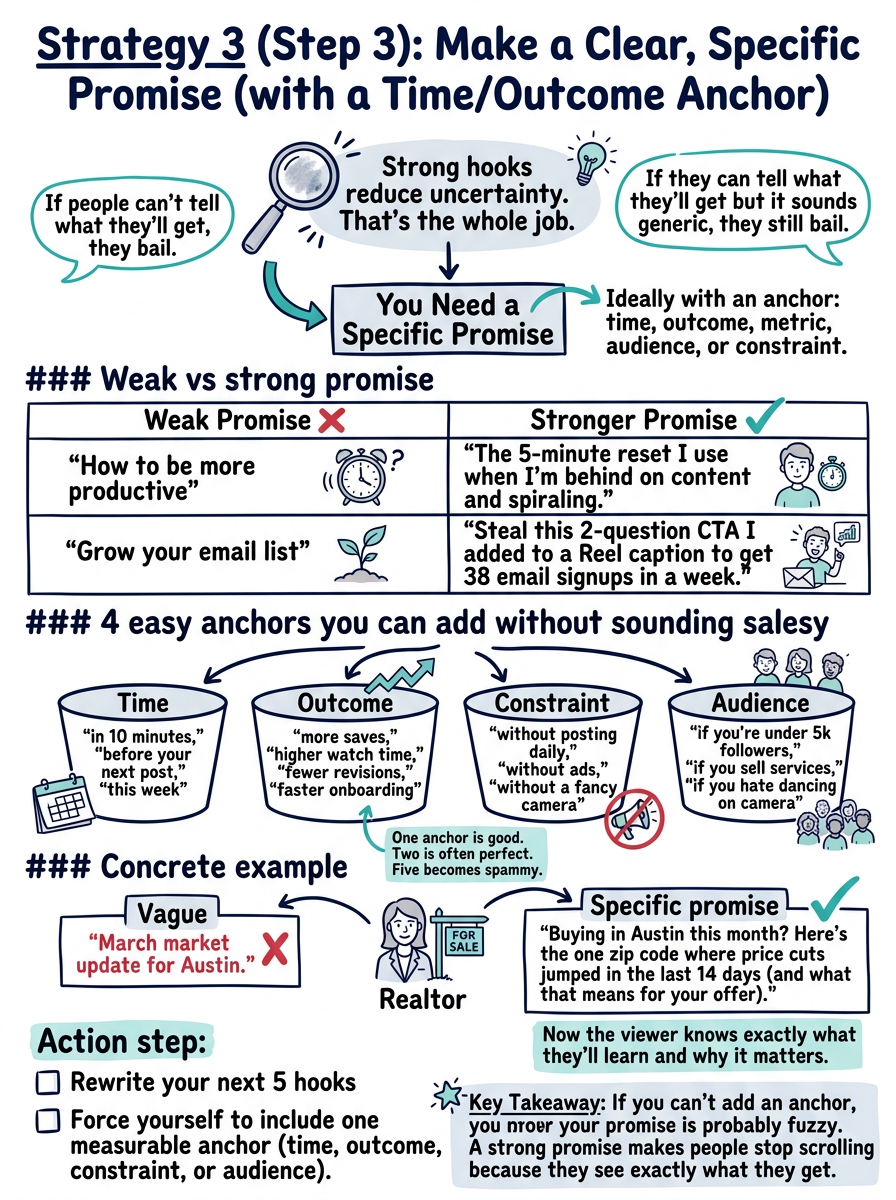
Concrete example
Let’s say you’re a realtor making market updates.
Vague: “March market update for Austin.”
Specific promise: “Buying in Austin this month? Here’s the one zip code where price cuts jumped in the last 14 days (and what that means for your offer).”
Now the viewer knows exactly what they’ll learn and why it matters.
Action step: Rewrite your next 5 hooks and force yourself to include one measurable anchor (time, outcome, constraint, or audience). If you can’t, your promise is probably fuzzy.
Strategy 4: Build an Open Loop That Forces the Next Swipe/Second
An open loop is ethical curiosity. It’s the “wait, why?” feeling.
Not mystery for mystery’s sake. It’s a gap your content is about to close.
And yes, it matters. A lot. Because retention doesn’t come from “great info.” It comes from great sequencing.
4 open loops that don’t feel like clickbait
- “The mistake” loop
“The reason your hooks flop is one sentence you keep adding.”
- “The twist” loop
“The best hooks aren’t emotional. They’re specific.”
- “The step everyone skips” loop
“Most people stop at the hook. That’s why retention dies at 4 seconds.”
- “Why it works” loop
“This sounds too simple, but there’s a psychology reason it works.”
Mini-scenario
Imagine you just spent an hour filming a tutorial. You start with “Today I’m going to show you…” and your retention graph looks like a ski slope. So you switch to:
“If your retention drops at 3 seconds, you’re probably opening with a topic instead of a micro-pain. Here’s the fix—and I’ll show you a real example at the end.”
Now they have a reason to stay: they want the fix, and they’re curious about the example.
Action step: Add one open loop line to your hook: “In a second I’ll show you…” or “The part most people miss is…” Then make sure you pay it off fast.
Strategy 5: Match Your Social Media Hook to the Content Type (So You Don’t Break Trust)
Hook-content mismatch is the silent killer.
You’ve seen it: a post promises the secret sauce, then delivers a lukewarm list of obvious tips. People feel tricked. They swipe away faster next time. Your future posts pay the price.
The goal isn’t just stopping the scroll. It’s stopping the scroll and keeping trust.
Pick hook styles based on what you’re posting
- Educational post
promise an outcome + preview the structure.
Hook: “Here’s the 4-part checklist I use to write hooks in under 10 minutes.” - Opinion post
use contrast + stakes.
Hook: “Unpopular opinion: ‘post more’ is the laziest growth advice.” - Story post
start at the turning point.
Hook: “I almost quit posting last month. Then one hook format doubled my watch time.” - Offer-driven post
lead with the problem you solve + who it’s for + one proof signal.
Hook: “If you’re a coach with solid results but inconsistent leads, your content probably isn’t saying this clearly.”
A quick trust rule
If your hook is spicy, your payoff needs to be fast. If your hook is calm, your payoff can be slower.
Creators try to write a “viral” hook for a calm tutorial and it feels off. Don’t do that.
Action step: Label your next post type (education/opinion/story/offer). Then choose a hook style that matches it. If you can’t name the type, your audience can’t predict the payoff.
Strategy 6: Use Proof Signals in the First Line
Proof signals are little credibility cues that make someone think, “Okay, this person might know what they’re talking about.”
And no, you don’t need to brag. You don’t need a Lambo. You don’t need a blue check.
You just need context.
Subtle proof signals that work
- Specific experience
“After writing 300+ hooks for client accounts…”
- Constraint proof
“This is what I do when I only have 20 minutes to post.”
- Result proof (light)
“This change took my average watch time from 4s to 7s.”
- Audience proof
“If you’re under 10k followers, this matters more than ‘posting daily.’”
Notice what’s missing: “I’m a leading expert.” Nobody believes that line anymore.
Example
Without proof: “Here’s how to write better hooks.”
With proof signal: “I rewrote 50 hooks for small creators last month—here are the 3 patterns that consistently raised retention.”
That’s informative. Not chest-thumping.
Action step: Add one proof signal to your first line this week. Keep it factual. If it feels like a humblebrag, tone it down and make it more specific.
Real Examples: 3 Social Media Hook Breakdowns (With the 4 Steps Labeled)
Let’s make this real. Below are three hooks you can steal the structure from, across different platforms.
Example 1: IG Reel hook (Creator education niche)
Full hook (spoken + on-screen text):
“If your Reels get views but no followers, your hook is probably answering the wrong question. In the next 20 seconds I’ll show you the 4-step fix—and the exact first line I’d use for your niche.”
- Step 1 (Micro-pain)
“views but no followers” (specific frustration)
- Step 2 (Pattern interrupt)
contradiction: “answering the wrong question” + fast pacing
- Step 3 (Specific promise)
“next 20 seconds” + “4-step fix”
- Step 4 (Open loop)
“the exact first line I’d use for your niche”
Why it works: It nails a common creator pain, promises a tight outcome quickly, and teases personalization (which people love).
First content beat: Show two hooks on screen: “Topic hook” vs “Micro-pain hook.” Then explain the difference in one sentence. Do not ramble.
Example 2: LinkedIn text post hook (B2B marketing niche)
Before (forgettable):
“Here are a few tips to improve your LinkedIn content.”
After (the hook):
Your LinkedIn posts aren’t underperforming because you’re boring.
They’re underperforming because your first two lines don’t make a promise.
Here’s the 4-step social media hook system I use to fix that (with examples).
- Step 1 (Micro-pain)
underperforming posts (implied: low reach/engagement)
- Step 2 (Pattern interrupt)
short, confident first line that reframes the issue
- Step 3 (Specific promise)
“4-step system” + “with examples”
- Step 4 (Open loop)
“the system I use” implies there’s a repeatable method coming
Why it works: It removes blame (“you’re not boring”) and gives a clear reason to keep reading.
First content beat: Immediately list the 4 steps as one-liners, then expand. Don’t bury the lead.
Example 3: TikTok hook (Meal prep / nutrition niche)
Full hook:
“If you meal prep on Sunday but still end up ordering takeout by Wednesday, it’s not your willpower—it’s your food sequencing. Give me 15 seconds and I’ll show you the ‘2 easy meals + 1 backup’ setup that fixes it.”
- Step 1 (Micro-pain)
meal prep fails mid-week
- Step 2 (Pattern interrupt)
reframe: not willpower, sequencing
- Step 3 (Specific promise)
“15 seconds” + named setup
- Step 4 (Open loop)
“2 easy meals + 1 backup” creates a curiosity gap
Why it works: It’s specific, non-judgy, and gives a simple structure to look for.
First content beat: Show the three meals on the counter with labels. Then explain the sequence (which one you eat first, which one you save, which one is the backup).
You can A/B test your hook using SocialCal's hook tester.
How to Create Social Media Hooks Automatically (Without Sounding Like AI)
Let’s be honest: coming up with hooks on demand is exhausting. Especially when you’re posting a lot.
What nobody tells you is that “good hook writers” aren’t magically creative every day. They have systems: templates, swipe files, and a quick way to generate variations so they can test instead of overthinking.
Build a small hook template bank (and reuse it)
Start with 5–7 templates you can plug your niche into:
“If you’re struggling with [micro-pain], it’s probably because [reframe].”
“Stop doing [common move]. Do [better move] instead (here’s why).”
“I tried [popular advice] for 30 days. Here’s what actually happened.”
“This is the fastest way to get [outcome] without [constraint].”
Then you generate 10 versions, pick the best 2, and test them across a week. That’s the job.
Use automation for variations, not for your voice
The smart way to “automate” hooks is using it like a brainstorming buddy, not a replacement for your brain.
I’ll do this when I’m stuck: I’ll paste my micro-pain + promise and ask for 15 hook options with different angles (contrarian, short, question, proof-first). Then I rewrite the best 2 so they sound like me.
If you want a simple workflow, SocialOrbit’s Hook Generator is helpful for cranking out on-brand variations quickly—especially when you already know the micro-pain and just need different ways to phrase it. I’ve also used Caption Generator when the hook is solid but the rest of the caption feels awkward.
If you’re building a bigger content workflow, the tool hub at SocialOrbit is basically where you can knock out drafts fast, then add your examples and personality after.
Want more hook templates to start from? Bookmark 47 social media hook formulas to stop the scroll. It’s a swipe file you’ll actually use.
Start creating viral content today
Join other creators who've transformed their social media presence with AI-powered content.
Start creating nowQuick Framework: The 4-Step Social Media Hook System (Checklist)
Screenshot this. Paste it into your notes. Use it before you post.
- 1. Micro-pain (one moment)
Prompt: “What’s the exact frustration they feel right before they need this content?”
Examples: “Views but no followers.” “Healthy all week, weekend wrecks it.” “Clients keep asking for revisions.” - 2. Pattern interrupt (platform-native)
Prompt: “How do I break autopilot in the first line/second without being weird?”
Examples: reframe, show outcome first, ‘wrong vs right’ slide, super short first line. - 3. Specific promise (anchor it)
Prompt: “What will they get, and how specific can I make it?”
Examples: “in 20 seconds,” “3 scripts,” “a 4-step checklist,” “without posting daily.” - 4. Open loop (pay it off fast)
Prompt: “What gap will I close in the next swipe/second?”
Examples: “the mistake,” “the twist,” “the step everyone skips,” “why it works.”
That’s the system. Micro-pain + interrupt + promise + open loop.
Then your content has one job: deliver what you promised.
FAQ: Social Media Hook Questions People Ask
What is a social media hook?
A social media hook is the first line or first 1–3 seconds of a post that earns attention, communicates a clear benefit, and pushes the viewer to keep going (watch, read, or swipe).
How long should a social media hook be?
Shorter than you want. For video, aim for one sentence in the first 1–2 seconds. For text posts, make the first line scannable and the first two lines enough to create a promise before “see more.”
What’s the difference between a hook and a headline?
A headline summarizes. A hook moves someone to take the next action. Headlines can be passive; hooks can’t. On social, your hook is basically your headline plus your first beat of persuasion.
How do I write hooks without sounding clickbait?
Make a promise you can actually keep, add specificity (time/outcome/constraint), and deliver the payoff early. If you need 45 seconds before you address the hook, the hook was too big.
Do hooks matter for small accounts?
Yes—arguably more. When you’re small, you don’t have “brand momentum” carrying your content. A clear social media hook is what earns you a fair shot at retention, saves, and follows.
Conclusion: Hooks Aren’t Talent—They’re a Repeatable System
Hooks aren’t magic. They’re a system: micro-pain + pattern interrupt + specific promise + open loop, then a clean payoff that matches the content type.
Build reps, test variations, and let retention and saves tell you what to double down on.
Create 10x More Content
Transform one idea into dozens of engaging posts for every platform.
Try Content GeneratorIf you want to speed up hook writing without losing your voice, generate a few variations in the hook generator save the winners, and reuse them by niche/persona the next time you post.