You spend 45 minutes on a post, hit publish, and… nothing. No clicks, no watch time, the graph is flatter than your energy. Then you see someone else posting three times a day, all starting with hooks that yank people in. Same niche. Same platform. What’s the difference? They’re not “more creative.” They’re using social media hook formulas instead of staring at a blank cursor.
Jump to a section:
- Why Social Media Hook Formulas Beat Staring at a Blank Cursor
- Quick Answer: What These Social Media Hook Formulas Are (and Who They’re For)
- How to Use These Social Media Hook Templates Without Sounding Like Everyone Else
- Emotion-Driven Curiosity Hooks (Make People Need to Click ‘See More’)
- Number-Backed, Outcome-First Hooks (Perfect for Case Studies & Tutorials)
- Relatable Pain & “Call-Out” Hooks (Speak Directly to Your People)
- Platform-Specific Hooks for TikTok/Reels vs LinkedIn/X
- Why Most People Still Don’t Get Results With Hook Formulas
- From One-Off Hooks to Repeatable Output (Without Burning Out)
- FAQ: Social Media Hook Formulas
- Bringing It Together: 47 Social Media Hook Formulas You Can Use Today
Quick answer: Social media hook formulas are plug-and-play opening line templates that grab attention fast, especially in busy feeds. You swap in your niche, audience, and outcome, and you’ve got a scroll-stopping first line in seconds. The trick is customizing them so they sound like you, not a copy-paste robot.
Why Social Media Hook Formulas Beat Staring at a Blank Cursor
Most creators think hooks come from random bursts of inspiration. That’s why they sit there rewriting the first line 15 times and still hate it.
Formulas change that. A good hook template gives you a proven structure that already matches how people scan feeds: promise + curiosity + specificity. You’re not inventing from scratch; you’re just filling in the blanks with your niche and story.
That’s why formulas usually outperform ad‑hoc brainstorming. You’re building on patterns that already work with human attention and algorithm signals – like higher click-through, longer watch time, more saves. The algorithm doesn’t care if you “felt inspired.” It cares if people stop scrolling.
Quick Answer: What These Social Media Hook Formulas Are (and Who They’re For)
Social media hook formulas are repeatable sentence patterns for your first line or first 3 seconds of content. Stuff like: “I did X so you don’t have to” or “You’re doing Y wrong (and it’s costing you Z).”
They’re for creators, founders, coaches, agencies – anyone posting consistently who’s tired of guessing their hook every time. Used right, they help you write faster, test more ideas, and consistently stop the scroll across TikTok, Reels, LinkedIn, and X.
How to Use These Social Media Hook Templates Without Sounding Like Everyone Else

Here’s the part most people skip. The formula isn’t the hook. Your details are.
If you just copy the template and change one word, you’ll sound like every “10x your income” thread bro in existence. The goal is to let the structure do the heavy lifting while your niche, language, and specific examples make it feel original.
Clarify your audience, outcome, and objection before you pick a formula
Before you even pick a hook style, answer three things:
- Audience
Who exactly is this for?
- Outcome
What result do they want?
- Objection
What’s the mental roadblock they have?
Example: “Freelance designers who want consistent $5k months but think they need more followers first.”
Now plug that into a formula like: “You don’t need [thing they think] to get [thing they want].” It becomes: “You don’t need 10k followers to hit consistent $5k freelance months.” Clean, pointed, and clearly for someone.
Action step: Before writing your next hook, jot those three answers in 1–2 sentences. Then grab a formula.
Swap in niche-specific language and concrete details
Generic phrases kill good formulas. “Grow your business,” “hit your goals,” “scale your content” – that stuff glazes people’s eyes over because it could be for anyone, which means it feels like it’s for no one.
Instead of “grow on social,” say “get your first 1,000 engaged followers.” Instead of “land clients,” say “sign 3 retainer clients at $2k/month.” Specific numbers and scenarios tap straight into pattern recognition in the brain. Your audience goes, “That’s me.”
Example transformation:
- Generic
“This is how I grew my business.”
- Specific
“This is how I went from 3 sad Etsy sales a month to 142 in 30 days, without paid ads.”
Action step: On every hook, ask: Can I add a number, a niche term, or a real scenario? If yes, do it.
Match the hook style to the platform format
The same sentence won’t hit the same way everywhere. TikTok wants quick, spoken hooks. LinkedIn wants clear, skimmable lines that feel professional but human. X likes punch and opinion. Instagram carousels need a hook that works as a bold first slide.
Example hook:
- TikTok/Reels
“You’re batching content the hard way. Watch.” (spoken to camera, text on screen)
- LinkedIn
“Most teams batch content the hard way. Here’s the 30-minute workflow we use instead.”
- X
“You’re batching content wrong. Here’s the 3-step workflow that actually survives Mondays.”
Same idea, different wrapper for each platform’s vibe and attention span. If you’re mapping hooks to a content calendar, pairing formulas with platforms makes it easier to plan a week of social media content fast.
Action step: For every big idea, write one short-spoken version (for video) and one clear-written version (for text platforms) from the start.
Emotion-Driven Curiosity Hooks (Make People Need to Click ‘See More’)
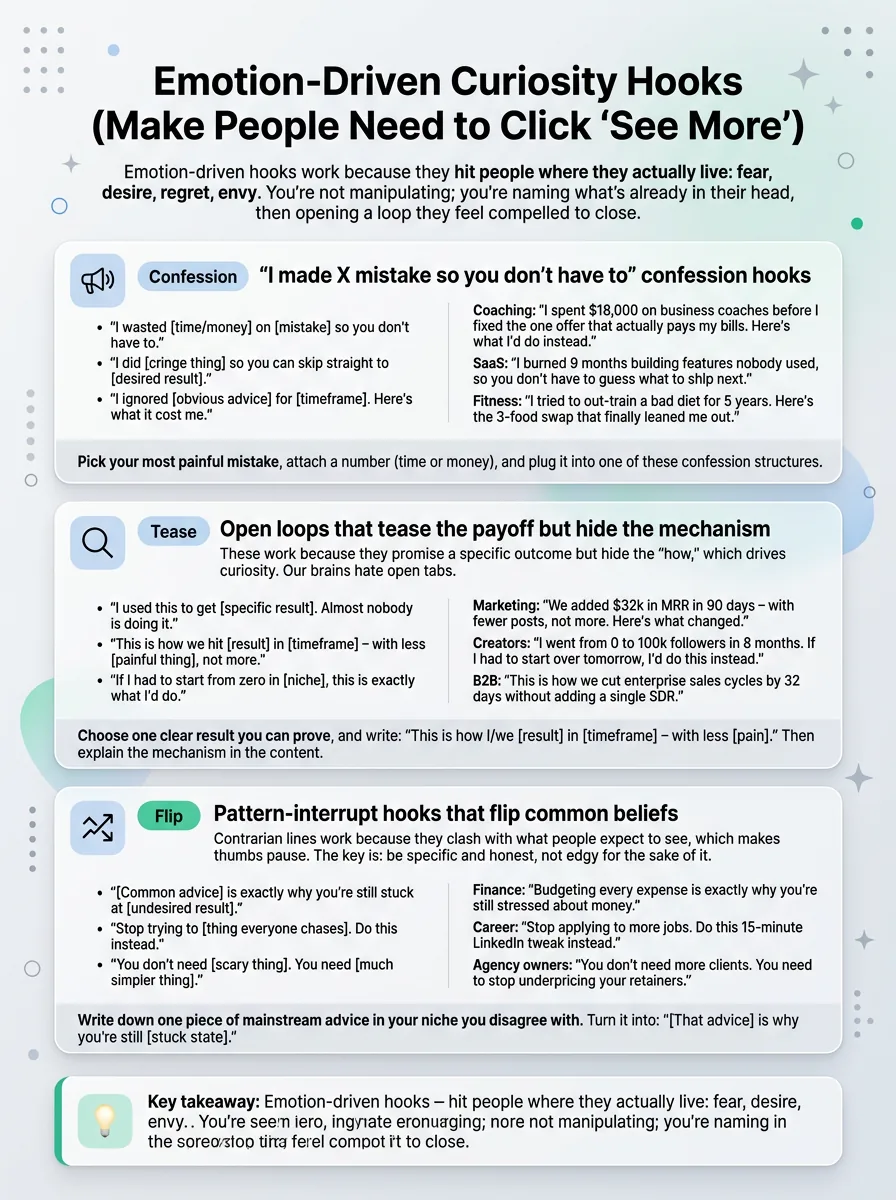
Emotion-driven hooks work because they hit people where they actually live: fear, desire, regret, envy. You’re not manipulating; you’re naming what’s already in their head, then opening a loop they feel compelled to close.
“I made X mistake so you don’t have to” confession hooks
Formula examples:
“I wasted [time/money] on [mistake] so you don’t have to.”
“I did [cringe thing] so you can skip straight to [desired result].”
“I ignored [obvious advice] for [timeframe]. Here’s what it cost me.”
Filled-in examples:
- Coaching
“I spent $18,000 on business coaches before I fixed the one offer that actually pays my bills. Here’s what I’d do instead.”
- SaaS
“I burned 9 months building features nobody used, so you don’t have to guess what to ship next.”
- Fitness
“I tried to out-train a bad diet for 5 years. Here’s the 3-food swap that finally leaned me out.”
Action step: Pick your most painful mistake, attach a number (time or money), and plug it into one of these confession structures.
Open loops that tease the payoff but hide the mechanism
These work because they promise a specific outcome but hide the “how,” which drives curiosity. Our brains hate open tabs.
Formula examples:
“I used this to get [specific result]. Almost nobody is doing it.”
“This is how we hit [result] in [timeframe] – with less [painful thing], not more.”
“If I had to start from zero in [niche], this is exactly what I’d do.”
Filled-in examples:
- Marketing
“We added $32k in MRR in 90 days – with fewer posts, not more. Here’s what changed.”
- Creators
“I went from 0 to 100k followers in 8 months. If I had to start over tomorrow, I’d do this instead.”
- B2B
“This is how we cut enterprise sales cycles by 32 days without adding a single SDR.”
Action step: Choose one clear result you can prove, and write: “This is how I/we [result] in [timeframe] – with less [pain].” Then explain the mechanism in the content.
Pattern-interrupt hooks that flip common beliefs
Contrarian lines work because they clash with what people expect to see, which makes thumbs pause. The key is: be specific and honest, not edgy for the sake of it.
Formula examples:
“[Common advice] is exactly why you’re still stuck at [undesired result].”
“Stop trying to [thing everyone chases]. Do this instead.”
“You don’t need [scary thing]. You need [much simpler thing].”
Filled-in examples:
- Finance
“Budgeting every expense is exactly why you’re still stressed about money.”
- Career
“Stop applying to more jobs. Do this 15-minute LinkedIn tweak instead.”
- Agency owners
“You don’t need more clients. You need to stop underpricing your retainers.”
Action step: Write down one piece of mainstream advice in your niche you disagree with. Turn it into: “[That advice] is why you’re still [stuck state].”
Number-Backed, Outcome-First Hooks (Perfect for Case Studies & Tutorials)
Data hooks work because numbers feel concrete. “Grow fast” is fluff. “Grow 37% in 30 days” feels real. Algorithms also reward these because people are more likely to click, save, and share specific outcomes.
Specific results in a specific timeframe
Formula examples:
“How we got [metric] to [number] in [timeframe] with [unexpected approach].”
“From [starting metric] to [ending metric] in [timeframe]: the exact breakdown.”
“The [number]-step system I used to go from [A] to [B] in [timeframe].”
Filled-in examples:
- Coaching
“From 3 to 27 clients in 60 days: the exact script I used.”
- Ecom
“How we cut CAC from $42 to $19 in 45 days with 1 creative tweak.”
- Productivity
“The 4-step system I used to reclaim 10 hours a week without waking up earlier.”
Action step: Grab one metric you’ve improved and fill in: “From [old number] to [new number] in [timeframe]: how.”
Before/after contrast hooks
These work because contrast is visual. People instantly picture the “before” and want the “after.”
Formula examples:
“[Before]: [short description]. [After]: [short description]. Here’s the bridge.”
“I went from [frustrating state] to [desired state]. Here’s the part nobody sees.”
“[Old way] vs [new way]: what changed everything for me.”
Filled-in examples:
- Health
“Before: 3pm crashes and 4 coffees. After: stable energy all day. Here’s exactly what I changed.”
- SaaS
“We went from 47% churn to 12% churn. The fix had nothing to do with features.”
- Freelancers
“I went from $40/hour projects to $4k retainers. Here’s the offer rewrite that did it.”
Action step: Write a one-line “before” and “after” from your own story or a client. Use “Here’s what changed” as the bridge.
Myth-busting stats and unexpected comparisons
These hooks use numbers to break assumptions. Our brains love mismatches: “Wait, that shouldn’t be true…”
Formula examples:
“[Surprising stat]. If that shocks you, you’re not alone.”
“[Smaller thing] outperforms [bigger thing] by [percentage]. Here’s why.”
“You only need [small number] of [thing] to [big outcome]. Here’s the math.”
Filled-in examples:
- HR
“76% of employees say their manager is more stressful than their workload. Here’s how to not be that boss.”
- Ecom
“Our ‘ugly’ UGC ad beat the polished studio shoot by 241%. Here’s why raw wins.”
- Education
“You only need 20 focused minutes a day to pass this exam. Here’s the schedule.”
Action step: Grab one surprising stat from your niche and build a hook around why it’s true or why it matters.
Relatable Pain & “Call-Out” Hooks (Speak Directly to Your People)
Relatable hooks work because they make your reader feel seen. You’re basically saying, “I know exactly what your Tuesday looks like.” When people feel understood, they give you more attention and more patience.
Direct call-outs to a specific identity
Formula examples:
“If you’re a [identity] who [specific struggle], read this.”
“[Identity] who want [specific outcome] but [objection]? This is for you.”
“Dear [identity]: you’re not crazy for [frustration].”
Filled-in examples:
- Creators
“If you’re a creator posting daily and still stuck under 1k views, read this.”
- Founders
“Bootstrapped founders who want consistent MRR but hate ‘personal branding’? This is for you.”
- Parents
“Dear working parents: you’re not lazy for being exhausted at 8pm.”
Action step: Pick one identity word your audience actually uses for themselves (creator, solo founder, new manager) and write directly to them.
Hyper-specific “this is you” scenarios
These work because the reader feels like you’re literally watching their day. The more specific, the better.
Formula examples:
“If you [very specific behavior], this is for you.”
“You [action], then [action], then wonder why [frustrating outcome].”
“You say you want [goal], but your calendar looks like [specific chaos].”
Filled-in examples:
- B2B
“If you’re still sending 3-paragraph cold emails with no CTA, this is for you.”
- Fitness
“You eat ‘clean’ all week, then erase it in 2 nights of mindless snacking and wonder why nothing changes.”
- Productivity
“You say you want focus time, but your calendar looks like a game of Tetris played by your coworkers.”
Action step: Think of one client or follower you know well. Write a hook describing their last 24 hours like a scene.
“You’re doing this wrong” pattern interrupts
These call people out gently. The goal isn’t shame; it’s “Hey, there’s a better way.”
Formula examples:
“You’re doing [common task] wrong. Here’s the easier version.”
“If you’re still [behavior], you’re making [specific thing] harder than it needs to be.”
“Stop [tiny habit]. Start doing this instead.”
Filled-in examples:
- Marketing
“You’re writing hooks backwards. Here’s the order that actually gets clicks.”
- Sales
“If you’re still asking ‘Got any questions?’ at the end of calls, you’re making closing way harder than it needs to be.”
- Habits
“Stop setting 10 goals at once. Start mastering one habit per month instead.”
Action step: Take one thing your audience is doing inefficiently and turn it into “You’re doing X wrong. Here’s the fix.”
Platform-Specific Hooks for TikTok/Reels vs LinkedIn/X
Same idea, different feed behavior. Short-form video hooks live or die in 1–3 seconds. LinkedIn and X live or die on the first line and how scannable the rest looks. You adjust the style to respect how people consume content there.
Short-form video hooks that work in the first 1–3 seconds
These need to be speakable, punchy, and visually supported with on-screen text.
Formula examples:
“Stop scrolling if you’re a [identity].”
“You’re doing [task] wrong. Watch.”
“Here’s what nobody tells you about [goal].”
Filled-in examples:
- Education
“Stop scrolling if you’re revising for exams and nothing’s sticking.”
- Lifestyle
“You’re cleaning your kitchen wrong. Watch this before you start.”
- Business tips
“Here’s what nobody tells you about your first year as a solo founder.”
Action step: Record yourself saying three of these to camera and add bold text for the key words in the first frame.
LinkedIn and X hooks that win the first line
These platforms reward strong first lines and skimmable structure. Think clear, opinionated, professional-but-human.
Formula examples:
“Hot take: [contrarian opinion].”
“Most [identity] are still doing [task] like it’s [old world].”
“I [strong verb] [result]. Here’s the part nobody mentions.”
Filled-in examples:
- Leadership
“Hot take: your 1:1s are performance reviews in disguise, and your team can tell.”
- SaaS
“Most SaaS founders are still shipping features like it’s 2015 – with zero customer input.”
- Hiring
“I tripled our inbound candidate quality in 30 days. Here’s the part nobody mentions on LinkedIn.”
Action step: For every LinkedIn or X post, write 3 alternate first lines, then pick the spiciest true one.
Carousel and thread hooks that set up multi-part content
These hooks promise a structured breakdown, which signals “This will be worth your time.” Perfect for Instagram carousels and X/LinkedIn threads.
Formula examples:
“[Number] lessons I learned from [specific experience].”
“Steal my [number]-step process for [outcome].”
“From [A] to [B] in [timeframe]: a thread/carousel.”
Filled-in examples:
“7 lessons I learned writing 300 LinkedIn posts in a year.”
“Steal my 5-step process for turning one blog into 6 posts across 3 platforms.” (Then you can literally show how you repurpose blog posts into social media posts.)
“From burnt-out manager to calm leader in 90 days: a thread.”
Action step: Next time you have a “how-to” idea, default to a numbered carousel/thread hook instead of a single-post rant.
Why Most People Still Don’t Get Results With Hook Formulas
Let’s be blunt: most people grab social media hook formulas, paste them into a doc, and see zero change. Here’s why.
Copying templates verbatim so you blend into the feed
If your hook could belong to any creator in your niche, it doesn’t belong to you. When people recognize the exact same template word-for-word, they scroll right past – it feels like stale stock content.
Fix: Always add your own numbers, niche terms, or a personal twist. Treat the formula like a skeleton, not a costume.
Promising outcomes you don’t back up in the content
Clickbait hooks might get short-term spikes, but they wreck trust. If your hook promises “How I hit 10k months in 30 days” and the content is vague fluff, watch time tanks, people bounce, and the algorithm stops showing your stuff.
Fix: Before you publish, check: “Do I actually show how I did this?” If not, tone down the claim or add proof and steps.
Using vague language instead of specifics
“Scale your business,” “grow faster,” “reach your goals” – these phrases feel like background noise. Vague hooks don’t trigger emotion or curiosity, so people keep scrolling.
Fix: Replace every generic phrase with a number, a timeframe, or a concrete situation. If a stranger couldn’t guess your niche from the hook alone, it’s too vague.
Ignoring platform norms and context
Copy-pasting the same long, thoughtful LinkedIn hook into a TikTok video caption and expecting it to work is wild. Different platforms reward different rhythms and tones.
Fix: Create a “platform version” of your best hooks: one spoken, one written, one super short. It’s 30 seconds of editing that can double performance.
Only testing one hook per post
Most creators stop at their first decent idea. That’s like recording one take of a YouTube intro and calling it done. Hooks are where you should burn reps.
Fix: For every important post, write at least 5 hook variations. Often the best one is option 3 or 4, not option 1. You can put them in SocialCal's Viral Hook tester to see which ones have the potential to go viral.
From One-Off Hooks to Repeatable Output (Without Burning Out)
The real problem isn’t knowing what a good hook looks like. You can see them all over your feed. The hard part is producing enough good hook variations, week after week, without spending an hour on every single intro.
Turn your best-performing hooks into reusable patterns
Your analytics are a goldmine. Any post that outperformed? That hook is a pattern you can reuse, not a one-time fluke.
Example: If “I wasted $X on Y so you don’t have to” crushes, turn it into a template for time, energy, and other resources too: “I wasted 6 months posting daily…” “I wasted 200 hours editing long-form…”
Action step: Screenshot your top 10 posts by reach or watch time and rewrite each hook as a generic formula you can plug new topics into.
Batch brainstorm 10–20 variations before you post
Instead of crafting one “perfect” hook, treat it like a mini-brainstorm session. Set a 10-minute timer and force yourself to write 10–20 hook variations for the same idea. The first 5 will be predictable. The next 5 will start to get interesting.
Then pick 2–3 best ones and either A/B test across platforms or save alternates for future repurposes of the same idea.
Action step: Next time you script a post or video, ban yourself from publishing until you have at least 8 hooks in your doc.
Use light templates, not scripts, as your creative starting point
Treat these formulas like prompts, not cages. If “How I did X in Y” sparks a better version halfway through writing, follow that. The point is to skip the blank-page panic, not to sound like everyone using the same template pack.
This is where tools can help in a non-gimmicky way: a generator that spits out 10 different curiosity or contrarian hook options from your topic lets you pick the one that actually sounds like you and tweak it. I’ve seen creators save ridiculous amounts of time using the SocialOrbit Hook Generator for exactly this – you drop in your idea, choose a style (curiosity, story-based, contrarian, etc.), and get multiple first-line options to edit instead of starting from zero.
Start creating viral content today
Join other creators who've transformed their social media presence with AI-powered content.
Start creating nowFAQ: Social Media Hook Formulas
How many hooks should I test for each post?
For most creators, 3–5 variations per post is realistic. You don’t need 50 options, you just need more than one. Test different versions across platforms or over time, and watch which structures consistently win.
How do I know if a hook is actually working?
On video (TikTok, Reels, YouTube Shorts), look at watch time and retention curves for the first 3–5 seconds. On text posts (LinkedIn, X), look at impressions-to-engagement ratio, link click-through, and saves. If people stick around and interact, your hook is doing its job.
Can I reuse the same hook formula across different platforms?
Yes – reuse the structure, not the exact wording. A curiosity hook that works on TikTok can absolutely work on LinkedIn, but you’ll adjust the tone, length, and context so it matches that audience’s expectations.
How often should I update my go-to hook templates?
Refresh your core set every 2–3 months, or when you notice performance flattening. Keep the formulas that still work, tweak the ones that are fading, and add new patterns you see performing well in your niche.
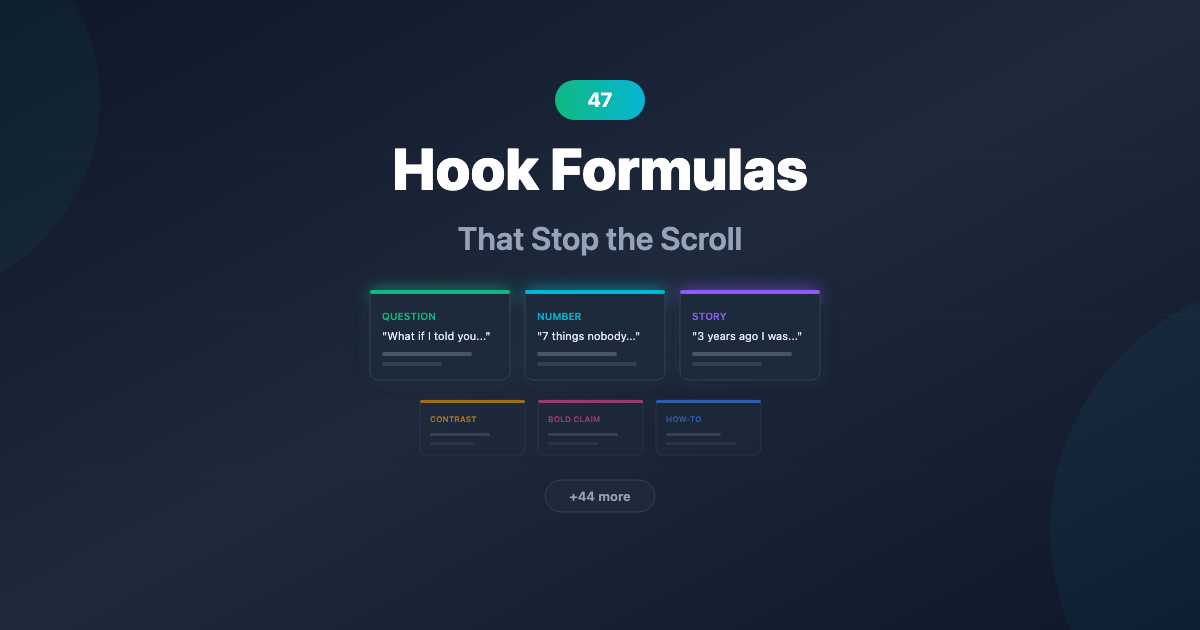
Bringing It Together: 47 Social Media Hook Formulas You Can Use Today
You don’t need to be a “natural writer” to write great hooks. You need solid social media hook formulas, clear audience targeting, and a habit of testing more than one option.
Pick 5–10 of the formulas in this post, plug in your niche and numbers, and use them for your next week of content. Then keep the ones your audience actually responds to and turn them into your own personal swipe file.
Write Hooks That Stop the Scroll
Generate attention-grabbing opening lines that make people stop and read.
Try Hook Generator