The 3-Second Rule: Why Your Content Is Getting Ignored
Most people think they have three seconds to grab attention. Not even close. You have about half a second before a thumb flicks your hard work into the void.
Jump to a section:
- The 3-Second Rule: Why Your Content Is Getting Ignored
- Quick Answer: What is a Problem-Solution Hook?
- How to Customize These Templates for Maximum Conversion
- B2B and SaaS Hook Templates: Efficiency and ROI
- Content Creator and Social Media Hooks: Engagement and Growth
- Why Most People Still Don't Get Results
- From Manual Writing to Repeatable Creative Output
- Frequently Asked Questions About Problem-Solution Hooks
- Conclusion: Start Hooking Your Readers
If you want to stop that scroll, you need an opening line that hits a nerve immediately. Content fails when it tries to be everything to everyone right out of the gate. You have to earn the right to explain your broad concepts by first targeting a narrow, painful frustration. That is exactly why keeping a swipe file of problem solution hook examples becomes mandatory for anyone serious about growing an audience.
Quick Answer: What is a Problem-Solution Hook?
A problem-solution hook is an opening line that identifies a highly specific audience frustration and immediately promises a tangible resolution. By framing the content around a known pain point in the first two sentences, these hooks hijack the reader's attention and force them to keep reading to find the fix.
How to Customize These Templates for Maximum Conversion
Naming a problem isn't enough anymore. You have to name the problem using the exact words your audience uses when they complain to their coworkers.
This works because of how our brains process information. We are biologically wired to ignore the mundane and hyper-focus on threats or unresolved issues. If you scroll past a post about "improving metrics," your brain filters it out as noise. But if you see a post about "plugging the MRR leak in your onboarding sequence," your scrolling finger freezes. The specificity acts as a trigger.
To make these templates actually convert, you have to swap out generic placeholders for high-emotion industry jargon. If you want to layer in a bit of mystery, pairing a specific problem with curiosity hook examples can dramatically increase your dwell time by making the solution feel exclusive.
B2B and SaaS Hook Templates: Efficiency and ROI
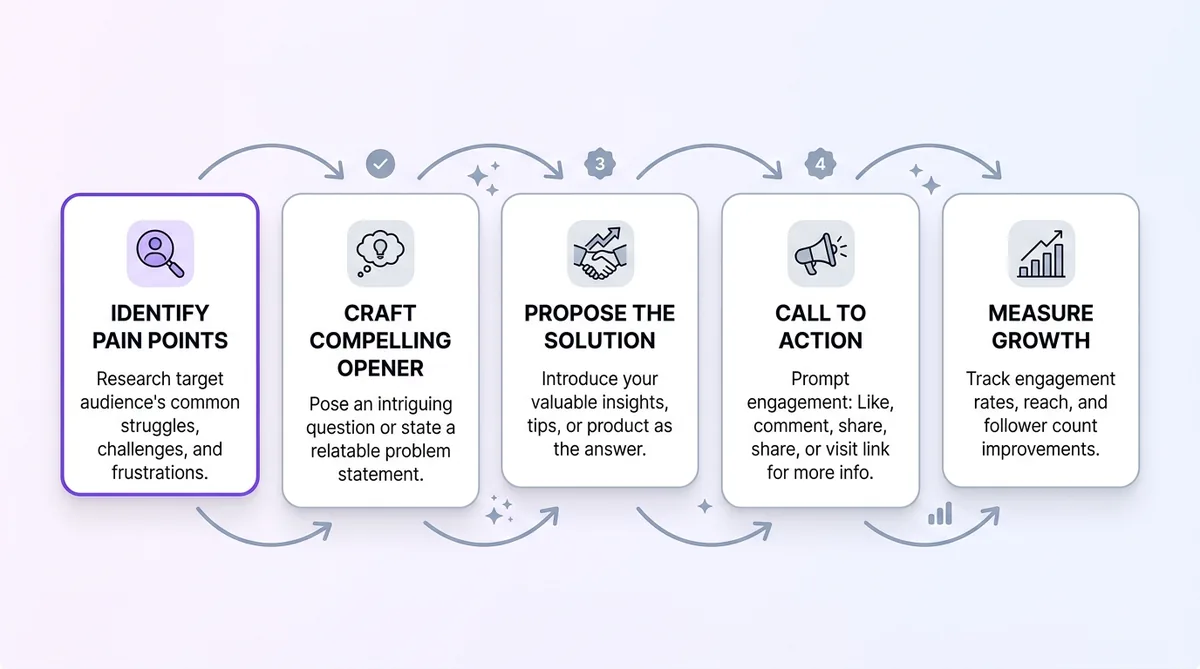
Professional audiences do not care about your product features. They care about lost time, wasted budget, and inefficient workflows that make their jobs harder.
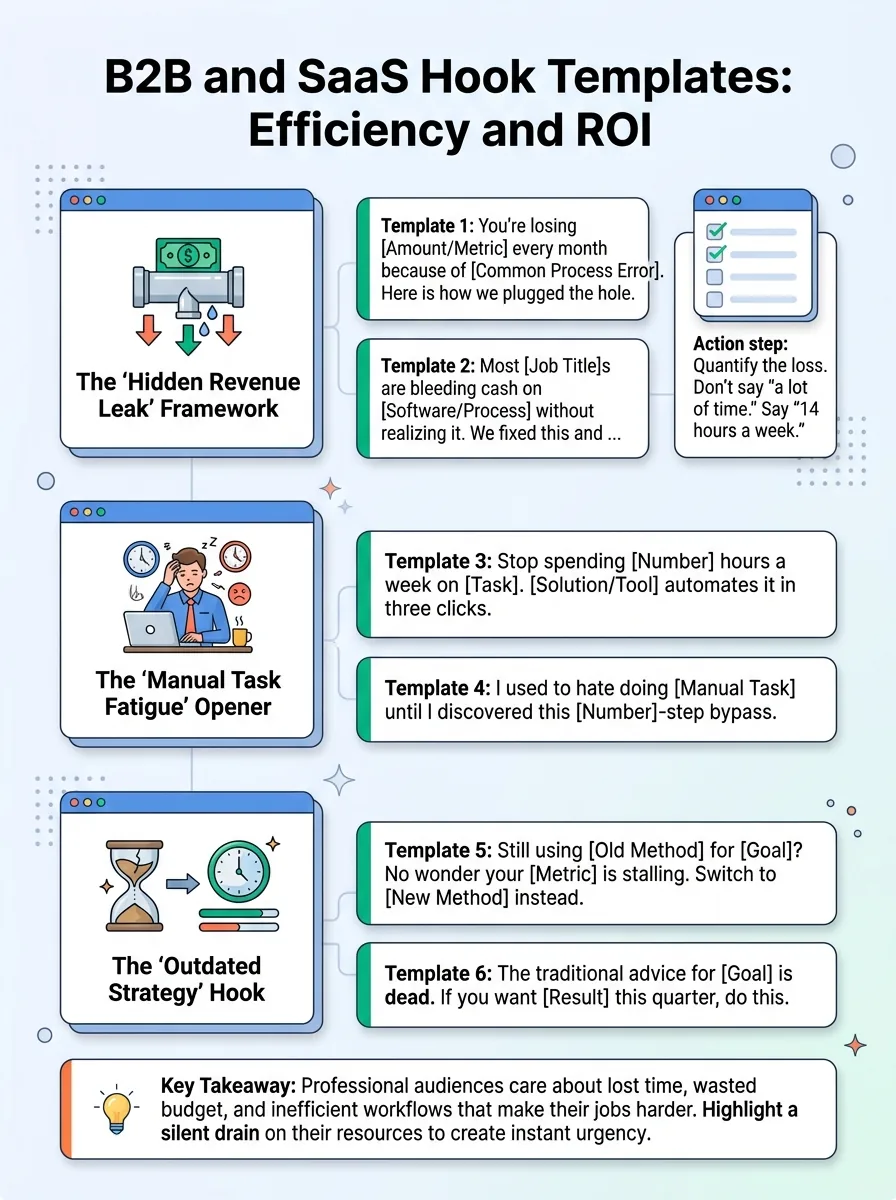
The 'Hidden Revenue Leak' Framework
Financial loss aversion is one of the strongest psychological triggers in B2B content. People are far more motivated to avoid losing money than they are to gain it. Highlighting a silent drain on their resources creates instant urgency.
- Template 1
You're losing [Amount/Metric] every month because of [Common Process Error]. Here is how we plugged the hole.
- Template 2
Most [Job Title]s are bleeding cash on [Software/Process] without realizing it. We fixed this and saved [Amount].
Action step: Quantify the loss. Don't say "a lot of time." Say "14 hours a week."
The 'Manual Task Fatigue' Opener
Nobody likes busywork. These hooks trigger the pain of repetitive, mind-numbing tasks and position your subsequent content as the escape hatch.
- Template 3
Stop spending [Number] hours a week on [Task]. [Solution/Tool] automates it in three clicks.
- Template 4
I used to hate doing [Manual Task] until I discovered this [Number]-step bypass.
The 'Outdated Strategy' Hook
Challenging the status quo works because it makes the reader question their own competence. It creates a sudden gap in their knowledge that they feel compelled to close.
- Template 5
Still using [Old Method] for [Goal]? No wonder your [Metric] is stalling. Switch to [New Method] instead.
- Template 6
The traditional advice for [Goal] is dead. If you want [Result] this quarter, do this.
Content Creator and Social Media Hooks: Engagement and Growth
Attention is the primary currency on platforms like LinkedIn and X. You need punchy, high-energy openers that disrupt the feed. According to official platform guidance from TikTok, highlighting your core message or problem in the very first visual or line of text significantly boosts view-through rates.
The 'Relatable Failure' Hook
Perfect stories are boring. Humanizing your content by leading with a failure builds immediate trust and makes your ultimate solution far more credible.
- Template 7
I tried [Popular Advice] for 30 days and it almost ruined my [Metric]. Here is the [Alternative] I used to fix it.
- Template 8
My first attempt at [Skill/Goal] was an absolute disaster. Then I learned the [Name of Concept] rule.
The 'Negative Benefit' Pattern
Telling people what to stop doing is often more scroll-stopping than telling them what to start doing. It acts as a severe pattern interrupt. If you need more ways to build these structures, reviewing specific social media hook formulas will give you plenty of structural inspiration.
- Template 9
Stop [Common Action] if you want to see [Desired Result]. Do this instead.
- Template 10
The fastest way to destroy your [Asset/Metric] is by doing [Common Mistake].
The 'Unfair Advantage' Swipe
Everyone wants a shortcut. This framework promises a disproportionate return on a small investment of time or effort.
- Template 11
Most people struggle with [Problem] for years. These [Number] tools solve it in 5 minutes.
- Template 12
The top 1% of [Profession] don't worry about [Common Problem]. They use this unfair advantage.
Why Most People Still Don't Get Results
Having a swipe file is useless if you execute the templates poorly. I see accounts stagnate for months because they keep making the same unforced errors in their first two sentences.
Check yourself against these mistakes:
Stacking three ideas in one opening line. You only have space for one core problem. If you try to address low engagement, burnout, and monetization in the same breath, you lose the reader entirely.
Copying viral hooks without matching audience intent. What works for a high-energy fitness influencer will sound ridiculous coming from a B2B logistics brand. The tone has to match the room.
Using vague claims like "this changed everything." Changed what exactly? Vague promises signal clickbait, which causes users to bounce immediately to protect their time.
Ignoring the 'So What?' test. If you name a problem but fail to imply a solution or stakes, the reader has no logical reason to click the "read more" button.
Presenting a problem the audience doesn't actually care about yet. You have to meet them at their current stage of awareness. Address the visible symptoms they feel today, not the invisible root cause you want to teach them about tomorrow.
From Manual Writing to Repeatable Creative Output
Writing one brilliant opening line is easy. The real problem isn't knowing what a good hook looks like.
It is producing dozens of high-performing variations consistently week after week without staring at a blinking cursor for an hour. When you are trying to scale an account, manual ideation quickly becomes a massive bottleneck. You end up defaulting to the same three openers just to get the post out the door.
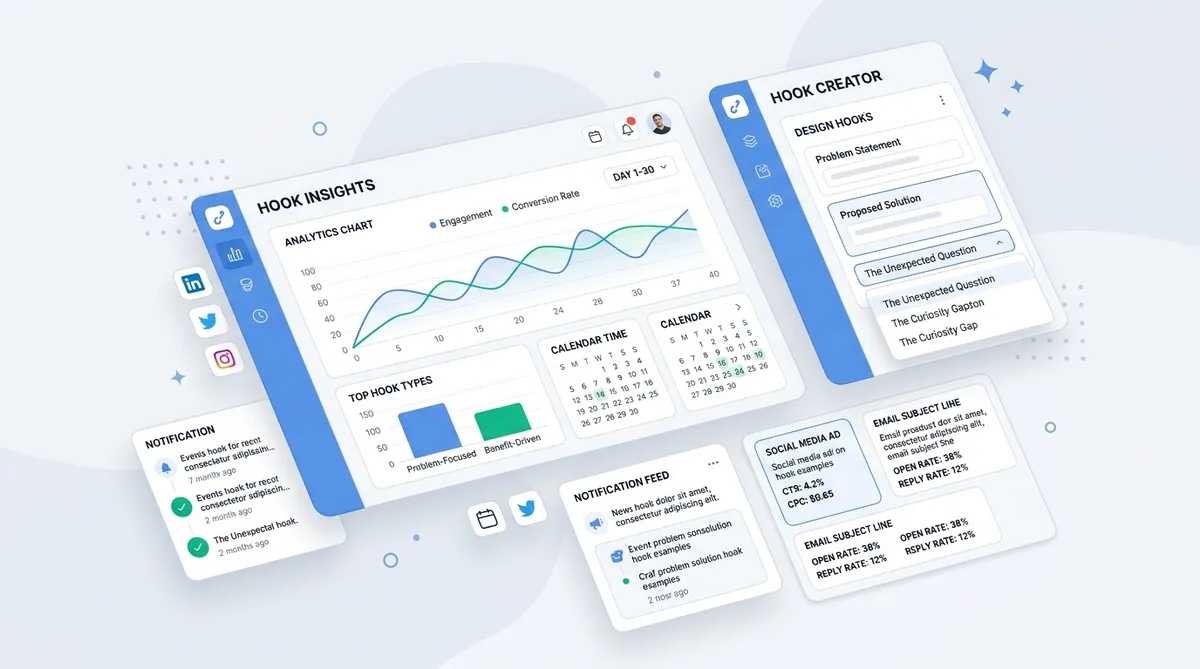
That is why consistent creators use a dedicated hook generator to automate the first draft phase. You simply describe your content idea, pick a preferred style like 'contrarian' or 'empathetic,' and let the system instantly output multiple optimized variations. You grab the strongest option, tweak it to your exact voice, and publish.
Start creating viral content today
Join other creators who've transformed their social media presence with AI-powered content.
Start creating nowFrequently Asked Questions About Problem-Solution Hooks
How long should a problem-solution hook be?
Keep it under 150 characters if possible. The goal is to fit the entire problem and the promise of a solution before the text gets truncated by the "read more" link on platforms like LinkedIn and Instagram.
Can I use these templates for email subject lines?
Absolutely. Email inboxes are just another feed. Adapting these frameworks into short, punchy subject lines often yields higher open rates than standard newsletter titles because they promise immediate utility.
How do I test which hook is working best?
Look at your retention graphs for video, or your impression-to-engagement ratio for text posts. If your video retention drops by 50% in the first three seconds, your hook failed to connect the stated problem to the viewer's actual daily pain points.
Conclusion: Start Hooking Your Readers
Write Hooks That Stop the Scroll
Generate attention-grabbing opening lines that make people stop and read.
Try Hook GeneratorStop treating your opening lines as an afterthought! The absolute best content in the world will not save a post that nobody pauses to read. Grab a few of these problem solution hook examples, plug in your specific industry pain points, and watch your engagement metrics shift.