The High-Speed Content System: Why Templates Are Your Secret Weapon
We have all been there. You stare at a blinking cursor, knowing you need to post today, but your brain is completely empty. The pressure to feed the algorithm daily is exhausting. It leads straight to creator burnout.
Jump to a section:
- The High-Speed Content System: Why Templates Are Your Secret Weapon
- Quick Answer: The 10x Content Repurposing Framework
- How to Customize These Templates Without Losing Your Voice
- Authority-Building Templates: Establishing Expertise
- High-Engagement Interaction Templates
- Storytelling and Relatability Swipe Files
- 5 Mistakes That Kill Your Content Multiplier Strategy
- Moving From Manual Grinding to Repeatable Systems
- Frequently Asked Questions
- Final Summary: Mastering 10x Content Creation
Most creators think they need a brilliant, original thought for every single post. Not even close. The secret to consistent growth isn't generating more ideas. It's squeezing every last drop of value out of the ones you already have.
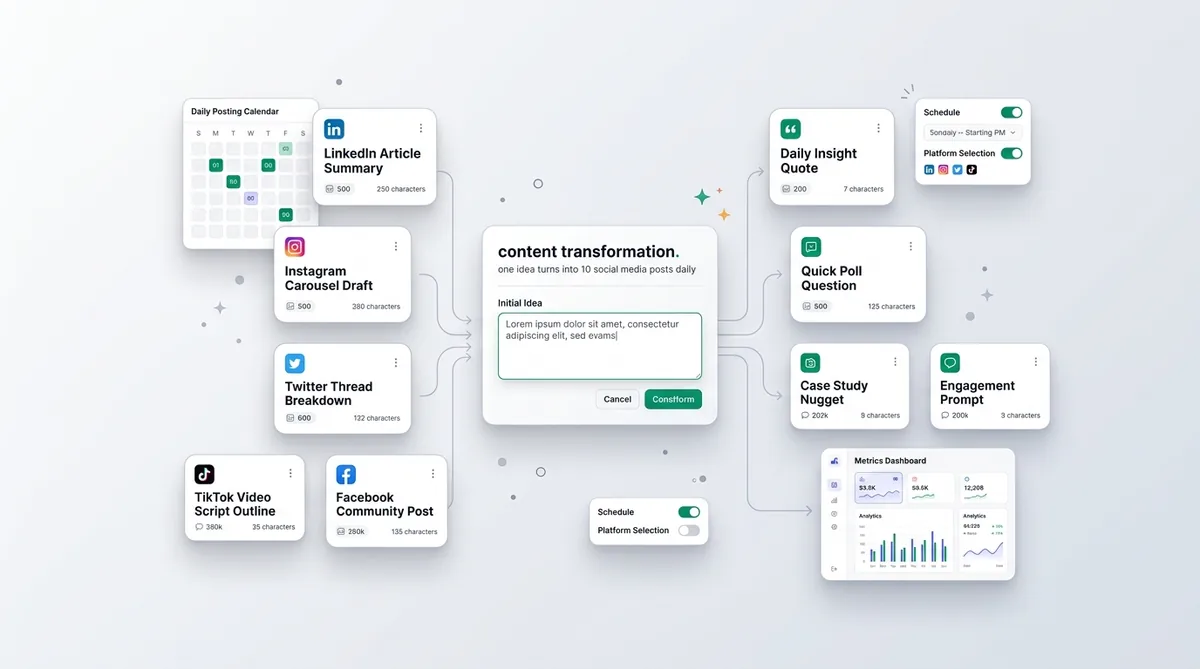
If you want to know how to turn one idea into 10 social media posts daily, you need a system. Specifically, a template-based repurposing system. When you use proven structural templates, you drastically lower the cognitive load required to hit publish. You stop reinventing the wheel. You just pour your specific idea into a new mold.
This changes everything. You go from spending two hours writing a single LinkedIn post to spending 30 minutes mapping out an entire week of cross-platform content.
Quick Answer: The 10x Content Repurposing Framework
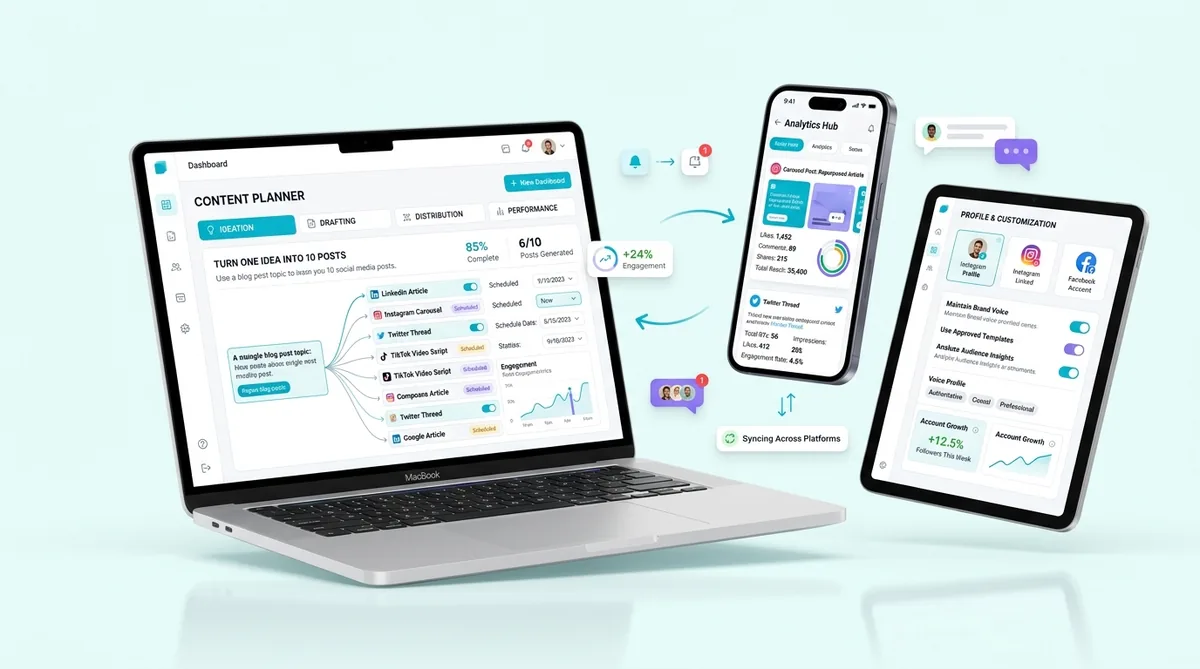
To turn one idea into 10 social media posts, you must atomize your core concept. Take a single "pillar" idea and run it through different psychological lenses: educational breakdowns, controversial takes, personal failures, and curated resources. Adapt the format for each platform—turning a deep-dive LinkedIn post into a punchy Twitter thread, a visual Instagram carousel, and a quick TikTok script.
How to Customize These Templates Without Losing Your Voice
Algorithms are getting incredibly good at spotting generic content. More importantly, human readers can spot it a mile away.
The templates below are frameworks, not straightjackets. If you just copy and paste them with boring, high-level statements, your retention graphs will flatline. What actually works is injecting hyper-specific data. Specificity creates a curiosity gap. Readers naturally slow their scroll when they see a weirdly specific number or an unusual personal anecdote.
If you're looking to repurpose blog posts into social media posts, the framework is the exact same: isolate the core concept and change the wrapper. Add your actual revenue numbers, the specific software you used, or the exact phrasing a client said to you. That is what makes the template sound like you.
Authority-Building Templates: Establishing Expertise
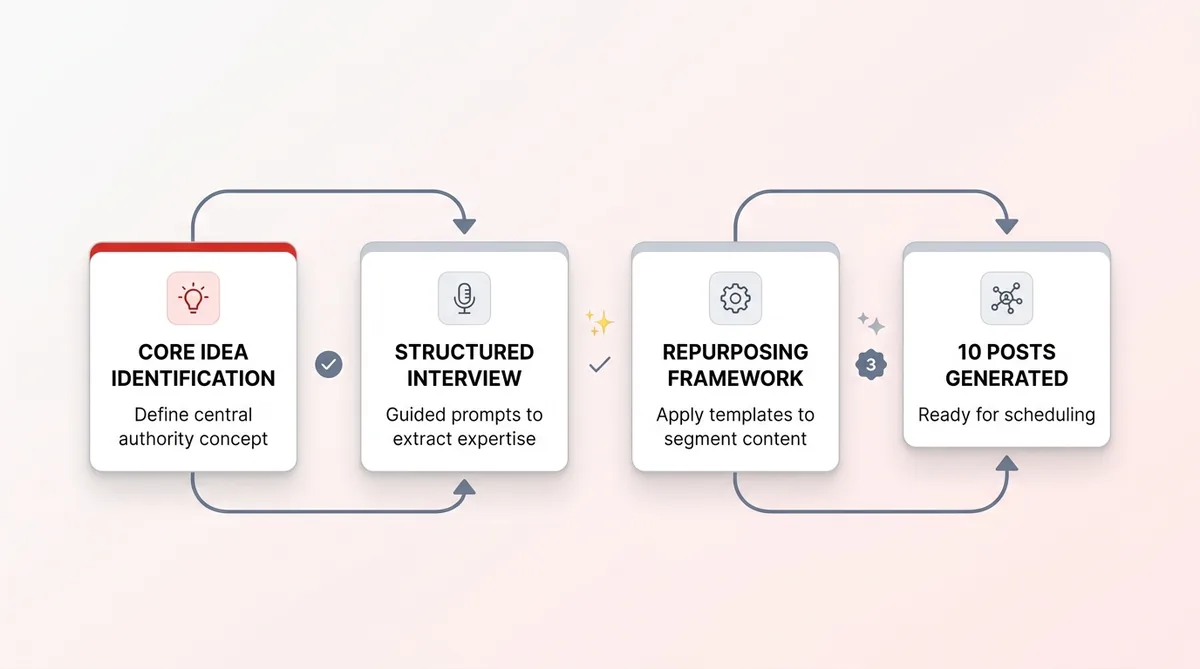
These templates position you as the guide. They work because they tap into the viewer's desire for quick, actionable status upgrades.
The 'Step-by-Step' Educational Deep Dive
People rarely read walls of text anymore. They scan. Breaking a complex process into numbered steps reduces visual friction, making the content feel achievable. This signals the algorithm that your post is highly readable, which boosts dwell time.
The Template:
Most [Target Audience] struggle with [Core Problem].
I used to be one of them. Then I discovered [Your Method/Solution].
Here is the exact [Number]-step framework I use to achieve [Desired Result]:
Step 1: [Actionable advice]
Step 2: [Actionable advice]
Step 3: [Actionable advice]
[Brief summary of the transformation].
The 'Myth vs. Reality' Industry Takedown
This format breaks mental schemas. When you tell someone they are wrong about a deeply held industry belief, cognitive dissonance forces them to stick around to see your proof.
The Template:
The biggest lie in [Your Industry]?
That you need [Common Misconception] to achieve [Goal].
In reality, that just leads to [Pain Point].
What actually works is [Your Core Idea].
Here is why this approach changes the game: [Explain the mechanism].
The 'Curated Resource' List Template
Lists naturally trigger the brain's pattern-recognition system. Furthermore, resource lists are heavily "saved" by users. According to industry algorithm research, saves are one of the strongest signals for algorithmic distribution because they indicate high long-term value.
The Template:
Stop wasting time trying to figure out [Topic] on your own.
Here are the [Number] resources I used to master [Core Idea] in [Timeframe]:
1. [Tool/Book] - [Why it matters]
2. [Tool/Book] - [Why it matters]
Bookmark this for your next [Project/Task].
High-Engagement Interaction Templates
You don't just want passive readers. You want comments. Comments feed the algorithm, extending the lifespan of your post.
The 'Controversial Opinion' Conversation Starter
You do not need to be offensive to be polarizing. You just need to take a firm stance against a popular trend. It invites people to defend their own methods in your replies.
The Template:
Unpopular opinion: [Common practice] is completely overrated.
If you want to actually achieve [Goal], you need to double down on [Your Core Idea] instead.
I've seen it work for [Example 1] and [Example 2].
Am I crazy, or is anyone else seeing this?
The 'Specific Question' Insight Prompt
Short-form text works incredibly well on LinkedIn and X. It demands a fast response.
The Template:
I'm testing a new theory about [Your Core Idea].
If you had to choose, what is the single biggest bottleneck preventing you from [Goal]?
Drop a specific answer below. I'm building something to fix this.
Storytelling and Relatability Swipe Files
Authority gets people to listen. Relatability gets people to trust you. Facts tell, but stories sell.
The 'Lessons Learned from Failure' Narrative
Vulnerability works. When you share a failure, you lower the audience's defenses. They become far more receptive to the lesson (your core idea) that follows.
The Template:
[Timeframe] ago, I completely failed at [Task].
I lost [Specific metric like time/money/clients] because I made one massive mistake: I thought [Incorrect Assumption].
It forced me to completely rebuild my approach to [Topic].
Here are the [Number] hard truths I learned about [Your Core Idea] the hard way.
The 'Behind the Scenes' Process Reveal
Show the messy middle. This is exceptionally powerful for video formats like Reels or Shorts. When you finally figure out how to repurpose a podcast into social media posts, you'll notice that the raw, behind-the-scenes clips usually outperform highly polished marketing graphics.
The Template:
Everyone sees the final [Result]. Nobody sees the messy process behind it.
Here is exactly what my workflow looks like for [Your Core Idea].
[Detail step 1: The setup]
[Detail step 2: The execution]
[Detail step 3: The review]
Which part of this process surprises you the most?
5 Mistakes That Kill Your Content Multiplier Strategy
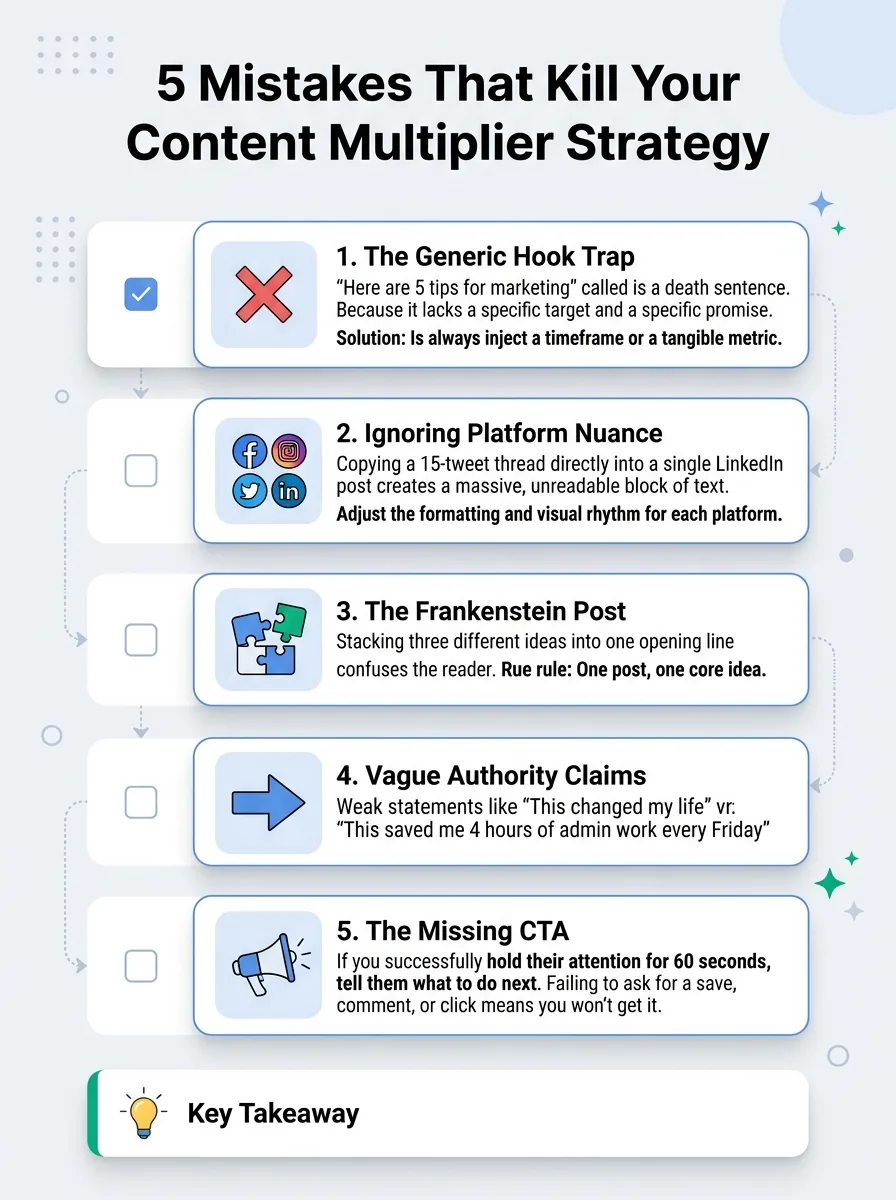
Most people try to multiply their content and fail miserably. They end up looking like spam bots. Here is why most people still do not get results when repurposing.
- The Generic Hook Trap.
Opening with "Here are 5 tips for marketing" is a death sentence. It lacks a specific target and a specific promise. Always inject a timeframe or a tangible metric.
- Ignoring Platform Nuance.
Copying a 15-tweet thread directly into a single LinkedIn post creates a massive, unreadable block of text. You have to adjust the formatting and visual rhythm for each platform.
- The Frankenstein Post.
Stacking three different ideas into one opening line confuses the reader. One post, one core idea. That's the rule.
- Vague Authority Claims.
Saying "This changed my life" is weak. Saying "This saved me 4 hours of admin work every Friday" is concrete and relatable.
- The Missing CTA.
If you successfully hold their attention for 60 seconds, tell them what to do next. If you don't ask for a save, comment, or click, you won't get it.
Moving From Manual Grinding to Repeatable Systems
The real problem isn't knowing what a good framework looks like. It is producing enough quality variations consistently without spending an hour manually typing out every single post.
Consistency is not a willpower problem. It is a systems problem.
That is why creators use a content generator to speed up the actual output. Instead of wrestling with a blank page, you drop your raw thought—even just six messy words—into the system. You pick your target platform and your desired tone, and it builds platform-ready drafts instantly. You get the Reel script, the LinkedIn post, and the Twitter thread formatted correctly. Then, you just tweak the nuances and hit publish. It turns an hour of grinding into five minutes of curating.
Start creating viral content today
Join other creators who've transformed their social media presence with AI-powered content.
Start creating nowFrequently Asked Questions
Do I need completely different ideas for every platform?
No. Your audience on TikTok barely overlaps with your audience on LinkedIn. Even if they do, people need to see a message multiple times before it clicks. Use the same core idea, just change the formatting to match the platform's native style.
How often should I post if I am repurposing 10x?
Quality still trumps sheer volume. If turning one idea into 10 posts gives you a week's worth of content, spread it out. Post 1-2 times daily across different platforms. Don't dump all 10 variations on the same day.
Won't my audience get bored if I repeat myself?
Only if you copy-paste the exact same phrasing. If you teach a concept on Monday, share a vulnerable story about it on Wednesday, and post a controversial take about it on Friday, it feels like an ongoing conversation, not repetition.
Repurpose One Post Into 15+
Turn your best content into posts for every platform in seconds.
Try Repurpose GeneratorFinal Summary: Mastering 10x Content Creation
Learning how to turn one idea into 10 social media posts daily is the fastest way to scale your presence without losing your mind. Stop treating every single post as a blank canvas. Start with one strong pillar idea, run it through proven templates, adapt the platform nuance, and let your system do the heavy lifting.