The Danger of 'Guessing' Your Content Strategy
Imagine spending five hours scripting, shooting, and editing a video. You hit publish, refresh the page a few times, and wait. Nada.
Jump to a section:
- The Danger of 'Guessing' Your Content Strategy
- How to Research Audience Pain Points (Quick Answer)
- Why Finding True Audience Pain Points Is So Hard
- 1. Mine Customer Support Tickets and Sales Transcripts
- 2. Eavesdrop on Niche Communities and Forums
- 3. Reverse-Engineer Competitor Reviews
- 4. Run Behavioral, Open-Ended Surveys
- The 14-Day Pain Point Validation Test
- 5 Research Mistakes That Kill Your Content Performance
- The Real Struggle: Manual Research vs. Repeatable Insights
- Frequently Asked Questions About Audience Pain Points
- Final Thoughts: Stop Guessing, Start Listening
Sound familiar?
Most creators get this wrong. They sit in a vacuum, stare at a blank Google Doc, and guess what their audience wants to see. They build entire content calendars around broad topics they think sound smart. That is a losing game.
High-converting content isn't guessed. It is echoed back from the market. If you want people to stop scrolling, save your posts, and actually buy your products, you need to stop acting like a creative director and start acting like an investigator. You need a structured framework to uncover the exact problems they are begging you to solve. We are going to build that framework right now.
How to Research Audience Pain Points (Quick Answer)
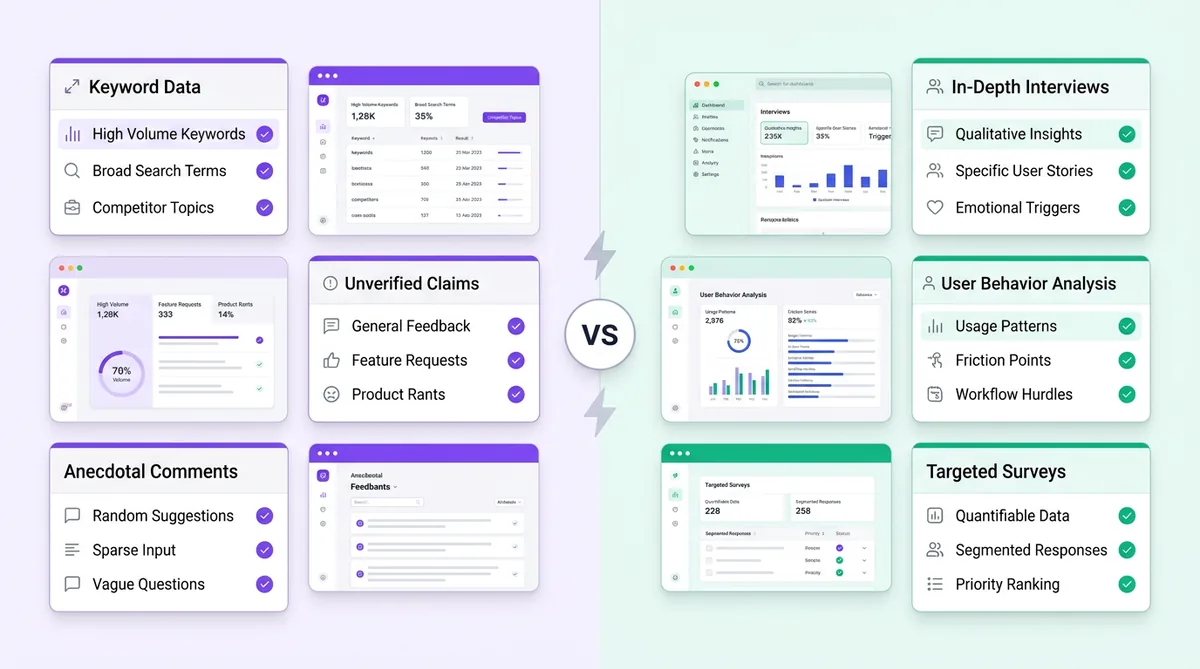
To research audience pain points for content, analyze customer support tickets, mine niche communities like Reddit and Quora, reverse-engineer 3-star competitor reviews, and run open-ended surveys. Never ask what content they want; observe the specific problems they actually pay to fix.
Why Finding True Audience Pain Points Is So Hard
Here is the reality of audience research. People are terrible at articulating what they actually need.
If you ask a freelancer what their biggest struggle is, they might say, "I need better time management." That is a surface-level complaint. The urgent pain point is actually, "I am working 14 hours a day, missing dinner with my family, and still barely making $4,000 a month."
There is a massive psychological disconnect here. Audiences frequently present symptoms, and creators mistakenly build content around those symptoms. You end up writing generic posts about "Pomodoro techniques" when your audience really needs content on "How to raise your rates so you can work fewer hours."
You have to dig beneath the polite, sanitized complaints to find the raw friction.
1. Mine Customer Support Tickets and Sales Transcripts
Support and sales logs are absolute goldmines. Why? Because they contain the unfiltered, high-intent language people use when they are actively experiencing friction or preparing to buy.
When someone is annoyed enough to submit a support ticket, they drop the corporate speak. They tell you exactly what is broken in their own messy words.
Extract Raw 'Voice of Customer' Data
Open up Zendesk, Intercom, or your Gong call recordings. Look for the exact syntax people use. Do not translate their words into marketing speak. If a customer says, "My email sequence is a complete dumpster fire," do not write a blog post titled "How to Optimize Your Marketing Funnel."
Write a post called "How to Fix a Dumpster Fire Email Sequence." Using their exact syntax in your H2s signals instant empathy. The algorithm rewards this because exact-match conversational queries drive massive click-through rates.
Start creating viral content today
Join other creators who've transformed their social media presence with AI-powered content.
Start creating nowLook for the 'I Tried X, But Y' Pattern
This is my favorite pattern to hunt for. People rarely start from zero. They usually have a problem because a previous solution failed them.
In B2B SaaS, nobody just asks "How to do accounting." They say, "I tried using Quickbooks for freelancer taxes, but it took me four hours to categorize my expenses." Turn that specific friction point into a targeted guide: "How to Categorize Freelance Expenses in 15 Minutes (Without Quickbooks)." That is how you steal attention.
2. Eavesdrop on Niche Communities and Forums
People are far more honest about their struggles on anonymous platforms than they are on your brand-sponsored Instagram polls. They want to complain to their peers, not to a marketer.
Scrape Subreddits for 'How Do You...' and 'I Hate...'
Do not just scroll the Reddit homepage. Use advanced search operators. Go to a niche subreddit and search for phrases like "how do you guys", "is anyone else struggling with", or simply "I hate".
Filter the results by "Top" posts from "This Year." This strips away the daily noise and surfaces validated, recurring pain points that the community has upvoted thousands of times. You are literally looking at a prioritized list of content ideas.
Analyze Slack and Discord Channel Q&As
Industry-specific Slack groups and Discord servers operate like real-time focus groups. Jump into the "#help" or "#general" channels.
Imagine you are in a SaaS founders Slack group and you see the same question pop up every Friday afternoon: "How are you guys handling churn from expired credit cards?" Take that raw Friday afternoon question and turn it into a comprehensive Monday morning blog post. You already know the demand exists.
3. Reverse-Engineer Competitor Reviews
Analyzing where competitors fall short reveals exactly what the market desperately wants but isn't getting. This is classic gap analysis, and it gives your content an instant competitive edge.
The Power of 2-Star and 3-Star Reviews
Ignore the 5-star reviews. Those are just super fans. Ignore the 1-star reviews. That is usually pure rage, often about shipping delays or billing errors.
You want the 2-star and 3-star reviews on platforms like G2, Capterra, or Amazon. These are written by rational people who desperately wanted the product to work, but hit a specific snag. They contain the most nuanced feedback about missing features and ongoing struggles.
Map the 'Feature-to-Frustration' Gap
Create a simple spreadsheet. Track what users repeatedly call "clunky," "confusing," or "missing" in rival products.
If fifty people complain that a popular CRM's reporting dashboard requires a PhD to understand, you now have your next content pillar. Create a "How to Build Simple Sales Reports" video. You are bridging the exact gap your competitor left wide open.
4. Run Behavioral, Open-Ended Surveys
Most creators run surveys that fail completely. Why? Because they ask people to predict their future behavior. Human beings are notoriously bad at predicting what they will do. They give aspirational answers instead of honest ones.
Ask About Past Actions, Not Future Desires
Never ask "What would you like to read about next month?" They will tell you they want advanced strategy content, but their browsing history shows they only click on beginner templates.
Ask about recent, specific struggles. Ask, "What was the hardest part about doing [Task] last week?" This forces them to recall an actual memory of frustration. The answers you get will be messy, specific, and highly actionable.
Use the 'Magic Wand' Question Framework
If you need to unearth deep-seated frustrations, use the Magic Wand framework. Ask: "If you could wave a magic wand and instantly fix one thing about [Topic], what would it be?"
This phrasing bypasses cognitive bias. It removes the constraints of reality and gets straight to the core desire. The answers will map directly to your most successful future content.
The 14-Day Pain Point Validation Test
Do not take your research and immediately lock yourself in a room to write a 2,000-word SEO guide. Validate it first.
Run a two-week testing framework. In Week 1, take your newly discovered pain points and publish 3-5 short-form social posts or brief daily emails. Just test the raw concepts.
In Week 2, measure the engagement. Look strictly at replies, shares, and time-on-page. Likes are vanity metrics; a long, detailed reply means you struck a nerve. Identify the clear winner. Once you have a validated topic, figuring out how to plan a week of social media content fast around that proven idea becomes incredibly simple.
5 Research Mistakes That Kill Your Content Performance
Even with good intentions, creators constantly shoot themselves in the foot during the research phase. Check your strategy against these specific failures.
- Confusing a broad topic with a pain point.
"SEO" is an industry category. "My new blog posts won't get indexed after three weeks" is a pain point. Write for the latter.
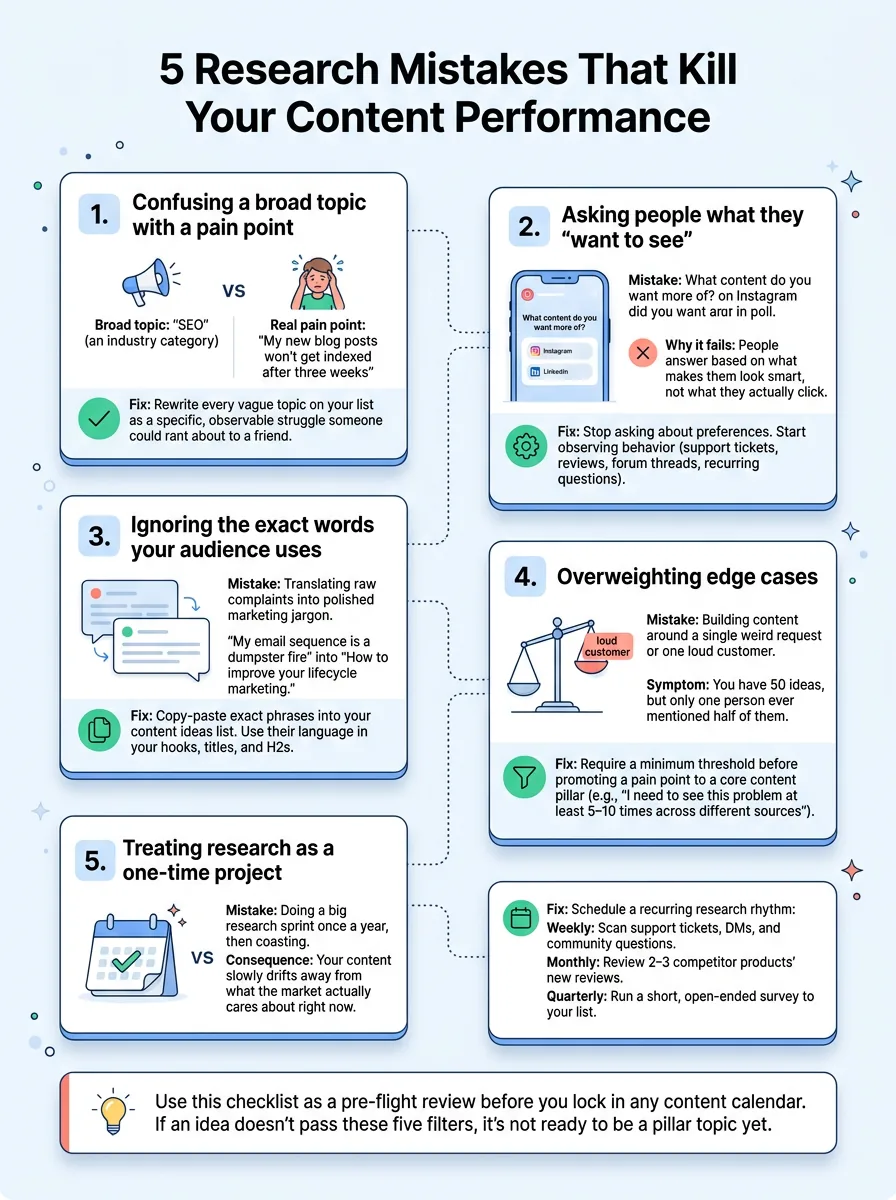
Key takeaways at a glance - Asking your audience "what they want to read."
They are consumers, not creative directors. It is your job to diagnose the problem, not theirs.
- Sanitizing the language.
You use corporate jargon instead of their exact messy words. You lose the emotional hook immediately.
- Worshipping search volume.
Relying solely on keyword search volume while ignoring the intent behind the search guarantees high traffic and zero conversions.
- The "5 Whys" failure.
You stop at the first symptom without digging to the root cause. Even the perfect social media hook system will fail if you are hooking readers on a superficial symptom instead of the cure they actually need.
The Real Struggle: Manual Research vs. Repeatable Insights
We need to be honest about something. Scraping subreddits, reading hundreds of Capterra reviews, and watching Gong calls takes hours.
The real problem isn't knowing how to research audience pain points for content. The problem is doing it consistently at scale without burning out. Most creators do this deep research once, coast on the ideas for a month, and then fall right back into guessing.
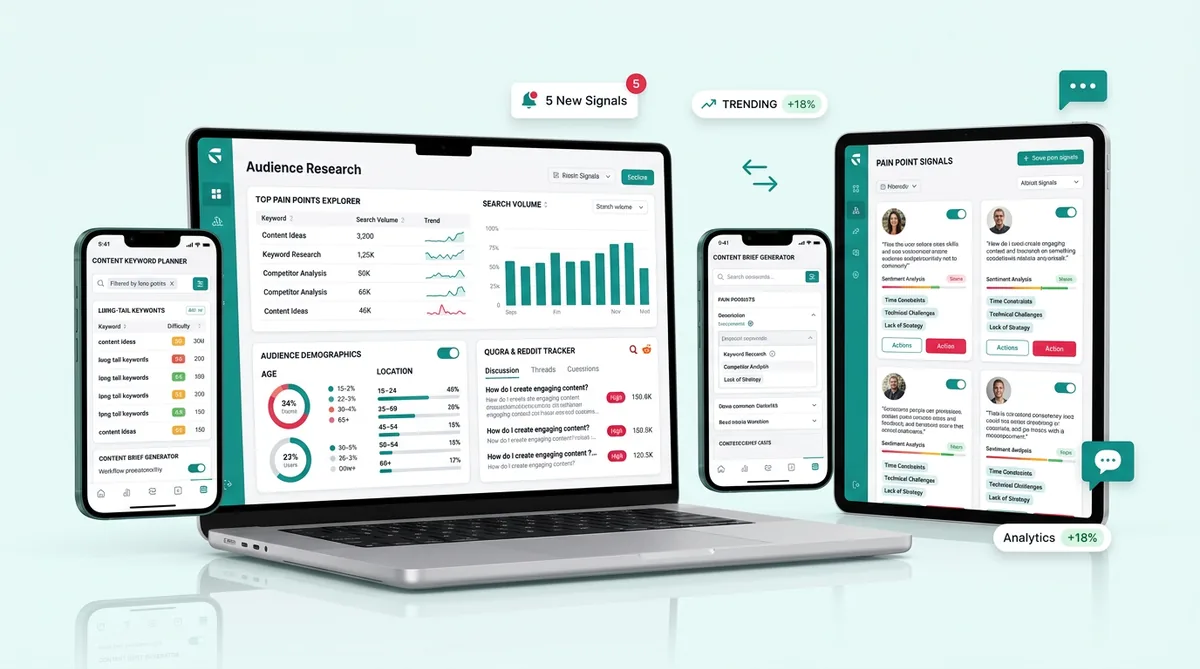
You need consistent, repeatable output. That is why serious creators stop doing this entirely by hand. Instead, they use a dedicated research generator to instantly scan top-performing content across platforms like TikTok, LinkedIn, and X. It analyzes what's working right now and outputs curated trend reports matched directly to your niche. You get the insights of hours of manual research handed to you in seconds, letting you focus on actually creating the content.
Frequently Asked Questions About Audience Pain Points
What is an example of a customer pain point?
A true pain point highlights a specific friction in a process. Instead of "marketing is hard," a real pain point is "I spend three hours formatting my weekly newsletter and still get format errors on mobile devices."
How do you identify B2B vs B2C pain points?
B2C pain points are usually tied to status, personal time, or individual emotion. B2B pain points are almost exclusively tied to revenue loss, team inefficiency, or compliance risks. You identify them by looking at where the respective buyer is bleeding money or time.
What questions should I ask to find pain points?
Avoid "yes/no" questions. Ask: "What is the most frustrating part of your current workflow?", "What solution did you try before this that failed?", and "What task takes up the most time in your day?"
How often should I research my audience?
Audience listening should be a continuous background process, not a yearly event. Formal deep-dives should happen quarterly, but you should be mining comments and support tickets weekly to catch shifting trends early.
Final Thoughts: Stop Guessing, Start Listening
Discover What Your Audience Wants
Find trending topics and content ideas that resonate with your followers.
Try Research GeneratorHigh-converting content is never guessed in a vacuum. It is deeply rooted in the raw, messy reality of your audience's daily struggles. Commit to making audience listening a weekly habit, and watch your engagement transform.