Why Curiosity Hooks are Your Secret Engagement Weapon
Imagine you spend three hours scripting, shooting, and editing a video. You hit publish, wait an hour, and check the analytics. Crickets. You dig into the retention graph and realize 80% of your viewers scrolled past in the first three seconds. Sound familiar?
Jump to a section:
- Why Curiosity Hooks are Your Secret Engagement Weapon
- Quick Answer: What are Curiosity Hooks and Who Should Use Them?
- How to Customize These Swipe Files for Your Specific Audience
- Group 1: The 'Information Gap' Hooks for High-Traffic Blog Posts
- Group 2: Psychological 'Open Loop' Hooks for Email and Social Media
- Group 3: Benefit-Driven Curiosity for Landing Pages and Ads
- 5 Mistakes That Kill Your Click-Through Rate
- From Manual Hook Writing to Repeatable Engagement Systems
- Frequently Asked Questions About Curiosity Hooks
- Summary: Start Hooking Your Readers Today
The harsh truth is that your core content wasn't the problem. Your opening was.
Most creators lose their audience before the value even begins because they state plain facts instead of sparking questions. The human brain is hardwired to seek answers to incomplete information. When you master curiosity hook examples, you stop guessing what might work. You tap directly into psychological triggers that force people to stop scrolling, read the next line, and signal to the algorithm that your content matters.
Quick Answer: What are Curiosity Hooks and Who Should Use Them?
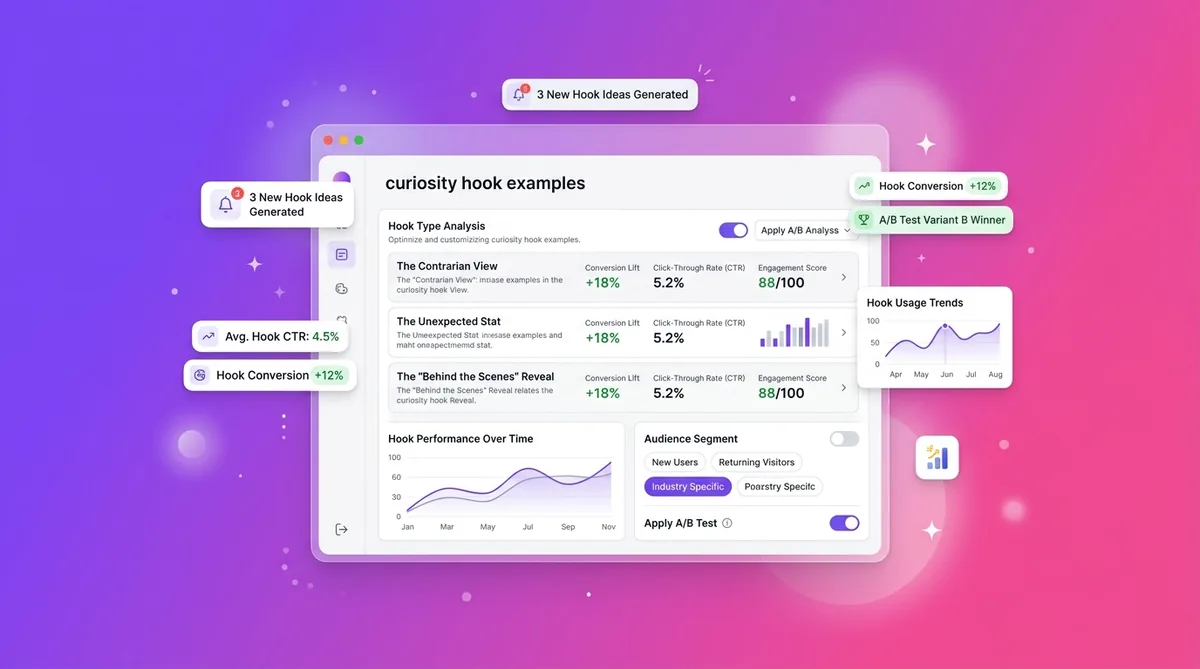
Curiosity hooks are psychological triggers used in the first sentence of content to create an "information gap." They present a highly desirable piece of information or an unexpected outcome without immediately revealing the answer. Every creator, founder, and marketer needs them to break through feed fatigue, command attention, and drive higher click-through rates.
How to Customize These Swipe Files for Your Specific Audience
Most creators make a critical error when using templates. They copy a viral hook word-for-word, swap in their topic, and expect magic.
In practice, this rarely works. A hook that crushed it for a fitness influencer will fall flat for a B2B SaaS founder because the audience intent is totally different. What actually works is identifying the underlying framework.
You need to pinpoint your audience's specific, agonizing pain point, and position that as the missing information. When you review the templates below, pay close attention to the bracketed variables. Make those variables hyper-specific to your niche. If you are struggling to adapt them, studying a wider variety of social media hook formulas can help you see the structural patterns behind viral content.
Group 1: The 'Information Gap' Hooks for High-Traffic Blog Posts

The concept of the information gap isn't just a marketing trick. According to research published in Harvard Business Review, curiosity triggers the brain's reward system much like a craving for food. When you present a gap between what someone knows and what they want to know, they feel a literal mental itch. The only way to scratch it is to keep reading.
The 'Counter-Intuitive Discovery' Hook
This format creates instant cognitive dissonance. Your reader holds a firm belief about their industry. You present a result that directly contradicts it. The brain cannot handle the conflict, forcing them to pause and resolve the tension.
- Example 1
"You're doing [Common Practice] wrong. Here is the 3-step [New Method] that actually gets [Result]."
- Example 2
"Why [Popular Tool/Strategy] is quietly killing your [Desired Outcome] (and what to do instead)."
- Example 3
"The worst thing you can do for your [Goal] is [Common Advice]. Do this instead."
- Example 4
"I completely stopped [Standard Industry Practice]. Here is exactly what happened to my [Metric]."
Notice the specificity. Specific numbers and direct challenges trigger pattern recognition. Vague claims get ignored.
The 'Hidden Pattern' Identification Hook
People love the idea that success is a formula they just haven't discovered yet. These copy/paste templates suggest a secret system that connects top performers.
- Example 5
"I analyzed 100 successful [Subject/People], and found 1 bizarre pattern almost all of them share."
- Example 6
"There is a hidden reason why [Competitor/Top 1%] keeps winning. It has nothing to do with [Common Excuse]."
- Example 7
"The [Number]-step framework behind every viral [Content Type/Result] this year."
- Example 8
"Look at any successful [Role]. You'll notice they all exploit this one simple [Tactic]."
Group 2: Psychological 'Open Loop' Hooks for Email and Social Media
If you write for X, LinkedIn, or email newsletters, you rely heavily on the Zeigarnik effect. This is the psychological principle stating that people remember uncompleted tasks better than completed ones. Opening a loop forces retention. High retention tells the algorithm your post is valuable, which pushes it to more feeds.
The 'Unfinished Story' Opening
Drop the reader right into the middle of a high-stakes moment. Don't warm up. Just start the story.
- Example 9
"I was staring at my screen, about to lose $[Amount], when I realized my entire strategy was backwards."
- Example 10
"We tried [Extreme Action] so you don't have to. The results were terrifying."
- Example 11
"Three years ago I was [Negative State]. Today I'm [Positive State]. The turning point was one weird conversation."
- Example 12
"It took me [Timeframe] to learn this the hard way. You can learn it in 2 minutes."
The 'Specific Failure' Lesson
Loss aversion is stronger than the desire for gain. Highlighting a specific mistake triggers an intense fear of missing out or repeating the same embarrassing error.
- Example 13
"The biggest mistake I made when scaling my [Business/Project]? Assuming [Common Belief] was true."
- Example 14
"99% of [Audience] fail at [Goal] because they ignore this one boring detail."
- Example 15
"I wasted [Resource] on [Bad Strategy]. Here is the framework I wish I had day one."
- Example 16
"If your [Metric] isn't growing, you are probably making this invisible mistake."
Group 3: Benefit-Driven Curiosity for Landing Pages and Ads
Landing pages and paid ads require a different mechanism. You are asking for a higher commitment (a click away from the platform or an email opt-in). You must blend a massive, highly specific promise with a mysterious execution method.
The 'Strange Solution' to a Common Problem
This shows the reader you understand their daily struggle, but offers an escape route they haven't tried yet.
- Example 17
"How to get [Big Result] without [Major Pain Point] (Even if you [Common Objection])."
- Example 18
"Stop wasting time on [Old Method]. Do this 5-minute [New Routine] instead."
- Example 19
"The strange 2-step system we use to bypass [Industry Bottleneck]."
- Example 20
"A completely legal way to steal your competitor's [Metric/Traffic] using [Unusual Tool]."
The 'Exclusive Access' Tease
Everyone wants to feel like an insider. These hooks use the psychology of the 'inner circle' to make readers feel they are about to learn something elite.
- Example 21
"The exact [Framework/Template] 1% of [Professionals] use to [Achieve Goal]."
- Example 22
"Inside the private strategy document that generated [Specific Metric] in [Timeframe]."
- Example 23
"What the top agencies know about [Topic] that you don't."
- Example 24
"I'm leaking the exact swipe file we used to close [Result]."
5 Mistakes That Kill Your Click-Through Rate
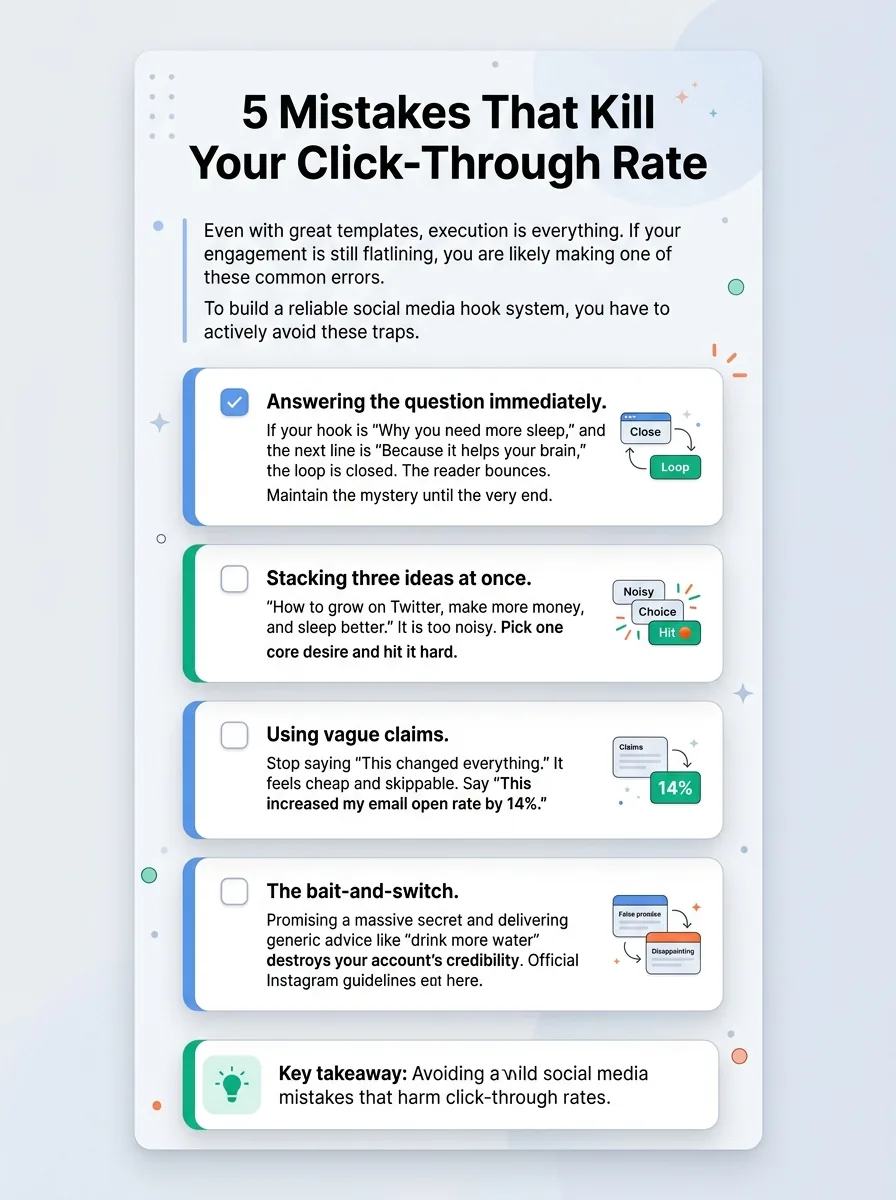
Even with great templates, execution is everything. If your engagement is still flatlining, you are likely making one of these common errors. To build a reliable social media hook system, you have to actively avoid these traps.
- Answering the question immediately.
If your hook is "Why you need more sleep," and the next line is "Because it helps your brain," the loop is closed. The reader bounces. Maintain the mystery until the very end.
- Stacking three ideas at once.
"How to grow on Twitter, make more money, and sleep better." It is too noisy. Pick one core desire and hit it hard.
- Using vague claims.
Stop saying "This changed everything." It feels cheap and skippable. Say "This increased my email open rate by 14%." Precision builds trust.
- The bait-and-switch.
Promising a massive secret and delivering generic advice like "drink more water" destroys your account's credibility. Official Instagram guidelines explicitly state that their algorithm downranks content that uses engagement bait without delivering value.
- Ignoring audience awareness.
Using a beginner hook on an advanced audience is a fast way to get scrolled past. Match your hook to your audience's actual skill level.
From Manual Hook Writing to Repeatable Engagement Systems
The real problem isn't knowing what a good curiosity hook looks like. It is producing enough quality variations consistently without spending an hour per post staring at a blinking cursor.
Writing one perfect opening line takes energy. Writing 20 variations so you can test them takes an afternoon. That is why smart creators stop relying on raw inspiration and start relying on systems to generate options at scale.
Instead of drafting from scratch every single time, a hook generator lets you simply describe your topic, pick a style preference like 'curiosity' or 'contrarian', and instantly get multiple scroll-stopping variations. You just choose the best one, tweak it to your voice, and hit publish.
Start creating viral content today
Join other creators who've transformed their social media presence with AI-powered content.
Start creating nowFrequently Asked Questions About Curiosity Hooks
How long should a curiosity hook be?
Keep it under 15 words if possible. On platforms like X or LinkedIn, your hook needs to fit entirely before the "See more" cutoff. Brevity forces clarity.
Do curiosity hooks work in B2B content?
Yes. B2B buyers are still human beings whose brains respond to information gaps. The key is shifting the "missing information" away from lifestyle desires and focusing it on operational efficiency, revenue growth, or competitor blind spots.
Are curiosity hooks considered clickbait?
Not if you deliver on the promise. Clickbait is a broken promise. A curiosity hook is simply a compelling invitation to consume valuable information.
Summary: Start Hooking Your Readers Today
Write Hooks That Stop the Scroll
Generate attention-grabbing opening lines that make people stop and read.
Try Hook GeneratorYour content is only as good as the number of people who actually consume it. Stop leaving your engagement to chance. Pick three templates from this list, adapt them to your specific niche, and test them on your next posts.