Stop Staring at a Blank Screen: Why Top Creators Use Systems, Not Luck
We have all been there. You sit down for your dedicated content batching time. You open a fresh document. The cursor blinks at you. You blink back. Twenty minutes later, you have written “Top 3 tips for…” and deleted it twice. Staring at a blank screen is the quickest way to kill your creative momentum.
Jump to a section:
- Stop Staring at a Blank Screen: Why Top Creators Use Systems, Not Luck
- Quick Answer: How to Use This Content Swipe File
- The 3-Step Process for Customizing These Templates
- Template Group 1: The 'Authority & Educational' Pillar
- Template Group 2: The 'Storytelling & Vulnerability' Pillar
- Template Group 3: The 'Engagement & Opinion' Pillar
- 5 Critical Mistakes That Kill Your Content Results
- Beyond the Swipe File: From Manual Brainstorming to Repeatable Systems
- Frequently Asked Questions About Content Ideation
- Start Turning Ideas into Published Posts Today
If you are wondering how to find content ideas for social media without losing your mind, you are not alone. It is the single biggest bottleneck for most founders and marketers. Most creators wait for inspiration to strike. They scroll their feeds hoping a brilliant hook will magically appear.
Top creators don't.
They use repeatable frameworks instead of relying on raw inspiration. Once you have a bank of proven templates, knowing how to plan a week of social media content fast becomes the easiest part of your job. You don't need more random ideas. You need better constraints.
Quick Answer: How to Use This Content Swipe File
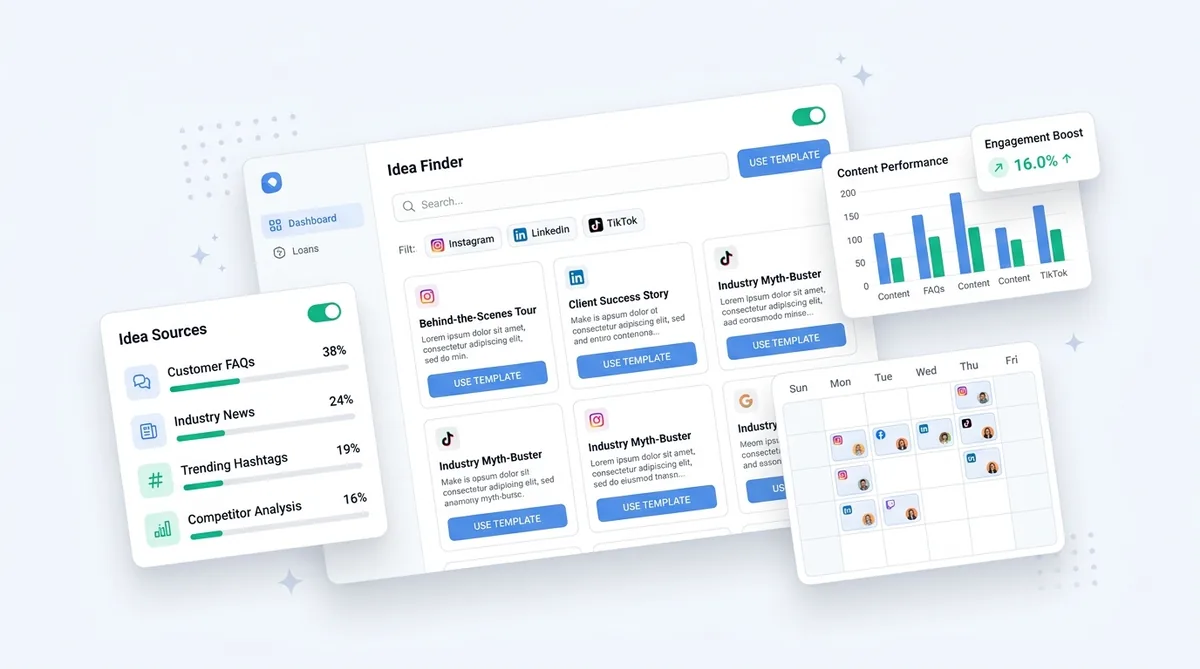
To find content ideas for social media efficiently, treat this swipe file like a restaurant menu rather than a rigid script. Pick a framework, inject your specific niche data, and swap the generic variables for real examples. These templates are engineered specifically for B2B SaaS, solo-entrepreneurs, and marketers who need to build authority fast.
The 3-Step Process for Customizing These Templates
Generic templates are useless if they sound like everyone else in your feed. Here is exactly what you do to make them yours.
First, identify the core struggle. Before you copy a prompt, figure out exactly what keeps your ideal follower up at night. Figuring out how to research audience pain points is mandatory. If you skip this, your content will flop regardless of how good the hook is.
Next, map that specific problem to the right framework. If the problem is technical, use an educational breakdown. If it is an emotional struggle, use a vulnerability story.
Finally, inject your unique data point. Do not just say you got "great results." Say you dropped client churn from 12% to 3%. Specificity builds trust.
Template Group 1: The 'Authority & Educational' Pillar
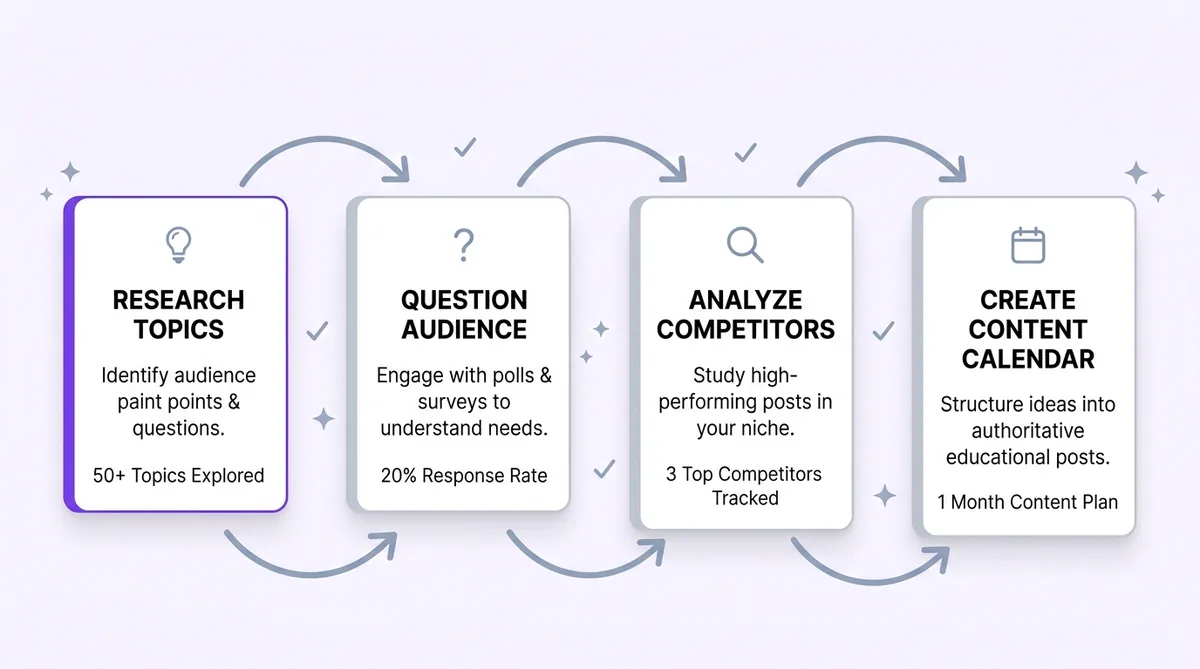
This group is about proving you actually know what you are talking about. You want to give away your secrets.
The 'Step-by-Step' Process Framework
Why do step-by-step breakdowns perform so well? Human brains crave cognitive ease. A giant block of text is overwhelming and causes users to scroll past. A numbered list reduces cognitive load, silently telling the reader that this complex problem is solvable. People also hit 'save' on step-by-step posts to use them as a bookmark, which sends massive positive signals to social algorithms. According to a Sprout Social breakdown on algorithm ranking factors, saves and shares heavily influence your total organic reach.
Here are a few ways to structure this:
- The Transformation
"How I went from [Bad State] to [Good State] in [Timeframe]. A simple [Number]-step process:"
- The Client Win
"We just helped a [Niche] client achieve [Specific Result]. I can't share the client's name, but I can share the exact 4 steps we used:"
- The System
"Stop wasting time on [Common Task]. Here is the [Number]-step system I use to automate it:"
For example, a fitness coach shouldn't write "How to lose weight." They should write, "How I helped a busy dad lose 15lbs in 90 days without giving up beer. A simple 3-step protocol:"
The 'Tool Stack' Reveal Swipe
People love shiny objects and behind-the-scenes access. They want the shortcut.
The Prompt: "Everyone asks what software I use to run my [Industry] business. I test dozens of apps so you don't have to. Here is my exact, minimal tool stack for 2024:"
List the tool, and more importantly, one sentence on why you use it. Do not just list the names. Explain the exact workflow it solves for you.
Template Group 2: The 'Storytelling & Vulnerability' Pillar
Educational content proves you are smart. Vulnerable content proves you are human. You need both.
The 'Mistake I Made' Vulnerability Template
Sharing a failure triggers the empathy gap. It hooks readers because they secretly want to know if they are making the exact same mistake. It creates a high-retention post because the audience waits for the resolution.
The Prompt: "My biggest mistake when I first started in [Industry]? [Specific Mistake]. It cost me [Quantifiable Loss in Time or Money]. Here are the 3 things I do differently now to prevent it:"
A real estate agent might write: "My biggest mistake when I started selling commercial real estate? Skipping the environmental review on a rush deal. It cost my client $40,000 and cost me a relationship. Here is the checklist I now refuse to compromise on."
The 'Client Transformation' Narrative
Show, rather than tell. Stop telling people your coaching program works. Tell the story of Sarah.
The Prompt: "[Client Name/Type] came to me completely burned out from [Specific Pain Point]. Within [Timeframe], they achieved [Specific Result]. The secret wasn't [Common Myth]. It was this one subtle shift we made in week two:"
Narrative arcs keep people reading until the end. High read-through rates signal high quality to the platform.
Template Group 3: The 'Engagement & Opinion' Pillar
Sometimes you do not want to teach. You just want to start a conversation. These templates are designed to farm comments through friction.
The 'Unpopular Opinion' Conversation Starter
Contrarian takes work because they polarize the audience. You force people to pick a side. They will either comment to violently agree with you, or comment to tell you why you are wrong. Both count as engagement.
The Prompt: "Unpopular opinion: [Common Industry Practice] is actually hurting your [Desired Result]. Here is why you should do [Contrarian Action] instead. Let me know why I'm wrong in the comments."
Just make sure you actually believe the opinion. Fake hot takes are easy to spot and damage your credibility.
The 'Comparison VS' Comparison Framework
Take two popular methods in your industry and pit them against each other.
The Prompt: "The ultimate debate: [Option A] vs [Option B]. I have tried both extensively. Here is my brutally honest breakdown of which actually works better for [Target Audience]:"
A marketer might compare SEO vs Paid Ads for new agencies. A developer might compare React vs Vue for solo-founders. It works in every niche.
5 Critical Mistakes That Kill Your Content Results
Why do most people still fail to get results even when they have a swipe file? Because they execute the templates poorly. Here are the specific mistakes to avoid.
Mistake 1: Stacking three ideas in one opening line. You want to be clear, not clever. If your hook tries to talk about productivity, mindset, and revenue all at once, the reader will scroll. Pick one single angle per post.
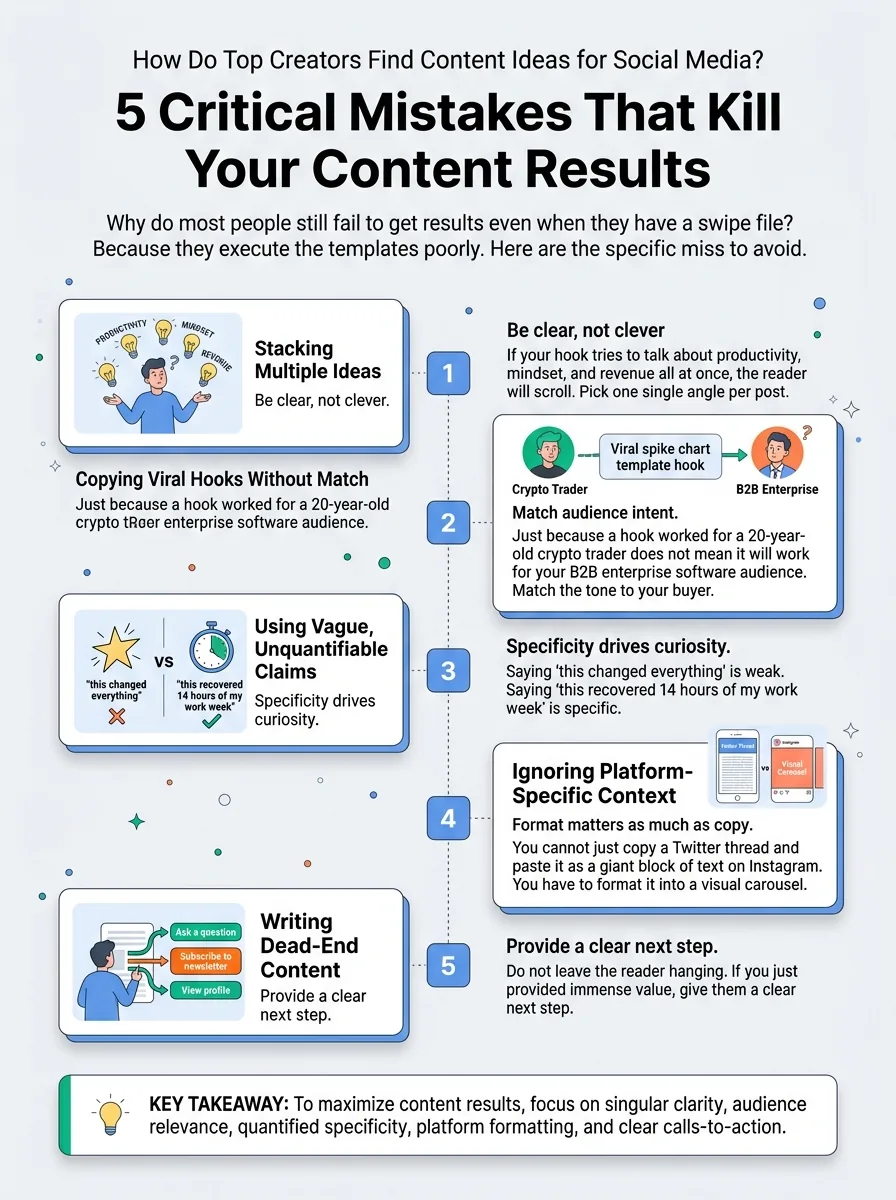
Mistake 2: Copying viral hooks without matching audience intent. Just because a hook worked for a 20-year-old crypto trader does not mean it will work for your B2B enterprise software audience. Match the tone to your buyer.
Mistake 3: Using vague, unquantifiable claims. Saying "this changed everything" is weak. Saying "this recovered 14 hours of my work week" is specific. Specificity drives curiosity.
Mistake 4: Ignoring platform-specific context. You cannot just copy a Twitter thread and paste it as a giant block of text on Instagram. You have to format it into a visual carousel. Context matters just as much as the copy.
Mistake 5: Writing dead-end content. Do not leave the reader hanging. If you just provided immense value, give them a clear next step. Ask a question, direct them to your newsletter, or point them to your profile.
Beyond the Swipe File: From Manual Brainstorming to Repeatable Systems
Look, templates are incredibly helpful. But the real problem isn't knowing what a good hook looks like. It is producing enough quality variations consistently without spending three hours a day on it.
When you do this entirely manually, you eventually run out of gas. You spend hours scrolling TikTok and LinkedIn, trying to guess what topics will hit, saving random links to a messy spreadsheet. It is exhausting.
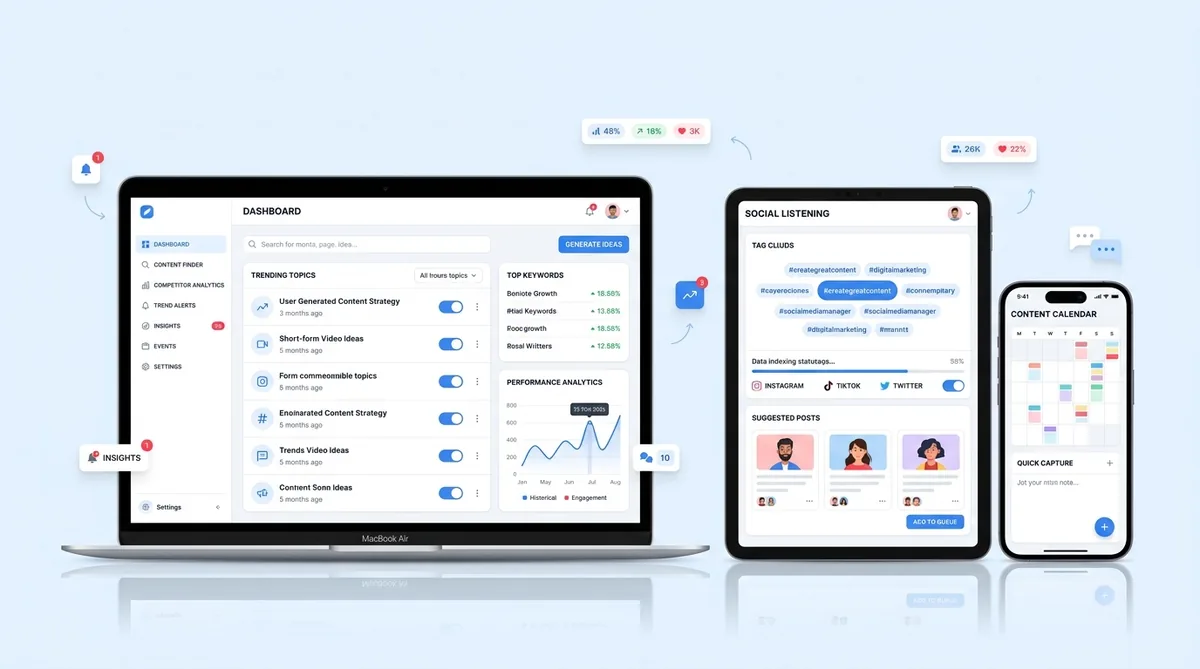
That is why serious creators automate the initial ideation phase to produce multiple options fast. If you are tired of guessing, a research generator can analyze cross-platform trends and give you curated reports with post ideas matched directly to your audience.
You just tell the system your niche and target audience. The AI scans top-performing content across platforms and outputs specific content angles that are already proven to work right now. You take those proven angles, drop them into the templates above, add your personal stories, and you are done.
Start creating viral content today
Join other creators who've transformed their social media presence with AI-powered content.
Start creating nowFrequently Asked Questions About Content Ideation
How often should I post on social media?
Consistency matters more than volume. It is better to post three high-quality, well-formatted pieces of content a week than to post garbage every single day just to check a box. Find a cadence you can sustain for six months without burning out.
What if I feel like my niche is too boring for social media?
There are no boring niches, only boring angles. If you sell commercial insurance, do not post about policies. Post about the massive, million-dollar mistakes business owners make because they didn't read the fine print. Find the human drama in your industry.
Where do I find trending topics before they peak?
Pay attention to the questions your clients ask you on sales calls or in your support inbox. If one person is asking it privately, thousands of people are searching for it publicly. That is your best source of relevant trends.
Start Turning Ideas into Published Posts Today
Stop hoarding ideas in your notes app and waiting for the perfect moment. Pick one single template from this list right now. Draft your version, add your unique perspective, and hit publish today.
Discover What Your Audience Wants
Find trending topics and content ideas that resonate with your followers.
Try Research Generator