The 'One-and-Done' Trap of Modern Podcasting
Imagine this scenario. You spend three hours researching a guest. Another two recording. Then you edit out all the awkward pauses, write show notes, and hit publish on your newest podcast episode.
Jump to a section:
- The 'One-and-Done' Trap of Modern Podcasting
- Quick Answer: How to Effectively Repurpose Podcast Content
- The Friction Factor: Why Most Creators Fail at Social Distribution
- Strategy 1: Transform Audio into Short-Form 'Value Clips'
- Strategy 2: Convert Transcripts into Authority-Building Carousels
- Strategy 3: Repurpose Powerful Quotes into Aesthetic 'Statement' Posts
- The 14-Day 'Test and Pivot' Testing Method
- 5 Mistakes That Kill Your Content Performance
- Bridging the Gap: From Manual Hustle to Scalable Systems
- FAQ: Master the Podcast-to-Social Workflow
- Conclusion: Build an Ecosystem, Not a Silo
You tweet the Spotify link.
Crickets. 14 downloads. 12 of them are your mom refreshing the page.
Sound familiar?
Most creators fall into the 'one-and-done' trap of modern podcasting. They treat the publish button like the finish line. But what nobody tells you is that your raw episode is just inventory. The real growth happens when you figure out how to repurpose a podcast into social media posts that actually command attention in the feed.
Quick Answer: How to Effectively Repurpose Podcast Content
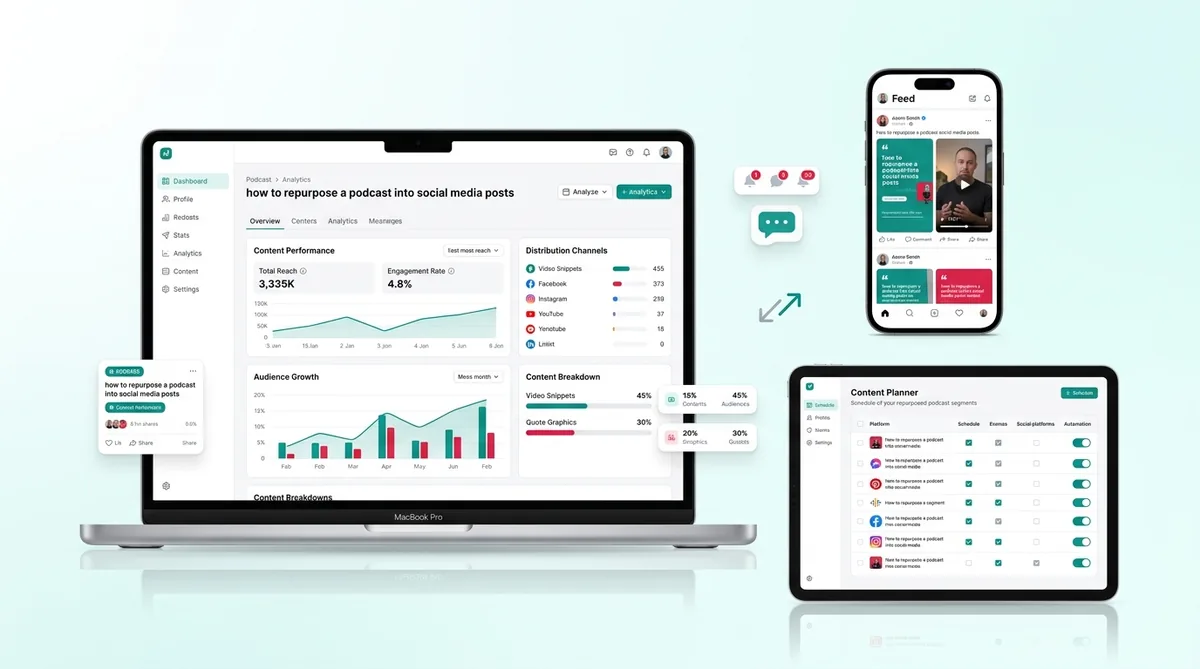
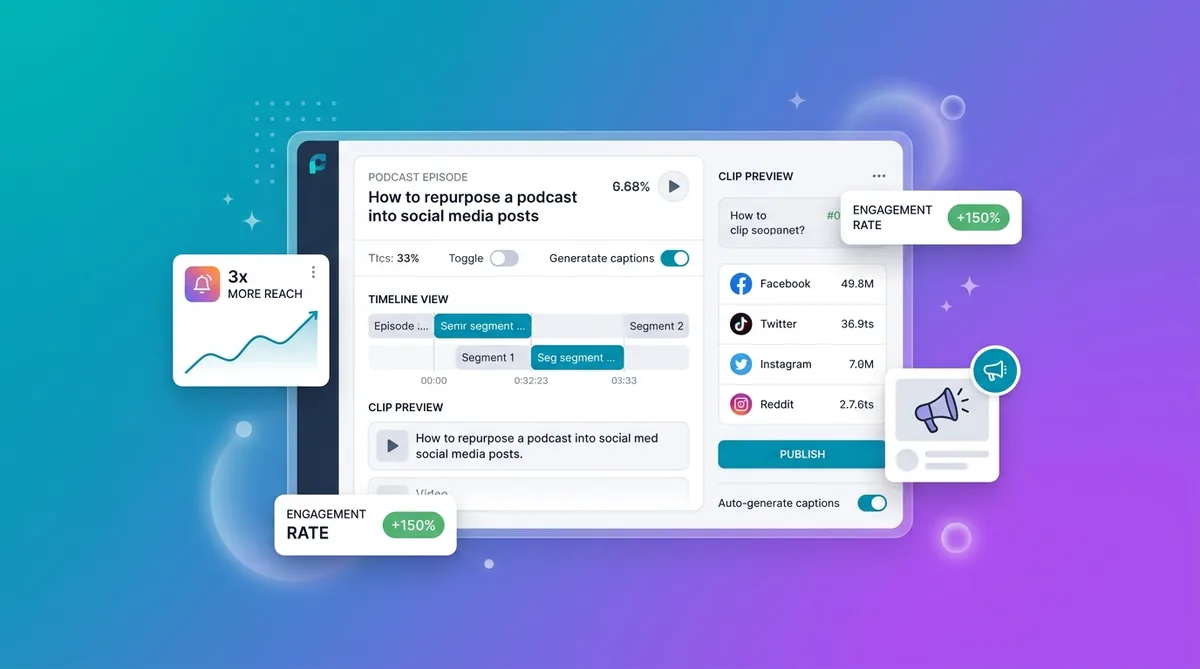
To successfully figure out how to repurpose a podcast into social media posts, you must extract standalone 'value clips' for TikTok and Reels, convert transcripts into readable LinkedIn carousels, and turn compelling quotes into text-based posts. The goal is matching your audio's core insights to each visual platform's native format.
The Friction Factor: Why Most Creators Fail at Social Distribution
You already know you should be chopping up your episodes. So why is it so hard?
It boils down to platform friction.
People opening Spotify or Apple Podcasts are actively choosing to spend 45 minutes with you. They have the intent to listen. People opening Instagram or X are looking for quick dopamine hits while waiting in line for coffee. They are scanning, not settling in.
When you just post a link to your episode, you're asking a scroller to completely change their behavior, leave the app, and invest an hour of their time. The algorithm actively punishes this. Social networks want users to stay on their platform, so they throttle posts containing external links.
To win, you have to adopt a social-first mindset. You bring the best 1% of the podcast directly to the feed. Native content only.
Strategy 1: Transform Audio into Short-Form 'Value Clips'
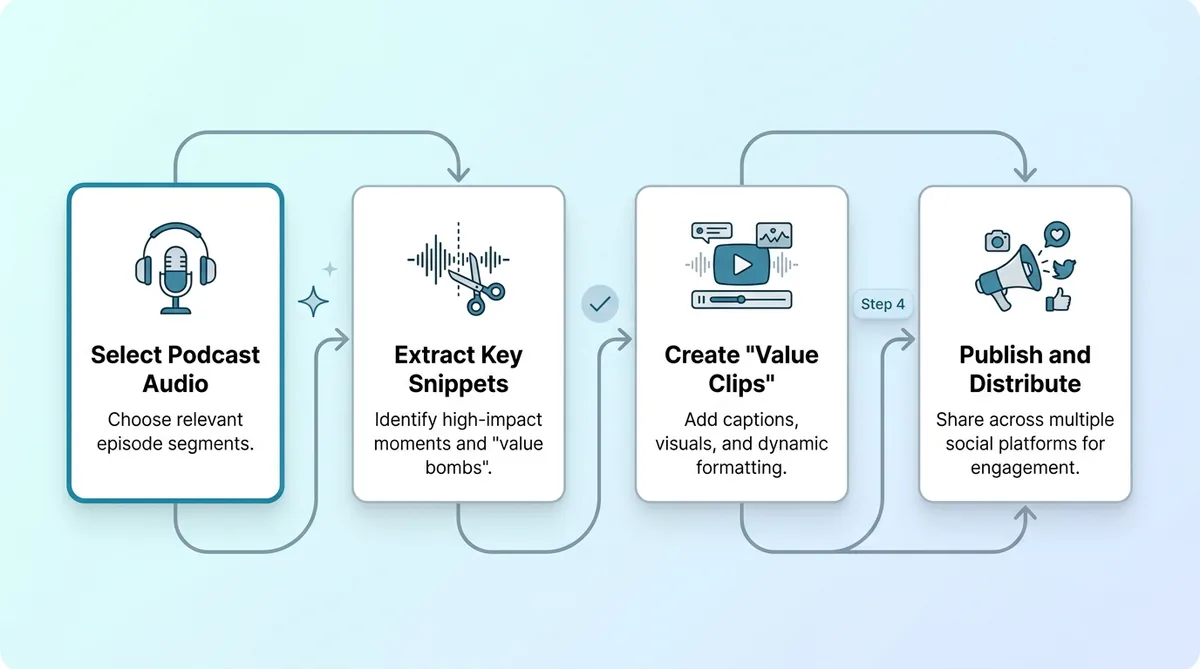
If you want to understand how to repurpose a podcast into social media posts for maximum reach, short-form vertical video is your primary engine. It is the single most effective way to get your face in front of people who don't know you yet.
But you can't just pick a random 60-second chunk.
Short-form algorithms operate entirely on watch time and retention. If a user swipes past your video in the first 3 seconds, the platform stops showing it to others. You have to be strategic about what you cut.
Identify the 'Aha' Moment for Maximum Retention
Your job is to find the aha moment. This is a 30 to 60-second window where your guest delivers a complete thought. A setup, a conflict, and a resolution.
If the clip starts with "Like I was saying earlier..." you have already lost. That phrasing requires external context the viewer doesn't have.
Instead, find the exact moment the energy shifts. Cut the clip right when the guest makes a controversial claim or drops a counterintuitive fact. That creates a curiosity gap. The viewer's brain needs to hear the explanation, so they stick around. This signals high relevance to the algorithm, triggering it to push your video to a wider audience.
Optimize for Silent Viewing with Dynamic Captions
Here is a reality check. Most people aren't even listening to your audio.
According to internal Facebook data, a massive percentage of video content on mobile is consumed with the sound off. If you post a video of two people talking with no text, you are invisible to silent scrollers.
You need dynamic captions. Not just a tiny block of text at the bottom. Make the text large, center-screen, and highlight the active word as it is spoken. This forces the viewer's eyes to track the movement, artificially boosting your watch time just because they are reading along.
Strategy 2: Convert Transcripts into Authority-Building Carousels
Video is great for reach, but text is how you build authority.
When creators ask me how to repurpose a podcast into social media posts for B2B audiences, my immediate answer is LinkedIn and Instagram carousels. Transcripts are absolute goldmines for this format.
Just like figuring out how to repurpose blog posts into social media posts, you aren't just copying and pasting paragraphs. You are extracting frameworks and making them digestible.
Start creating viral content today
Join other creators who've transformed their social media presence with AI-powered content.
Start creating nowThe 'Listicle' Framework for LinkedIn Slides
Let's say your podcast episode was about scaling a freelance business. Your guest probably rambled for ten minutes about client acquisition before hitting the core points.
Read the transcript and find the structural beats to build out a deck.
Slide 1 is your hook. Make it specific: "My guest scaled to $10k/month. Here is her exact 5-step client acquisition system."
Slides 2 through 6 each get one specific step. Keep the text under 40 words per slide.
Slide 7 is the payoff and a call to action directing them to the full episode.
The mechanism here is completion rate. Carousels require users to physically tap or swipe through. Every swipe is an active engagement signal telling the algorithm the content is valuable. By breaking a long audio segment into distinct, scannable slides, you turn a passive listening experience into an active reading one.
Strategy 3: Repurpose Powerful Quotes into Aesthetic 'Statement' Posts
Sometimes the most impactful piece of a 60-minute interview is a single sentence.
Look for punchy, definitive statements. Something like, "You don't have a traffic problem, you have a conversion problem."
These text-based statement posts work because they trigger social proof and relatability. When someone agrees with a bold claim, they share it to their own stories or retweet it to signal their own identity to their followers. It becomes a badge they wear on their profile.
Pair Bold Text with Brand-Consistent Backgrounds
Don't overcomplicate the design. Slap the quote on a high-contrast background that matches your brand colors. Add a small headshot of the guest and their handle.
In practice, I've seen simple text graphics outperform highly produced video clips simply because they take less than a second to consume. The friction to read, agree, and share is basically zero. You get massive distribution for a fraction of the editing effort.
The 14-Day 'Test and Pivot' Testing Method
You shouldn't guess what your audience wants. You should test it.
Take one killer podcast episode and extract 10 different social assets. Maybe that looks like three short videos, four text quotes, two carousels, and one long-form written post.
Schedule them out over two weeks.
Watch the metrics closely. If the text quotes bomb but the carousels get saved and shared, you now have a data-backed directive. Double down on carousels for the next episode. And before you start driving all that new traffic to your profile, make sure an outdated social media bio isn't costing you followers.
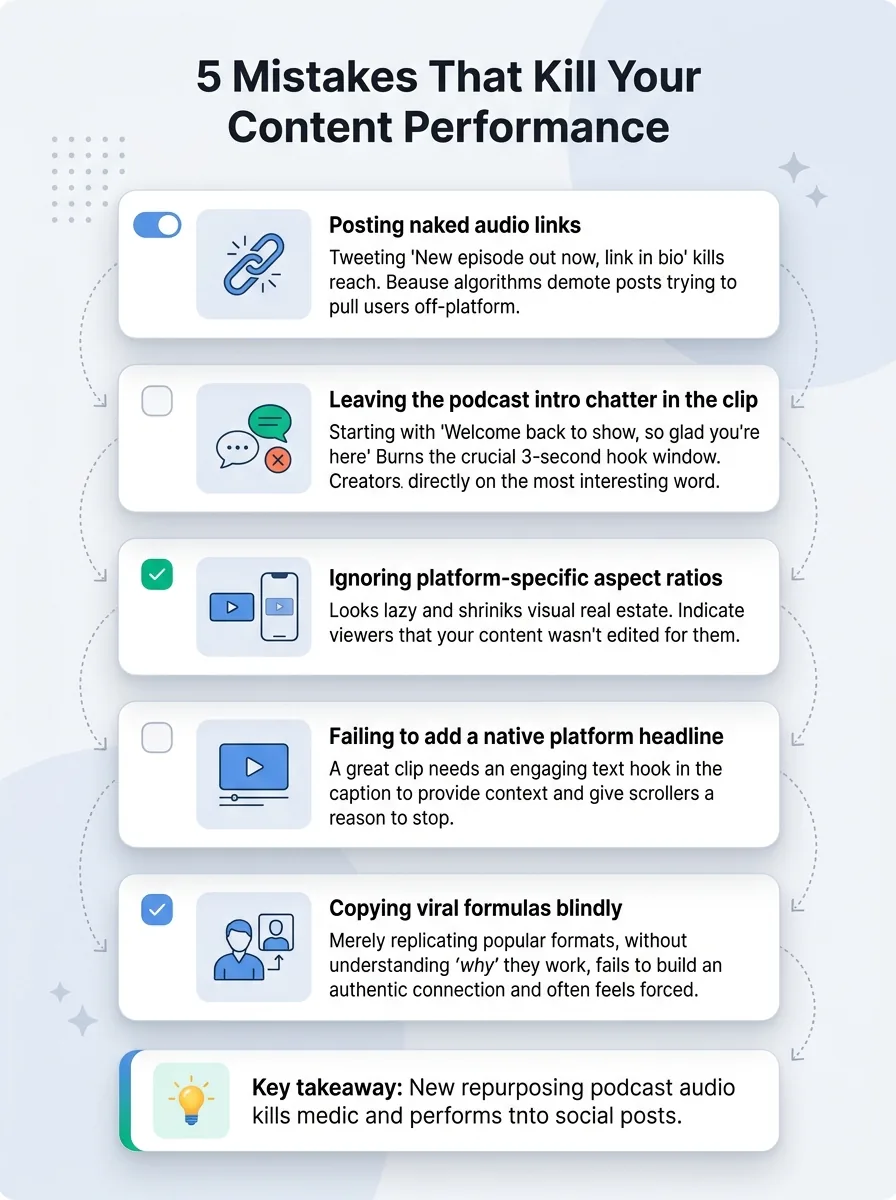
5 Mistakes That Kill Your Content Performance
Most people still don't get results when trying to repurpose long-form audio. I see the same execution errors every single day. Check yourself against these common mistakes.
- Posting naked audio links.
Tweeting "New episode out now, link in bio" is the fastest way to kill your reach. The algorithm intentionally demotes posts that try to pull users off-platform.
- Leaving the podcast intro chatter in the clip.
Starting a social video with "Welcome back to the show, so glad you're here" burns the crucial 3-second hook window. Start directly on the most interesting word.
- Ignoring platform-specific aspect ratios.
Uploading a horizontal YouTube video onto a vertical TikTok feed looks lazy. It shrinks your visual real estate and tells the viewer you didn't edit this for them.
- Failing to add a native platform headline.
A great video clip still needs an engaging text hook in the caption to give context. Without a headline, scrollers have no reason to stop.
- Copying viral hooks that don't match the audio.
Don't slap "This changes everything" on a video about standard accounting practices. Bait-and-switch tactics destroy your viewer retention metrics.
Bridging the Gap: From Manual Hustle to Scalable Systems
The real problem isn't knowing what good content looks like. It is the execution.
Chopping up an hour of audio, reading through messy transcripts, rewriting concepts for LinkedIn, and formatting tweet threads takes hours. You eventually hit a wall where you're spending more time formatting than actually creating new ideas. It leads straight to creator burnout.
That is why creators use dedicated generators to produce multiple options fast, then choose the best one. I use a repurpose generator where you just paste your podcast transcript, select your target platforms, and it instantly builds out your LinkedIn carousels, TikTok scripts, and tweet threads based on the core narrative.
FAQ: Master the Podcast-to-Social Workflow
How many social posts should I make from one podcast episode?
Aim for 5 to 10 unique pieces of content. This usually breaks down into 3 short-form videos, 2 text-based posts, 1 carousel, and a few quote graphics.
Which social media platform should I prioritize first?
Focus on the platform where your target audience already hangs out. For B2B, start with LinkedIn carousels and text posts. For consumer topics, prioritize TikTok and Instagram Reels.
What if my podcast audio or video quality is bad?
Lean heavily into text repurposing. Use the transcript to write high-value threads and newsletters. You don't need perfect studio video if the ideas are strong enough to carry a written post.
Conclusion: Build an Ecosystem, Not a Silo
Your podcast is not the final product. It is the raw material.
Repurpose One Post Into 15+
Turn your best content into posts for every platform in seconds.
Try Repurpose GeneratorStop letting your best interviews disappear into the archives after three days. By breaking down your audio into native, platform-specific pieces, you build a constant ecosystem of content that works for you around the clock. That is how you turn a single conversation into compounding audience growth.