
Why Your Instagram Growth Has Suddenly Stalled
You are posting four times a week. You are jumping on trending audio. You are writing long, thoughtful captions. Yet your reach looks like a flatline on a hospital monitor. Sound familiar?
Jump to a section:
- Why Your Instagram Growth Has Suddenly Stalled
- How to Audit Your Instagram Content (The Short Answer)
- Why Diagnosing Your Own Instagram Feed Is So Hard
- System Part 1: The Quantitative Metrics Audit (Finding Your Baseline)
- System Part 2: The Qualitative Aesthetic & Format Review
- System Part 3: The Caption, Hook, and Messaging Analysis
- Strategy 4: The Profile Funnel Optimization (Bio, Highlights, and Link)
- Strategy 5: Competitor Benchmarking (The Gap Analysis)
- Real World Case Studies: Before & After an Instagram Audit
- 5 Mistakes That Render Your Instagram Audit Useless
- The Reality Check: Manual Audits vs. Repeatable Output
- The 3-Part Instagram Audit Checklist
- Frequently Asked Questions About Instagram Audits
- Closing Summary: Consistency Over Perfection
Most creators experience this scenario and immediately blame the algorithm. They assume Instagram is actively hiding their content. The harsh reality is usually staring right back at them from their own grid. When you spend hours crafting a post, you lose total objectivity. You are simply too close to the work to see why it fails.
That is why learning how to audit your Instagram content is a non-negotiable skill if you want to survive. You need a method to step back, strip away your emotional attachment, and find out exactly what the market actually wants. I am going to show you the exact 3-part system I use to diagnose stalled accounts and get them back to growth.
How to Audit Your Instagram Content (The Short Answer)

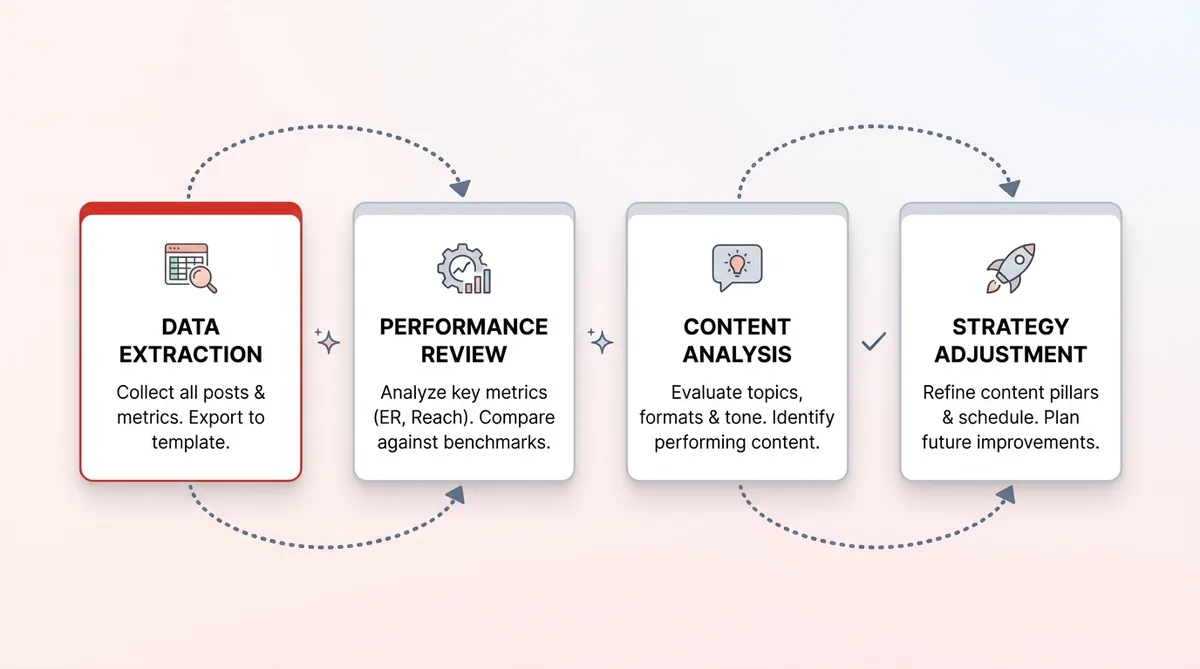
To audit your Instagram content, start by analyzing your 90-day quantitative metrics to identify top performers based on saves and shares. Next, evaluate your visual formatting to ensure aesthetic consistency isn't hurting retention. Finally, optimize your profile funnel—bio, link, and highlights—to convert new visitors into followers. Doing this every 90 days prevents content stagnation.
Why Diagnosing Your Own Instagram Feed Is So Hard
Auditing your own account feels like performing surgery on yourself. It hurts, and you are blind to your own blind spots.
First, there is the emotional attachment. You vividly remember the three hours you spent color-grading that cinematic Reel. So when a blurry, seven-second text video outperforms it, you secretly resent the audience. You try to force the cinematic style anyway. This is a massive mistake.
Then you get distracted by vanity metrics. Likes are cheap dopamine. They trick you into thinking a post was successful when it actually did nothing for your account growth. If you obsess over likes instead of high-intent actions, you end up creating content that gets a polite nod instead of a frantic bookmark. The frustration builds because you feel like you are doing everything right, but the follower count refuses to budge.
Let's break down how to actually fix this.
System Part 1: The Quantitative Metrics Audit (Finding Your Baseline)
Data does not care about your feelings. It strips away all your personal bias and reveals exactly what the algorithm and your audience actually value.
The Psychology of Vanity Metrics vs. Actionable Metrics
You need to understand the mechanism behind how Instagram distributes content. Likes are a passive metric. A user can double-tap your photo while half-asleep on the couch. It requires zero commitment.
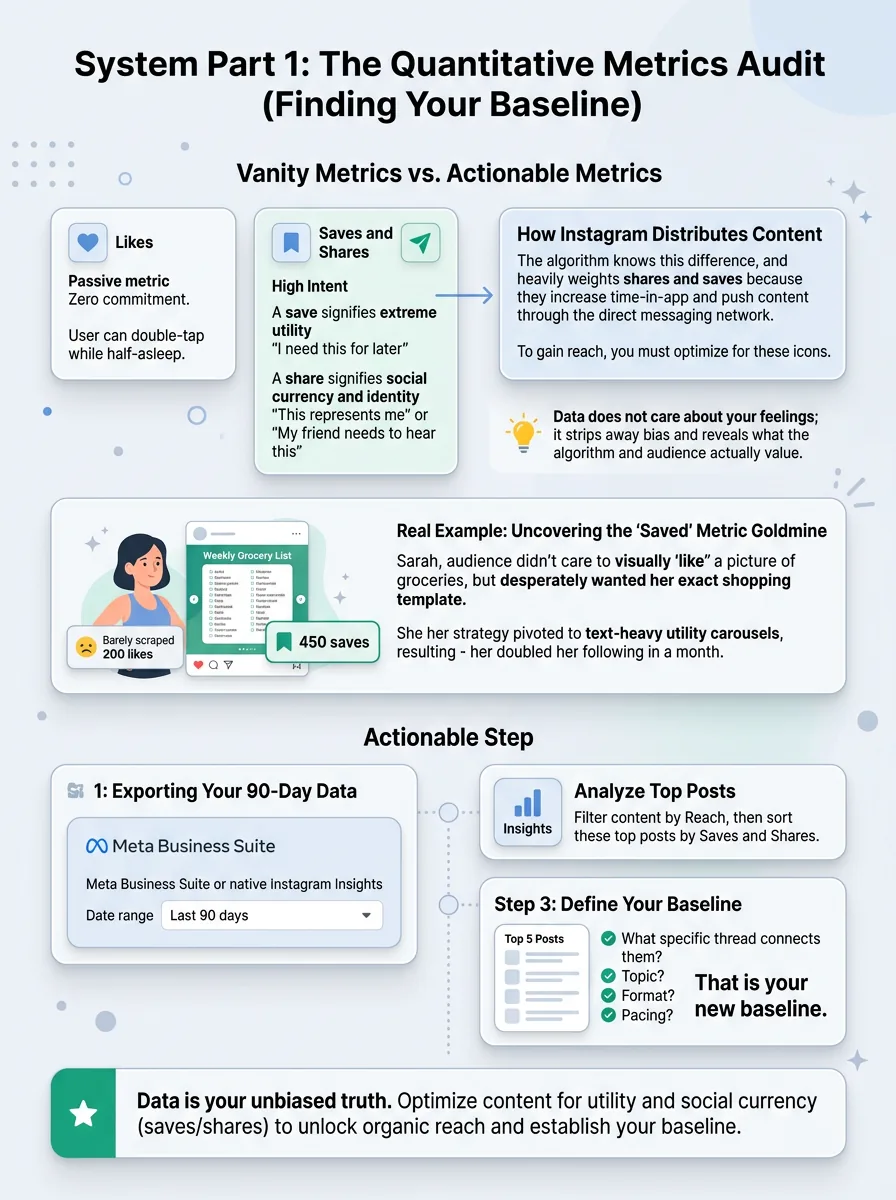
Saves and shares, on the other hand, signal high intent. A save literally means "I need this information for later." It represents extreme utility. A share means "This represents my identity" or "My friend desperately needs to hear this." It represents social currency. The algorithm knows this difference. Instagram's engine heavily weights shares and saves because they increase time-in-app and push content through the direct messaging network. If you want reach, you must optimize for the bookmark and paper plane icons.
Real Example: Uncovering the 'Saved' Metric Goldmine
Take my friend Sarah, a fitness creator. She posted a static carousel breaking down her weekly grocery list. It barely scraped 200 likes, and she was seconds away from deleting it. I told her to check the back-end insights first. She had 450 saves.
Her audience did not care to visually "like" a picture of groceries, but they desperately wanted her exact shopping template. She pivoted her entire strategy to text-heavy utility carousels. She doubled her following in a month.
Actionable Step: Exporting Your 90-Day Data
Open your Meta Business Suite or the native Instagram Insights on your phone. Set the date range to the last 90 days. Filter your content by Reach first, then sort those top posts by Saves and Shares.
Write down the top five posts. Put them side by side. What specific thread connects them? Was it the topic? The format? The pacing? That is your new baseline.
System Part 2: The Qualitative Aesthetic & Format Review
Once you have the raw numbers, you need to look at the packaging. The best information in the world will fail if the visual delivery pushes people away.
Why Visual Consistency Builds Unconscious Trust
This comes down to cognitive load. When a new user lands on your profile, their brain makes a split-second decision based entirely on visual patterns. If your grid is a chaotic mess of ten different fonts, random selfies, and misaligned text, the brain perceives it as high-effort to consume. So they bounce.
Visual consistency lowers that cognitive load. It signals professionalism and authority before they even read a single caption. A Sprout Social report on platform statistics confirms that visual clarity and grid cohesion are massive factors in whether a user decides to follow a brand after their first profile visit.
Real Example: The 'Messy Middle' Feed Clean-Up
I recently audited a B2B SaaS brand's account. Their grid looked like a ransom note. Product screenshots lived right next to low-res office party photos, which sat next to text graphics with zero margin spacing.
We did not reinvent their content. We simply archived the off-brand posts and instituted a strict two-color palette using a single font for all text overlays. Their profile conversion rate jumped 40 percent in two weeks. The content was exactly the same, but it finally looked organized enough to trust.
Decision Rules: When to Archive vs. Keep Older Posts
Do not go on a massive deletion spree. That destroys your historical data. Follow these rules instead.
Archive outdated promotional flyers, blurry personal photos that serve no pillar, and low-performing posts that ruin your current visual hierarchy. Keep high-performing evergreen content even if the branding is slightly old. If a post has massive social proof in the comments, leave it alone. If you spend more than a minute agonizing over whether to delete a post, just leave it up.
System Part 3: The Caption, Hook, and Messaging Analysis
Great visuals get people to stop scrolling. Copywriting gets them to stay.
The Curiosity Gap: Why Most Captions Fail to Retain
The first 3 seconds of a Reel or the very first line of a caption dictates your algorithmic retention. You need to master the curiosity gap. This means giving the reader just enough information to realize they are missing something crucial, but withholding the actual answer until they read further.
Most creators write descriptive hooks. They write "Here is my recipe for chicken." That kills curiosity instantly. There is no tension. There is no reason to stay.
Real Example: A Simple Hook Rewrite That Tripled Reach
Look at the difference between these two approaches. A generic hook says: "Here are 3 tips for SEO." It is vague, boring, and offers absolutely zero stakes.
A curiosity-driven hook says: "Why your SEO is failing (and the 3-minute fix)." This works beautifully because it introduces a threat—failing—and pairs it with a highly specific, low-effort solution. It triggers the brain's pattern-recognition system. The algorithm rewards this specific phrasing because it drives a much higher click-through rate.
Actionable Step: Categorizing Your Content Pillars
Go through your last 30 posts. Tally them up into three categories: Educational, Entertaining, or Promotional. Most stalled accounts realize they are accidentally running an 80% promotional feed.
If you need to learn how to plan a week of social media content fast, you must have a defined ratio. Aim for 70% value (education or entertainment) and 30% promotion. Anything heavier on the promo side will slowly choke your engagement.
Strategy 4: The Profile Funnel Optimization (Bio, Highlights, and Link)
An amazing piece of content that goes viral is useless if your profile cannot capture that traffic. You are just renting eyeballs.
How Profile Completeness Signals Authority
Think of your profile as a frictionless funnel. When someone taps from an engaging Reel over to your profile, they are in discovery mode. If your Name field just repeats your username instead of using an SEO keyword, you are totally invisible in search.
If your bio is a vague inspirational quote instead of a clear "I help X do Y" statement, they have no idea why they should follow you. As Instagram has detailed in their official ranking explanations, fully optimized profiles surface much faster to high-intent users in search and suggested accounts.
Actionable Step: Mapping the User Journey
Take out your phone and tap your own profile link right now. Does it load fast? Does it go to a broken page? Do your Highlights still promote a launch from 2022?
Clean it all up. Remove dead links, clarify your primary offer in the top line of your bio, and curate three main Highlight bubbles: Start Here, Client Wins, and My Story. Make it painfully obvious what someone gets by following you.
Strategy 5: Competitor Benchmarking (The Gap Analysis)
You cannot audit your content in a vacuum. You need to look at the neighborhood you are trying to rank in.
Understanding Share of Voice and Format Gaps
Competitor research is not about stealing hooks or copying personalities. It is about finding format gaps in the market. If every single creator in your niche is doing high-energy talking-head Reels, the market is completely saturated with that format.
You could dominate simply by pivoting to calm, highly designed text carousels. It is about zagging when the rest of the market zigs. Find the format your audience likes but isn't getting enough of.
Actionable Step: Building Your Competitor Matrix
Pick three direct competitors and two aspirational accounts. Look at their output over the last 30 days. Document their top-performing formats, their most repeated topics, and where their engagement drops off.
Find the gap. Position your next 90 days of content to directly fill that void.
Real World Case Studies: Before & After an Instagram Audit
Let's look at a fitness coach who was stuck at 5k followers for two agonizing years. She audited her account using this exact system.
She realized her highly-edited workout montages got zero saves and barely any watch time. But her messy, raw text-overlay Instagram Stories answering basic nutrition questions got hundreds of direct messages. The audit revealed a harsh truth: her audience did not want aesthetic inspiration. They wanted tactical advice.
She immediately pivoted her main feed to screenshot-style nutrition tips and talking-head myth-busting. She hit 20k followers in three months. The audience was there. She was just serving them the wrong meal.
5 Mistakes That Render Your Instagram Audit Useless
Most people still do not get results after an audit because they sabotage the process. Here is why most creators fail to fix their accounts:
- Deleting high-performing posts because they don't look pretty.
Never sacrifice raw data for aesthetics. If an ugly post got 1,000 saves, you leave it up.
- Copying viral hooks without matching audience intent.
Using a massive creator's generic hook will fail if your small, hyper-niche audience requires specific context.
- Looking at a tiny 7-day window.
Seven days is statistical noise. Ninety days is a trend. Do not pivot your entire strategy based on one bad week.
- Stacking three ideas in one opening line.
Confused audiences don't scroll, they swipe away. One hook, one idea.
- Over-indexing on follower count drops.
Unfollows are completely natural when you pivot your content. You are shedding dead weight and unengaged ghosts, not losing true fans.
The Reality Check: Manual Audits vs. Repeatable Output
Here is the reality of doing a deep, 90-day content audit. It is exhausting. The manual effort required to pull the data, analyze your hooks, and figure out exactly why a post failed is the reason most creators only do this once a year.
The real problem isn't recognizing what a good post looks like. The real problem is consistently applying those lessons to produce high-quality variations without spending an hour analyzing every single draft. If you are constantly struggling with how to create content faster while maintaining quality, a manual audit only solves half the equation.
That is why smart creators build systems for repeatable output. You can use an analyze generator to handle the heavy lifting of the review process. Instead of guessing why your caption feels flat, you just paste your existing draft into the tool. It gives you instant analysis on your hooks and structure, handing back specific improvement suggestions for Instagram, LinkedIn, or Threads. You apply the fixes, hit publish, and move on.
Start creating viral content today
Join other creators who've transformed their social media presence with AI-powered content.
Start creating nowThe 3-Part Instagram Audit Checklist
Export your 90-day data and sort strictly by saves and shares.
Archive off-brand, visual clutter that hurts your current aesthetic trust.
Rewrite descriptive, boring hooks into curiosity-driven setups.
Categorize recent posts to ensure a 70% value to 30% promotion ratio.
Optimize your Name field for SEO and fix your bio link funnel.
Frequently Asked Questions About Instagram Audits
How often should I audit my Instagram?
You should conduct a deep audit every 90 days. This gives you enough time to gather meaningful data and spot real trends without letting bad habits ruin your account for months.
Should I delete old Instagram posts?
No, you should archive them. Mass deleting content can sometimes trigger algorithmic spam filters, and archiving keeps your historical back-end insights intact for future review.
What is a good engagement rate on Instagram?
It varies wildly by account size. Generally, anything between 1% to 3% for accounts over 10k followers is considered healthy. Smaller, hyper-niche accounts should aim for 3% to 5%.
Can a shadowban affect my audit data?
Yes. If you have community guideline violations restricting your account status, your reach will be artificially throttled. This makes your data highly unreliable. Always check your Account Status in settings before starting an audit.
Closing Summary: Consistency Over Perfection
Get Actionable Feedback on Any Post
AI-powered analysis that tells you exactly how to improve your content.
Try Analyze GeneratorAn audit is not about creating a flawless, perfectly curated museum exhibit of a feed. It is simply a diagnostic tool to figure out what genuinely resonates with your audience so you can double down on it. Run the numbers, find your baseline, and get back to creating.