The "Content Treadmill" Dilemma
You stare at the screen. You know you need to post today, but every idea feels stale, and drafting it from scratch feels like climbing a mountain. Most creators hit this exact wall. You want to scale your output, but scaling usually means either burning out or producing bland, watered-down garbage that ruins the trust you've built with your audience.
Jump to a section:
- The "Content Treadmill" Dilemma
- Quick Answer: How to Create Content Faster Without Losing Quality
- Why Balancing Speed and Quality Feels Impossible
- Decouple Ideation from Execution
- Engineer Standard Operating Procedures (SOPs) and Templates
- Implement The "Batching" Workflow
- The Fractional Repurposing Flywheel
- The 14-Day Content Sprint: Measure Your Velocity
- 5 Mistakes That Kill Your Content Velocity
- The Limits of Manual Hustle (And The Power of Systems)
- Frequently Asked Questions About Content Efficiency
- Consistency Over Intensity
Figuring out how to create content faster without losing quality isn't about typing quicker. It's about decoupling the time you spend from the actual output. Look, I've been on that exhausting content treadmill. It drains your soul. But there is a systematized way out.
Quick Answer: How to Create Content Faster Without Losing Quality
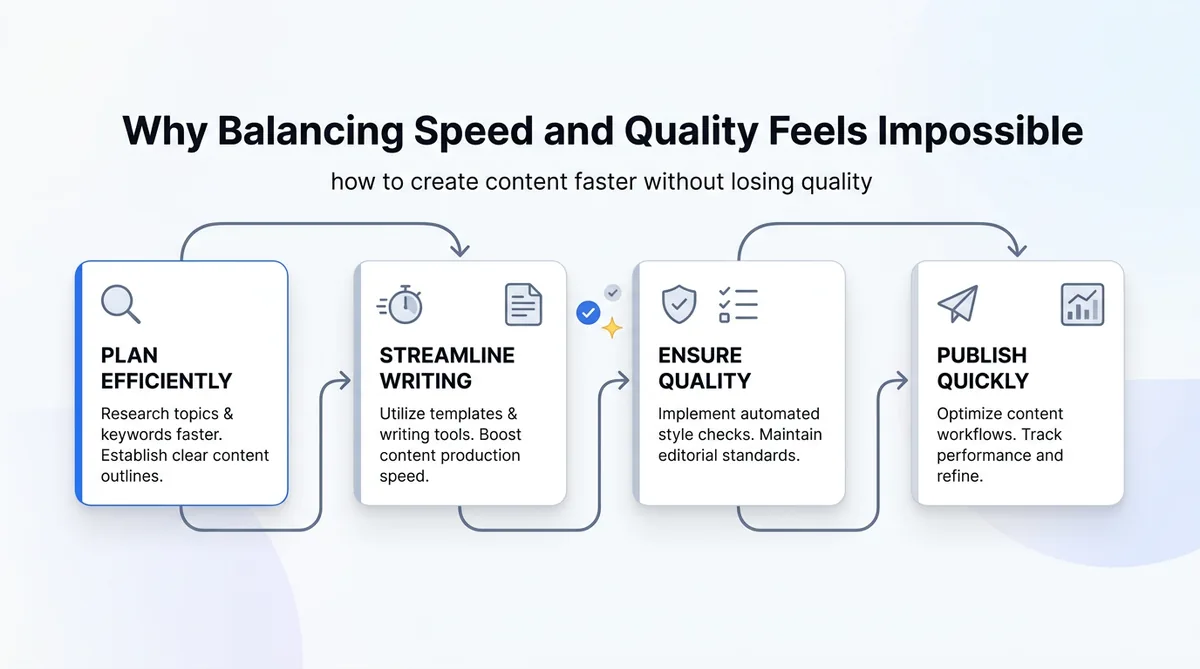
To create content faster without losing quality, you must separate ideation from drafting, build modular content templates, and batch-process your tasks. Speed doesn't come from typing faster. It comes from eliminating micro-decisions and structural choices before you even sit down to write your first sentence.
Why Balancing Speed and Quality Feels Impossible
Let's be honest. Trying to be fast and good at the same time feels like a trap. The cognitive load of context switching is what actually drains you. You open Google Docs, stare at the blinking cursor, try to think of a topic, figure out the hook, write the body, and edit sentences as you go. That is paralyzing.
It's the classic blank page syndrome mixed with perfectionism disguised as editing. When you try to do the job of a strategist, writer, and editor all in one sitting, your brain rebels. The gears grind to a halt because you are asking your mind to perform conflicting tasks simultaneously.
Decouple Ideation from Execution

Brainstorming and analytical writing use entirely different cognitive processes. Ideation is expansive, messy, and creative. Drafting is structured, linear, and critical. Doing both simultaneously causes massive mental friction. It slows you down to a crawl because you are constantly shifting gears between "is this a good idea?" and "is this the right word?"
Build a Frictionless "Idea Capture" System
You need a way to catch ideas the second they happen. I use a simple Kanban board on my phone, but a basic voice-note app works just as well. The goal is absolute zero friction. If it takes more than two clicks to log a thought, you won't do it. When you're walking the dog and realize a mistake your industry consistently makes, dump it into the capture system. Don't write the post. Just log the raw thought so it's waiting for you later.
The "10 Ideas a Day" Muscle
Getting fast means generating raw concepts daily without filtering them for quality. Write down 10 ideas every single morning. Most of them will be terrible. That is exactly the point. You are building a backlog of pre-vetted topics so you never sit down to write without knowing exactly what you're writing about. Wondering what those topics should be? It helps to figure out what your audience is actively struggling with first so your daily ideas are actually rooted in real demand.
Engineer Standard Operating Procedures (SOPs) and Templates
Constraints breed creativity. This sounds backward, but it's true. By removing structural choices like formatting, pacing, or headline style, you pour all your cognitive energy into the actual value and insight of the piece. When you use an SOP, you aren't being boring. You are just removing the operational drag that eats up your time.
Create Fill-in-the-Blank Briefs
Before drafting a single word, force clarity. Use a standard content brief template. Mine is painfully simple: Target Audience, Core Argument, and 3 Main Takeaways. If I can't fill those out in two minutes, the idea isn't baked enough to write about. This mechanism prevents you from rambling and ensures every piece of content has a sharp, focused point.
Start creating viral content today
Join other creators who've transformed their social media presence with AI-powered content.
Start creating nowDesign Modular Content Blocks
Structure your posts using repeatable blocks. Readers don't read word-for-word on the internet; they scan. Modular blocks cater directly to this scanning behavior, keeping retention high while making your job easier. A standard LinkedIn post might look like: Hook, Context, Step-by-Step, Common Mistakes, Conclusion. A B2B SaaS blog needs entirely different modules than an e-commerce product page. Once you know your modules, you aren't writing a post anymore. You are just filling in the specific blocks.
Implement The "Batching" Workflow
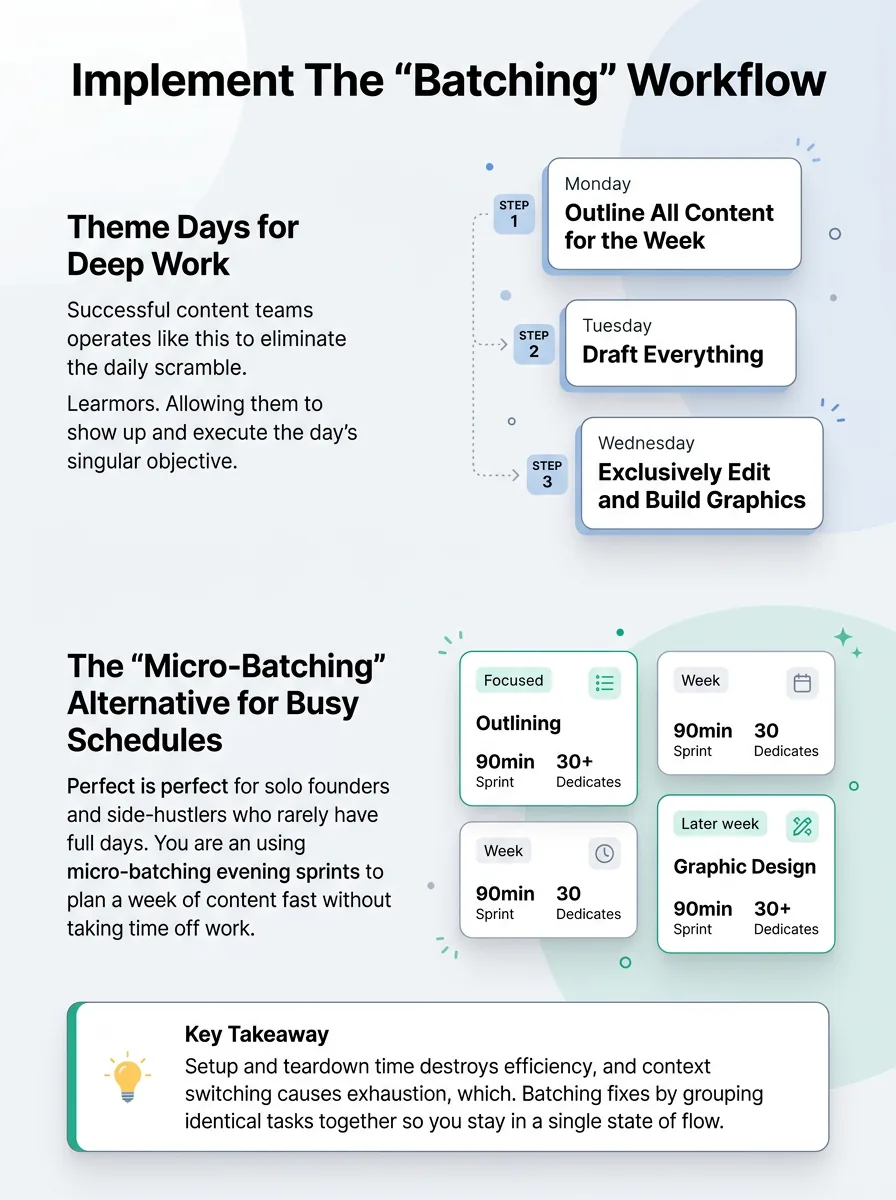
The behavioral algorithm of deep work is simple: setup and teardown time destroys efficiency. Every time you switch from writing text to designing a graphic to scheduling a post, your brain spends 15 minutes just recalibrating to the new software and task. This context switching is why you feel exhausted after only producing one piece of content. Batching fixes this by grouping identical tasks together so you stay in a single state of flow.
Theme Days for Deep Work
Dedicate specific days to single tasks. Mondays are for outlining all content for the week. Tuesdays are for drafting everything. Wednesdays are exclusively for editing and building graphics. Successful content teams operate like this because it eliminates the daily scramble. You just show up and execute the day's singular objective.
The "Micro-Batching" Alternative for Busy Schedules
Solo founders and side-hustlers rarely have full days to dedicate to content. That's fine. Use micro-batching instead. Dedicate a focused 90-minute sprint entirely to outlining. Do another 90-minute sprint later in the week just for graphic design. If you need to plan a week of content fast without taking off work, grouping these micro-tasks into evening sprints is your best bet.
The Fractional Repurposing Flywheel
Atomization is the secret to volume. You take one high-effort pillar asset and splinter it into multiple native formats. This maximizes output without diluting the core quality. The mechanism here is algorithmic. Different formats reach different segments of your audience at different times. A deep-dive YouTube video satisfies search intent and builds deep trust, while a short text post triggers algorithmic scanning and quick saves.
Turn One Pillar Asset Into 10 Micro-Pieces
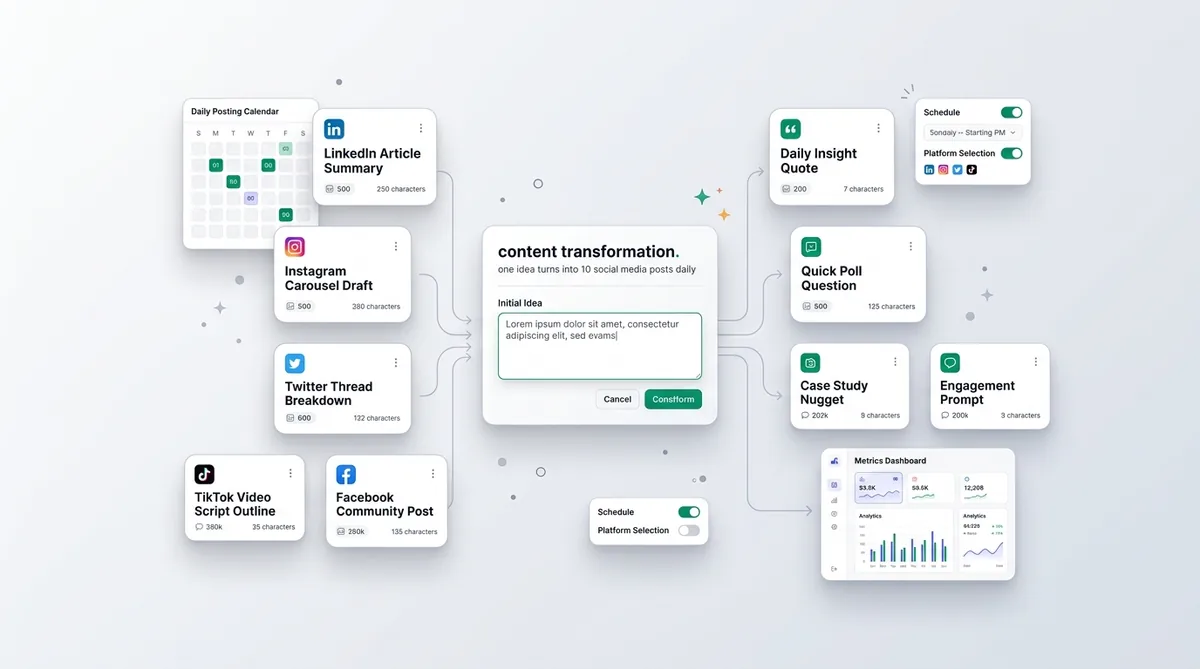
Imagine you just spent three hours writing a 1,500-word blog post. Don't just publish it and move on. That same idea could become a newsletter, three LinkedIn posts, a Twitter thread, and a script for a short-form video. You did the hard thinking once. Now you just reformat the delivery to match the native psychology of each platform.
Niche Variations: B2B vs. B2C Repurposing
A B2B SaaS company might atomize a dense whitepaper into five highly actionable LinkedIn carousels. Meanwhile, a B2C brand might turn a lifestyle guide into a TikTok series and Instagram Reels. The format changes drastically, but the core insight remains exactly the same.
The 14-Day Content Sprint: Measure Your Velocity
Don't just guess if this is working. Test it. Establish a baseline in Week 1. Track exactly how many hours it takes you to ideate, draft, edit, and publish three pieces of content. In Week 2, implement the templating and batching workflows we just discussed. Measure the reduction in your time-to-publish. More importantly, track your engagement metrics to ensure the quality remained stable. If your time drops by half and your engagement stays flat, you've won the game.
5 Mistakes That Kill Your Content Velocity
Most creators try to speed up, but they end up spinning their tires. Why? Because they hold onto terrible habits disguised as standard practices. Here is why most people still don't get results.
- Editing while drafting
Fixing typos and adjusting sentence structure while you write breaks your creative flow state. Write the ugly first draft. Edit later.
- Starting without a strict outline
If you don't know the exact end of the post before you write the hook, you will ramble. Rambling takes massive amounts of time to fix during edits.
- Waiting for inspiration to strike
Professionals write on a schedule. Amateurs wait for the muse.
- Using vague claims as hooks
Opening a post with "this changed everything" gives the reader zero context. Copying viral hooks without matching your specific audience intent causes massive bounce rates.
- Failing to define what "good enough" looks like
Perfectionism is just procrastination in a fancy suit. Decide what minimum viable quality looks like for your brand, hit that mark, and hit publish.
The Limits of Manual Hustle (And The Power of Systems)
The real problem isn't knowing what a good piece of content looks like. It's producing enough quality variations consistently without spending hours glued to your keyboard. Even with perfect habits, outlining, and batching, manual execution hits a hard ceiling. You only have so much energy in a day.
That's why successful creators transition from typing everything from scratch to using systemic workflows. They use a content generator to transform a single raw thought into ready-to-post content across platforms. You drop in a rough idea or a few notes, choose your platform and desired tone, and get a tailored Reel script or LinkedIn post instantly. It adapts the structure perfectly for you. It's about generating options fast, tweaking the best output, and posting without the inevitable creator burnout.
Frequently Asked Questions About Content Efficiency
Does using AI lower content quality?
Not if you use it as a drafting partner rather than an outsourcing tool. Quality only drops when you blindly copy-paste outputs without injecting your own personal perspective, specific examples, or unique brand voice.
How many blog posts should I write a week?
Consistency matters significantly more than raw volume. If you can only sustain one high-quality post per week without burning out, do that. Two to three is the sweet spot for rapid growth, provided you don't sacrifice depth.
How long should it take to write 1,000 words?
With a solid outline and no distractions, a seasoned writer can draft 1,000 words in 60 to 90 minutes. Add another 30 minutes for editing. If it regularly takes you four hours, your ideation and drafting phases are likely tangled up.
What is the fastest way to write an article?
Work from a highly detailed brief, dictate your messy first draft using voice-to-text software, and then edit ruthlessly. Dictation completely bypasses the inner critic that usually slows down your physical typing.
Consistency Over Intensity
Predictable, repeatable systems will always beat frantic bursts of motivation. Figuring out how to create content faster without losing quality ensures you stay in the game long enough to actually see compounding results.
Create 10x More Content
Transform one idea into dozens of engaging posts for every platform.
Try Content GeneratorBuild your capture system, respect your modular templates, and just keep hitting publish.