
Imagine you spend six hours researching, writing, and formatting a massive guide for your audience. You hit publish. Crickets. A month later, you check your analytics and see exactly zero impressions. Sound familiar?
Jump to a section:
- The Content Treadmill: Why Your Niche Authority is Stalling
- Fast-Track Guide: How to Find Content Gaps in 60 Seconds
- Why Meaningful Differentiation Is So Hard
- Reverse-Engineering Competitor Visibility via Keyword Overlap
- Mining Community Forums for Unmet Search Intent
- The Internal Audit: Finding Gaps in Your Own Funnel
- Decoding SERP Features to Spot Format Gaps
- The 14-Day Content Validation Framework
- 5 Content Gap Analysis Mistakes That Kill Your ROI
- From Manual Audits to Sustainable Strategy
- Frequently Asked Questions About Content Gap Analysis
- Mastering the Art of Modern Niche Authority
Most creators assume they just didn't write a good enough post. Not even close. The actual issue is that they answered a question nobody was asking—or worse, a question everyone else had already answered better. If you want to stop screaming into the void, you need to learn exactly how to identify content gaps in your niche.
Quick Answer: Figuring out how to identify content gaps in your niche comes down to reverse-engineering search results. Use an SEO tool to compare your domain against your top three competitors. Find the high-volume keywords they rank for, but you don't. Filter those results for outdated articles, thin word counts, or weak formats on page one, then publish a targeted, superior piece to steal that traffic.
The Content Treadmill: Why Your Niche Authority is Stalling
Here's what nobody tells you about building an audience: creating "high quality" content isn't enough anymore. The internet doesn't need a 40th version of the exact same beginner's guide.
When you merely mimic existing articles, you trap yourself on a content treadmill. You're working incredibly hard, sweating over every paragraph, but your niche authority stalls because you aren't filling any unmet needs. Search algorithms are designed to prioritize unique value. If your piece is just a reshuffled version of the top three results, the algorithm has zero incentive to rank it. You have to find the holes in the market.
Fast-Track Guide: How to Find Content Gaps in 60 Seconds
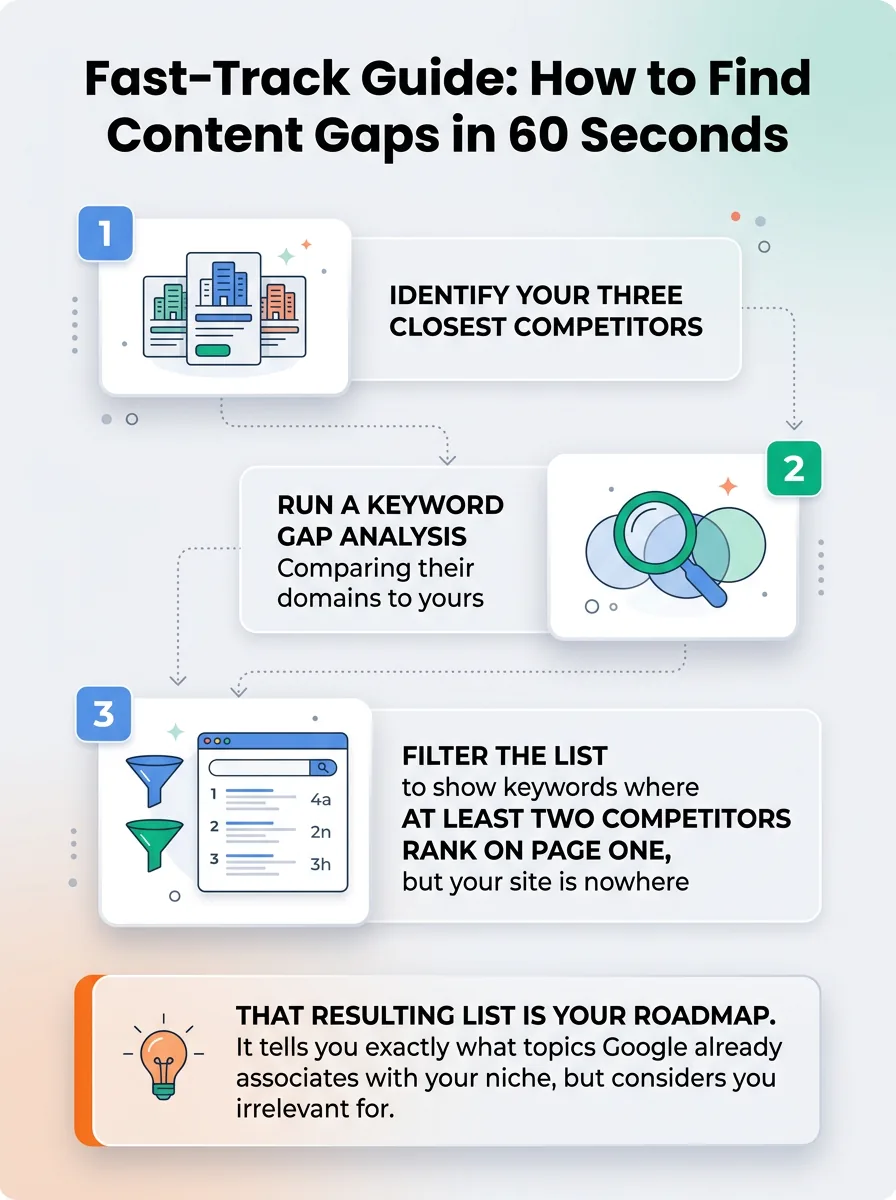
Before we break down the advanced mechanics, let's look at the basic workflow. Finding a gap isn't about guessing what your audience wants. It is a data-driven process of competitive benchmarking.
First, identify your three closest competitors. Second, run a keyword gap analysis comparing their domains to yours. Third, filter the list to show only the keywords where at least two of them rank on page one, but your site is nowhere to be found. That resulting list? That's your roadmap. It tells you exactly what topics Google already associates with your niche, but considers you irrelevant for.
Why Meaningful Differentiation Is So Hard
If finding gaps is just a matter of running a report, why do so many creators fail at it?
Because of a psychological barrier. When you live and breathe your niche, you suffer from the curse of knowledge. You look around and think, "Every possible topic has already been covered." So you settle for writing copycat content. But user problems are rarely static. Software updates break old workflows. Industries shift. What worked in 2021 probably doesn't work today. The gap isn't usually a totally new topic—it's a modern, nuanced answer to an old problem.
Reverse-Engineering Competitor Visibility via Keyword Overlap
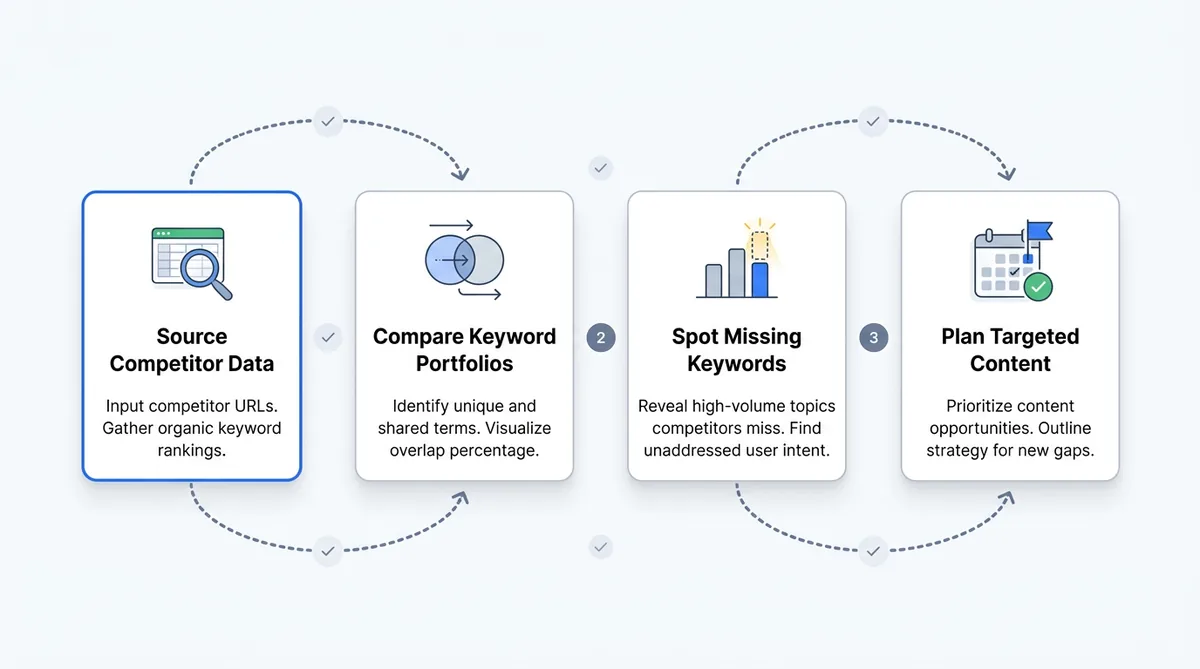
Competitive benchmarking works because search engines are giant pattern-recognition machines. By analyzing keyword overlap, you can see exactly where rivals are siphoning traffic you haven't even targeted.
Analyzing High-Volume Keywords You Don’t Rank For
When you run a gap analysis, don't just look at the raw data. Filter for intent. You are looking for "missing" keywords where at least three competitors rank in the top 10. Why three? Because if three competitors rank for it, it proves the topic is highly relevant to your specific sub-niche.
Specific numbers and metrics matter here. A keyword with 500 monthly searches and high intent is infinitely more valuable than a vague term with 10,000 searches. The algorithm reinforces this because specific, intent-driven searches drive higher click-through rates.
Identifying 'Thin' Content Opportunities in Top Results
Sometimes the gap isn't a missing topic. It is a quality gap.
Look at the competitors ranking for your target keywords. Are their articles a wall of text? Do they bury the answer under 500 words of fluff? That's a massive vulnerability. When a competitor ranks for a high-intent keyword with a low-quality or 400-word "thin" article, they are practically begging you to take their spot. Google only ranks them because nothing better exists yet.
Mining Community Forums for Unmet Search Intent
Keyword data is lagging. It tells you what people searched for three months ago. If you want a first-mover advantage, you need to understand social listening.
Forums are raw, unfiltered pain points. People go to Reddit when Google fails them. This behavioral search intent is a goldmine because it highlights the exact phrasing your audience uses when they are frustrated.
Converting Reddit and Quora Pain Points into Solutions
Don't just read the top posts on a subreddit. Look for the "how-to" questions with zero upvotes but highly detailed comments. These are hyper-specific problems that haven't been addressed by formal blog posts yet. When you find a raw, emotional Reddit query, it actually makes the perfect opening line for your social media hook system to drive initial traffic to your new post.
Bridging the Gap Between Modern Search Intent and Stale Results
Search intent evolves faster than search results. Think about it. If someone searches "best email marketing tools," the intent used to be finding a cheap platform. Now, the intent is finding a platform with the best AI automations.
If the top SERP results are still showing advice from two years ago, that's your gap. As outlined in Google's core documentation on helpful content, providing original information that reflects current realities is a primary ranking factor. Exploit the staleness of your competitors.
Start creating viral content today
Join other creators who've transformed their social media presence with AI-powered content.
Start creating nowThe Internal Audit: Finding Gaps in Your Own Funnel
Stop looking at what your competitors are doing for a second. Sometimes the biggest gaps are sitting on your own website.
Topical authority dictates that Google wants to see you as an expert in a specific cluster of topics. If you have a massive guide on "Facebook Ads" but zero supporting articles on "Facebook Ad creatives" or "budgeting for Facebook Ads," you have an internal gap.
Mapping Existing Content to the Buyer’s Journey
Just like you'd audit your Instagram content for engagement drops, you need to audit your blog for funnel disconnects. Check if you have content for all three stages of the buyer's journey.
Awareness content focuses on the problem. Consideration content focuses on the solution. Decision content focuses on the product. Most creators write 50 awareness posts and completely forget to write the comparison tables and review posts that actually drive revenue.
Spotting Disconnects in Topic Clusters and Internal Linking
Look for "orphaned" content—articles that have zero internal links pointing to them. These are dead ends for both users and algorithm crawlers. Filling an internal gap usually means writing a small, highly specific sub-topic post just to bridge two larger pillar pages together. This signals deep, comprehensive knowledge to search engines.
Decoding SERP Features to Spot Format Gaps
What if the topic has been covered perfectly, but the format is wrong?
Format gaps are the most overlooked opportunity in content creation. If everyone on page one is writing 2,000-word essays, but the user is desperately looking for a 30-second video tutorial, the essay format is a failure.
Identifying Opportunities for Video, Listicles, and Comparison Tables
Look at the SERP layout. Do you see a carousel of YouTube videos at the top? That means Google knows users want a visual demonstration. Is the top result a dense paragraph when the user just needs a quick checklist? Build a listicle. Aligning your content medium to satisfy the user's specific scanning behavior is often enough to outrank domains with much higher authority.
Leveraging Featured Snippet Deficiencies in Your Niche
Pay close attention to the Featured Snippet box. Often, Google pulls a paragraph snippet that is confusing, grammatically awkward, or overly long simply because it's the "best available" option.
You can steal this spot by creating a superior 'List' or 'Table' format that answers the query with mathematical precision. Specificity triggers the algorithm's pattern-recognition system for relevance.
The 14-Day Content Validation Framework
Don't spend a month writing a definitive guide for a gap that might be a mirage.
Instead, use the 14-Day Validation Framework. Publish a "minimum viable" version of the content—a solid 800-word piece that directly answers the gap. Submit it to Google Search Console. Wait 14 days and monitor the impressions. If it starts generating impressions quickly, it proves the gap exists and Google is testing your relevance. Once validated, you can expand the piece into a massive pillar post.
5 Content Gap Analysis Mistakes That Kill Your ROI
Why do most people still not get results even after finding gaps? Because they make these exact mistakes.
- Chasing raw volume instead of intent
Going after a 10,000-search keyword where the user actually just wants to log into a piece of software, not read a blog post.
- Ignoring internal broken links
Finding external gaps while your own site architecture is a messy, unlinked disaster.
- Copying viral hooks blindly
Ripping off a competitor's topic without matching your specific audience's intent or pain level.
- Using vague, filler solutions
Writing "you need to be consistent" instead of giving a specific, actionable framework.
- Failing to update the "gap" content
Writing a great piece to fill a hole, then letting it rot for three years until a new competitor steals it from you.
From Manual Audits to Sustainable Strategy
The real problem isn't knowing what a good content gap looks like. It's producing enough quality variations consistently without spending an entire afternoon on a single post.
Imagine you spend an hour finding the perfect gap and writing the core blog post. That same idea needs to become three Instagram posts, a YouTube Shorts script, and a LinkedIn update to maximize your reach. Doing that manually leads straight to burnout. That's why smart creators use dedicated generators to scale their output. You drop a raw thought or idea into a content generator, choose your platform and target tone, and it instantly hands you platform-ready posts. You tweak the output, hit publish, and move on.
Frequently Asked Questions About Content Gap Analysis
How often should I run a content gap analysis?
For most creators, once a quarter is plenty. This gives the search algorithms enough time to process your new pages and provides fresh data on what your competitors have been publishing.
Do I need expensive tools to find these gaps?
While premium SEO tools speed up the process immensely by visualizing keyword overlap, you can start for free by simply comparing your Google Search Console query data against the auto-complete suggestions on YouTube and Google.
How do I measure the depth of a content gap?
Look at the top three ranking pages. If they don't have custom images, lack internal links, use outdated dates, and fail to answer the direct question in the first 200 words, the gap is deep. It is ripe for the taking.
Mastering the Art of Modern Niche Authority
Create 10x More Content
Transform one idea into dozens of engaging posts for every platform.
Try Content GeneratorFinding gaps isn't a one-and-done hack; it's a fundamental shift in how you view your niche. Stop writing what you want to write and start writing exactly what the ecosystem is missing. That is how you turn a struggling blog into an undeniable authority.