People scroll your profile, pause on your content for two seconds… then leave. No follow. No click. And half the time, the reason is boring and fixable: your social media bio quietly tells them, “This isn’t for you.”
Jump to a section:
- What Makes a Social Media Bio Work (and Why Yours Doesn’t Yet)
- Why Writing a High-Converting Social Media Bio Is So Hard
- Clarify Who You’re For and What You Deliver in One Line
- Turn Your Bio Into a ‘Mini Landing Page’
- Optimize Your Social Media Bio for Each Platform’s Design and Culture
- Make Your Bio Link and Highlights Work Harder
- Test Your Social Media Bio With a 7–14 Day Experiment
- 5 Social Media Bio Mistakes That Quietly Kill Your Growth
- Why ‘Knowing What to Write’ Isn’t Your Real Bio Problem
- FAQ: Fixing and Optimizing Your Social Media Bio
- Remember: A Good Social Media Bio Does One Thing Well
Writing that tiny block of text feels weirdly hard. You overthink every word, stuff in your job title, a quote you like, three links, and hope for the best. Then nothing changes, so you blame the algorithm.
Let’s fix that. You’re getting a clear, practical framework to turn your social media bio into a simple “yes/no” filter that attracts the right people and repels the wrong ones on purpose.
What Makes a Social Media Bio Work (and Why Yours Doesn’t Yet)
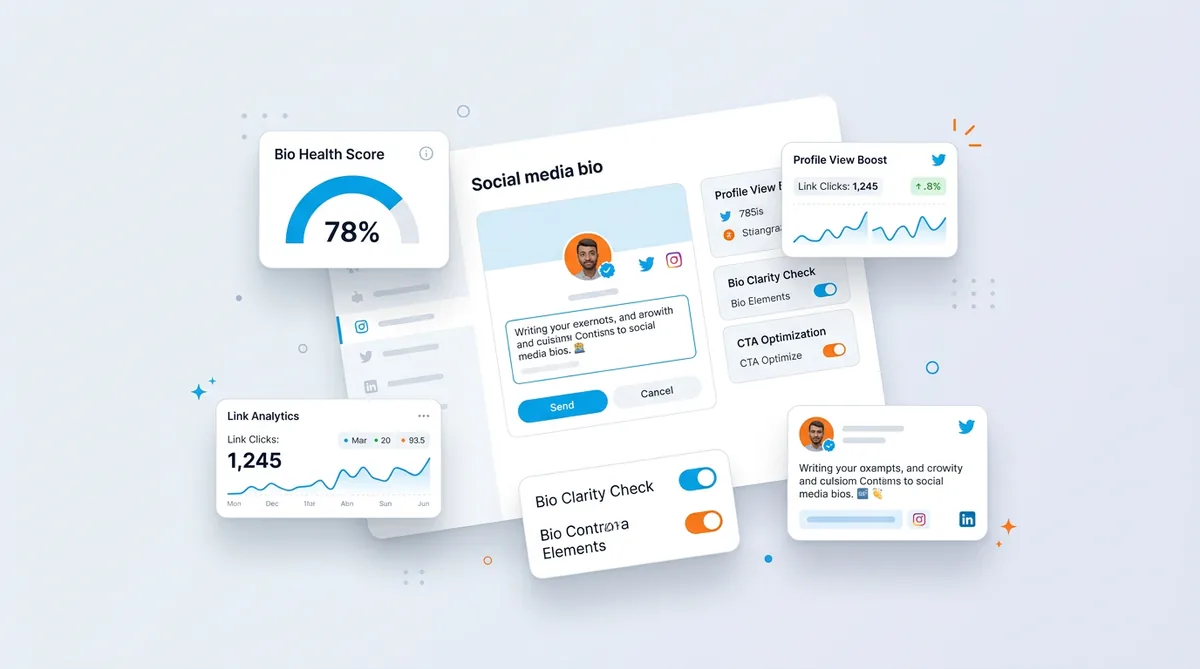
A high-performing social media bio tells a specific audience what outcome you help them get, why they should trust you, and what to do next — in a format that fits each platform’s layout.
Most bios fail because they sound like vague résumés instead of mini landing pages: no clear audience, no concrete promise, and three competing calls to action fighting for attention.
Why Writing a High-Converting Social Media Bio Is So Hard
Let’s be honest: writing about yourself is awkward.
You’re trying to pack all of this into 150 characters:
Who you are
Who you’re for
Why anyone should care
And what they should do next
So you default to the safest option: “Founder @ X | Coffee addict | Sharing tips about Y.” It feels fine. It’s also forgettable.
Here’s what creators tell me all the time:
“I don’t want to niche down too hard in my bio and scare people off.”
“I’ve tried rewriting it 10 times, but I can’t tell what actually performs better.”
“I post about multiple things – how do I squeeze that into one line?”
“Every ‘perfect bio’ example I see feels cringe on my profile.”
And the big one: you’re busy making content. Your bio becomes a set-it-and-forget-it thing you wrote in five minutes when you opened the account.
The problem is attention behavior. People skim your social media bio in under two seconds. If their brain can’t instantly answer “Is this for me?” and “What will I get here?”, they bounce. Not because you’re bad. Because the cognitive load is too high for a casual scroll.
Clarify Who You’re For and What You Deliver in One Line
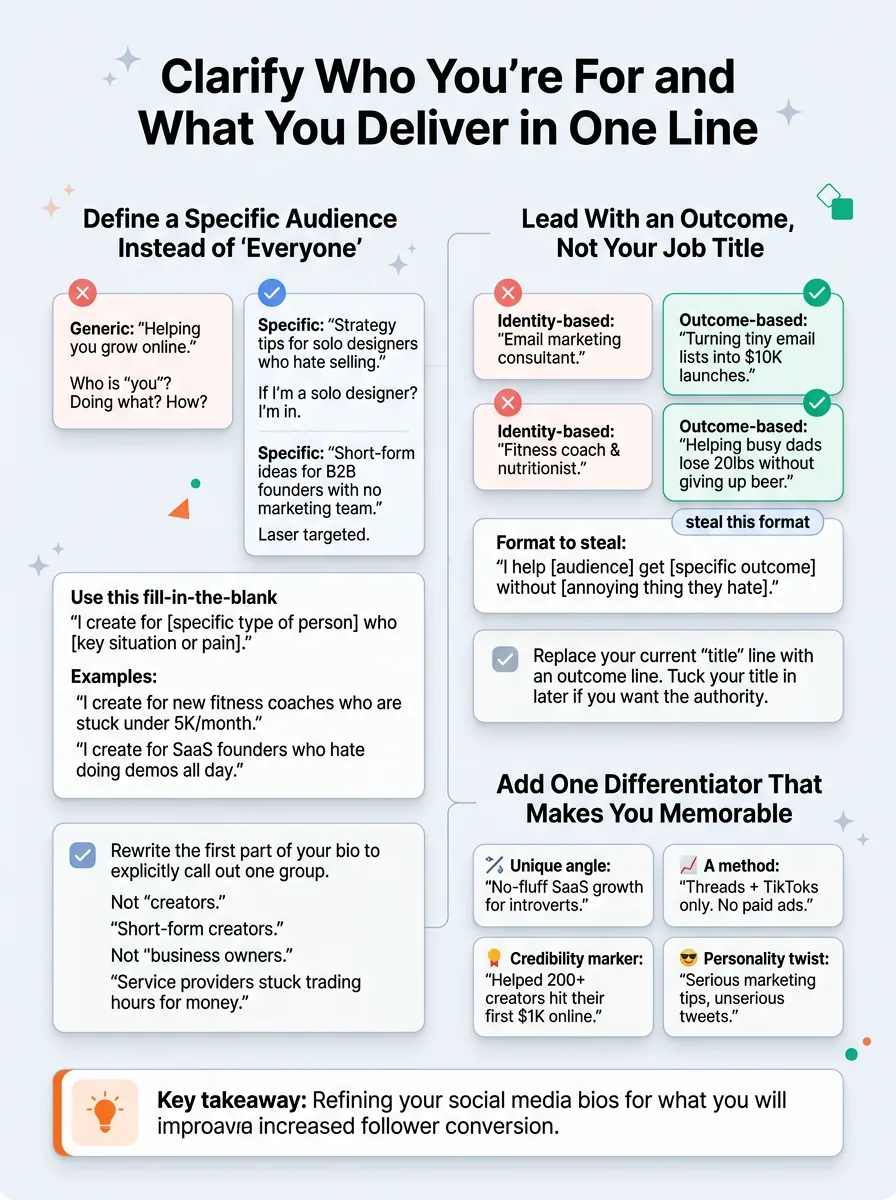
Your bio’s first job isn’t to impress people. It’s to qualify them.
Think of your main line as a fast filter: this is for you, or it isn’t. The more specific it is, the more it converts.
Define a Specific Audience Instead of ‘Everyone’
Most creators try to keep their social media bio broad so they “don’t scare away potential followers.” In practice, the opposite happens. Nobody feels directly spoken to, so they scroll away.
When you name a clear audience, two things happen:
People in that group feel called out and understood (micro hit of recognition = follow).
People outside that group self-filter out, which reduces low-quality followers who never engage.
Compare these:
- Generic
“Helping you grow online.” Who is “you”? Doing what? How?
- Specific
“Strategy tips for solo designers who hate selling.” If I’m a solo designer? I’m in.
- Specific
“Short-form ideas for B2B founders with no marketing team.” That’s laser targeted.
Use a simple fill-in-the-blank to draft your audience line:
“I create for [specific type of person] who [key situation or pain].”
Examples:
“I create for new fitness coaches who are stuck under 5K/month.”
“I create for SaaS founders who hate doing demos all day.”
Action step: Open your main platform and rewrite the first part of your social media bio to explicitly call out one group. Not “creators.” “Short-form creators.” Not “business owners.” “Service providers stuck trading hours for money.”
Lead With an Outcome, Not Your Job Title
Your job title is context, but it doesn’t sell the follow.
People don’t care that you’re a “coach,” “founder,” or “strategist.” They care what following you will change for them.
Outcome-based bios work better because they answer the selfish question in the visitor’s head: “What do I get if I see this account more often?”
Watch the difference:
- Identity-based
“Email marketing consultant.”
- Outcome-based
“Turning tiny email lists into $10K launches.”
- Identity-based
“Fitness coach & nutritionist.”
- Outcome-based
“Helping busy dads lose 20lbs without giving up beer.”
The second versions create a mental movie. I can picture the result. That makes the follow feel like a small, logical step toward that outcome.
Format to steal:
“I help [audience] get [specific outcome] without [annoying thing they hate].”
Action step: Replace your current “title” line with an outcome line. You can still tuck your title in later if you want the authority.
Add One Differentiator That Makes You Memorable
In most niches, 50 accounts are saying some version of what you do. Your social media bio needs one hook that makes people think, “Oh, that’s different.”
That differentiator can be:
- A unique angle
“No-fluff SaaS growth for introverts.”
- A method
“Threads + TikToks only. No paid ads.”
- A credibility marker
“Helped 200+ creators hit their first $1K online.”
- A personality twist
“Serious marketing tips, unserious memes.”
The mechanism here is memory. Specific, unusual details create “handles” for the brain to grab onto. Generic labels slide right off.
Action step: Add one short phrase that either shows your twist (“no cold DMs”, “for shy founders”) or your track record (“ex-Google”, “200+ clients”). Only one. You’re not stacking a résumé, you’re planting one sticky idea.
Turn Your Bio Into a ‘Mini Landing Page’
Stop thinking of your social media bio as a résumé. Treat it like a compressed landing page: hook, proof, call to action.
You’re guiding a visitor from curiosity to “follow” or “click” in three moves.
Open With a Hook That Stops the Scan
The first line of your bio has one job: interrupt the scroll just long enough for them to read the rest.
People scan profiles in an F-shaped pattern: photo, name, first line of bio, top content. That first line needs to hit hard and be instantly scannable.
Formats that work across platforms:
- Outcome + audience
“More leads for shy B2B founders.”
- Contrarian promise
“Audience growth without posting 3x a day.”
- Pattern breaker
“Your favorite marketer’s secret weapon.”
Avoid starting with vague fluff like “Passionate about helping people…” Nobody feels that.
Action step: Write three alt first lines and screenshot your profile with each. Ask 2–3 friends (or your audience via Stories) which one immediately tells them what you’re about. Pick the winner for your main platform.
Use Social Proof or Specifics to Build Trust Fast
After the hook, people look for evidence you’re legit. That doesn’t always mean huge follower counts. It means specifics.
Examples of fast trust builders:
“Trusted by 120+ ecommerce brands.”
“Ex-Meta ads strategist.”
“Grew from 0→50K on TikTok in 6 months.”
“Helping creators land $1–5K brand deals.”
If you’re early and don’t have big numbers yet, use concrete details instead of vanity metrics:
“Daily content ideas for new fitness creators.”
“Documenting my journey from 0→10K followers.”
“Sharing what I learn building my first SaaS from scratch.”
The mechanism: specific numbers and details reduce perceived risk. The brain thinks, “Real person, real track record, real focus,” which nudges them toward following.
If you’re also working on your posts, pairing a strong bio with engagement-focused captions helps your whole profile convert better, so it’s worth reading How to Write Captions That Get Comments Every Time once your bio is dialed in.
Action step: Add one line of proof: a number, a credential, or a specific journey you’re on. Keep it narrow and believable. No “helped thousands globally” unless you actually have.
End With One Clear Call to Action (Not Three)
This is where most bios fall apart.
You see stuff like: “Buy my course ↓ | New YouTube video ↗ | Newsletter ⬇ | DM for coaching.” That’s not a funnel. That’s a buffet.
Too many choices = decision fatigue. People default to doing nothing.
Pick one primary action that supports your current goal:
- Growth focus
“👇 Follow for daily [topic] breakdowns.”
- Email list focus
“Free [X resource] here ↓”
- Client focus
“Apply for 1:1 support ↓”
Then match your link and pinned content to that CTA. More on that in a minute.
Action step: Delete extra CTAs. Choose one: follow, subscribe, click, or DM. Write it as a direct, plain sentence, not a clever joke.
Optimize Your Social Media Bio for Each Platform’s Design and Culture
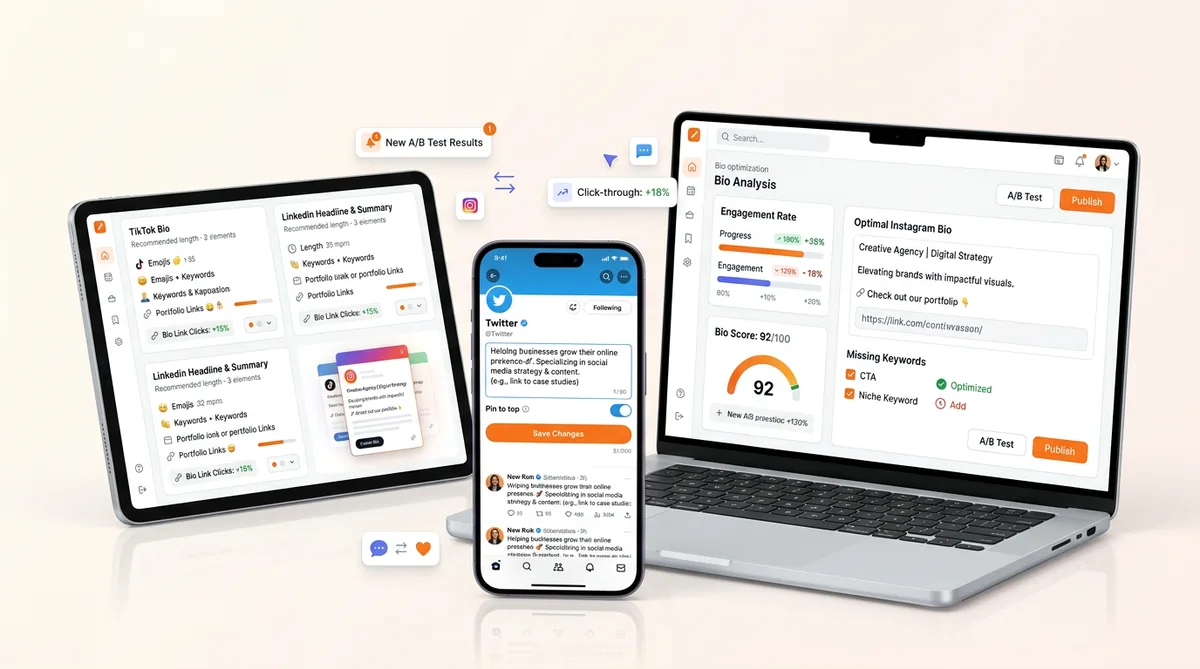
Same core message, different outfits. Each platform shows your bio differently and has its own “vibe.” If you copy-paste the exact same text everywhere, it’ll feel slightly off in at least one place.
Match the Character Count and Visual Layout
Quick reality check on how bios show up:
- Instagram
~150 characters, line breaks and emojis matter, people see it under your name + Story Highlights.
- TikTok
Short, tight. Your first line and link are key. Emojis can help break it up.
- X/Twitter
160 characters, no line breaks. Needs to read clean in one scan.
- LinkedIn
Headline + About. You get more characters and people actually read longer descriptions.
- YouTube
Channel description is more buried, but your first 1–2 lines still matter when someone checks your profile.
The mechanism here is scanning speed. Line breaks, emojis, and separators (like “•” or “|”) change how quickly someone can parse your message.
Example of adapting one core idea:
- Core positioning
“Helping solo designers land better clients without spending all day on social.”
- Instagram
“Better clients for solo designers ✦ No cold outreach ✦ Free client checklist ↓”
- X
“Helping solo designers land better clients without living on social. Free client checklist ↓”
- LinkedIn headline
“Helping solo designers land premium clients | Positioning & lead systems | No cold DMs”
Action step: Start with your main platform. Then create shorter and slightly longer versions of the same core bio to fit the others. Don’t fight the layout. Work with it.
Align Tone With Platform Culture (Without Losing Your Voice)
Each platform has its own social norms. Same person, different room.
Rough guide:
- Instagram
Casual, visual-first, light humor works.
- TikTok
Playful, chaotic, “I’m just like you” energy does well.
- X
Punchy, opinionated, slightly nerdy.
- LinkedIn
Professional, but not stiff anymore. Clear value > buzzwords.
- YouTube
Slightly more “host” energy. You’re the guide to a topic.
What you don’t want is personality whiplash. Don’t be a meme lord on TikTok and a corporate robot on LinkedIn if the same people might follow you across platforms.
Instead, imagine a dimmer switch, not an on/off.
Example: core voice = direct, slightly sarcastic.
- TikTok
“Zero-BS content tips for creators who hate fake guru advice.”
- LinkedIn
“Straightforward content strategy for creators tired of vague ‘personal brand’ advice.”
Same person, different level of polish.
Action step: Pick 3 adjectives for your voice (e.g., “direct, curious, playful”). Make sure each bio keeps those, then adjust only the formality and slang per platform.
Niche-Specific Tweaks for Creators, Coaches, and SaaS
Different roles need different angles in their social media bio.
Content creators: Focus on your niche and content cadence.
“Daily reels for busy moms who want to get strong at home.”
“Threads + carousels that grow your audience while you sleep.”
Coaches & service providers: Focus on outcomes and next step.
“Helping health coaches sign 3–5 new clients/month | Free client script ↓”
“DFY email strategy for SaaS from ex-agency operator | Book a teardown ↓”
SaaS / tech brands: Focus on use case and user type, not features.
“Content calendar for solo creators who hate spreadsheets.”
“Client reporting that takes you 5 minutes, not 50.”
Notice how every example answers: who is this for, and what does it help them do?
Action step: Identify your main role (creator, coach, SaaS). Rewrite one line of your bio to emphasize either “content type” (creators), “core outcome” (coaches), or “primary use case” (SaaS).
Make Your Bio Link and Highlights Work Harder
Your social media bio doesn’t live alone. People read it, then instantly glance at your link, your pinned posts, your Highlights or playlists. If those don’t match the promise you just made, trust drops.
Align Your Bio Promise With Your Pinned or Recent Content
This is expectation matching. If your bio says “Daily TikTok hooks for creators,” and your last three posts are random lifestyle shots, people feel a tiny bait-and-switch and leave.
Imagine this: you tweak your bio to say “Helping founders turn blog posts into a month of content,” but the grid is still a mix of selfies, quotes, and brunch. The message and evidence don’t match, so the brain hesitates.
Instead, do this:
Update your bio promise.
Pin 1–3 posts that best deliver on that promise.
Make sure your recent content aligns with your stated niche and outcome.
If your promise includes repurposing content, pairing it with a strong system helps, and you can steal ideas from How to Repurpose Blog Posts into Social Media Posts to keep that promise real in your feed.
Action step: Read your bio out loud, then look at your top six posts. Would a stranger say, “Yep, this matches”? If not, tweak either the bio or the content (or both) until they line up.
Use One Primary Offer or Freebie as the Click Magnet
Your link-in-bio should feel like the obvious “next step” after reading your description.
Instead of a menu of 10 links (“YouTube / Latest blog / Podcast / Newsletter / Coaching / Freebie / Calendar / About…”), choose one primary offer that supports your current focus.
Examples:
“Free Notion template: plan 30 days of content in 60 minutes.”
“Grab my 5-email welcome sequence that turned followers into $12K/month.”
“Watch the 15-min tutorial I use to batch 7 TikToks at once.”
Make the text above your link specific: what is it, who is it for, what outcome do they get?
Action step: Pick one primary freebie or offer and rewrite your link text to sell just that. If you use a link hub, demote everything else and visually highlight the main link.
Organize Highlights and Playlists as Proof and Pathways
Highlights (IG), playlists (YouTube), and pinned threads (X) are underestimated bio support tools.
Think of them as “proof and pathways”:
- Proof
Client wins, testimonials, case studies, behind-the-scenes.
- Pathways
“Start here” threads, beginner playlists, FAQs.
Example for a fitness coach:
- Highlights
“Client Wins,” “Workouts,” “Nutrition,” “Start Here.”
- Pinned post
“New here? Start with this 3-day at-home workout plan.”
So after reading: “Helping busy moms lose 10–20lbs at home,” the visitor immediately sees proof (client wins) and a path (start here). That consistency builds trust quickly.
Action step: Rename or reorder your Highlights / playlists so the first 2–3 directly support your bio promise. Kill any dusty, random ones that confuse the story.
Test Your Social Media Bio With a 7–14 Day Experiment
Most people rewrite their bio, glance at it, and then immediately rewrite it again based on vibes. That’s not a test. That’s guessing.
Here’s a simple experiment you can actually run:
- 1. Pick one platform
to test on first (usually your biggest or most important).
- 2. Choose two bio versions
that differ mainly in positioning line or hook, not in 10 different ways.
- 3. Run version A for 7 days.
Keep your content cadence roughly the same.
- 4. Track
profile visits, follows from profile, link clicks.
- 5. Switch to version B for the next 7 days
and track the same metrics.
Don’t obsess over small daily fluctuations. You’re looking for noticeable trends: “With version B, I got more profile follows per 100 profile visits.”
Action step: Screenshot your current stats (or note them) and commit to one 14-day test with just two bio variants. Decide your winner based on data, not mood.
5 Social Media Bio Mistakes That Quietly Kill Your Growth
Here’s where most creators and brands still sabotage themselves, even after reading guides like this.
- Stacking three ideas in one opening line.
“Helping creators grow, monetize, and stay motivated with content, habits, and mindset.” That’s six concepts fighting for attention. Pick one main idea per line.
- Copying viral bios from big accounts.
You grab a bio from a 500K-follower creator whose audience intent, offer, and content format are totally different. It looks cool, but misaligns expectations and tanks conversions.
- Using vague goals like “helping you live your best life.”
Nobody wakes up searching for that. They search for “quit sugar,” “get clients,” “manage ADHD.” Make your promise concrete.
- Stuffing emojis instead of substance.
A few well-placed emojis help scanning. A wall of icons looks like spam and hides your actual message.
- Listing job titles instead of outcomes.
“Founder | Podcaster | Speaker | Writer.” Cool. But why should I follow? These are roles, not reasons.
- Changing your bio every other day.
Constant tweaks mean you never get clean data. Commit to a version for at least a week before judging it.
Why ‘Knowing What to Write’ Isn’t Your Real Bio Problem
By now, you probably know what a good social media bio looks like. The hard part is keeping all your bios sharp as your offers, niche, and content evolve.
Manually rewriting Instagram, TikTok, X, LinkedIn, YouTube, and Threads every time you refine your positioning is annoying enough that you’ll procrastinate it for months. That’s the real growth leak.
What actually helps is having a way to generate multiple, platform-specific versions fast, so you can pick the best line instead of staring at a blinking cursor. That’s why a lot of creators I know use the SocialOrbit Bio Generator — you plug in your niche, audience, and key wins once, pick your platform, and it spits out several on-brand bios already trimmed to the right character limit, which you can then test instead of writing from scratch every time.
Start creating viral content today
Join other creators who've transformed their social media presence with AI-powered content.
Start creating nowFAQ: Fixing and Optimizing Your Social Media Bio
How often should I update my social media bio?
Update your bio whenever your core offer, niche, or audience focus changes. For most creators, that’s every 2–3 months. Between those updates, run small A/B tests, but avoid daily tinkering so you can actually see what works.
What should I put in my social media bio if I’m just starting?
Keep it simple: pick a specific audience, a clear topic, and the journey you’re on. For example: “Learning email marketing from scratch and sharing what works for small ecommerce brands.” You don’t need huge proof; you need clarity and consistency.
Should I include hashtags in my bio?
On most platforms, hashtags in bios don’t meaningfully help discovery and can make your bio harder to read. Use that space for a stronger promise, proof point, or CTA instead of #keyword stuffing.
Is it better to push following or link clicks in my bio?
It depends on your current goal. Early on, prioritize follows to build an audience (“Follow for daily X”). Once you have an offer or email list dialed in, shift your CTA toward your primary funnel (“Free X to do Y ↓”). Don’t try to optimize for both at once in the same line.
Can I use the same bio across all platforms?
You can keep the same core message, but tweak length, tone, and formatting for each platform’s character limits and culture. Think “same idea, different version,” not copy-paste everywhere.
Craft a Bio That Converts
Create a compelling bio that turns profile visitors into followers.
Try Bio GeneratorRemember: A Good Social Media Bio Does One Thing Well
Your bio doesn’t need to tell your whole life story. It just needs to clearly say who you’re for, what they’ll get, and what to do next.
Pick one change from this guide — tighter audience, clearer outcome, or one focused CTA — update your social media bio today, and let the next 7–14 days of data tell you what’s working.