The Invisible Barrier Between Your Profile and Your Next High-Value Lead
Imagine you just spent an hour writing a highly detailed post. You hit publish, and within a few hours, it pulls in thousands of impressions. The dopamine hits. You check your notifications and see dozens of new profile views from directors and founders in your exact target market.
Jump to a section:
- The Invisible Barrier Between Your Profile and Your Next High-Value Lead
- How to Use a LinkedIn Bio Generator to Attract More Leads
- The 'Blank Page' Syndrome: Why LinkedIn Bios Are Paradoxically Difficult
- Leveraging Copywriting Frameworks for Psychological Authority
- Crafting the 'Hook': How to Stop the Scroll in the First 155 Characters
- Strategic Keyword Integration for LinkedIn SEO Visibility
- The 14-Day Bio Optimization Sprint: How to Measure What Works
- 5 Mistakes That Kill Your Professional Credibility
- Scale vs. Precision: Moving Beyond the Manual Bio Draft
- Frequently Asked Questions About LinkedIn Bios
- Your Bio is Your Digital Handshake
Then comes the silence.
No inbound DMs. No connection requests with actual context. Your content did exactly what it was supposed to do, but your profile dropped the ball entirely.
Most creators get this wrong. They treat their LinkedIn profile like a static digital resume instead of a highly targeted landing page. When a prospect clicks your name, you have about three seconds to signal that you understand their specific problem. If they hit a wall of generic job titles and corporate jargon, they bounce right back to their feed. That is the invisible barrier sitting between your current audience and your actual revenue.
How to Use a LinkedIn Bio Generator to Attract More Leads
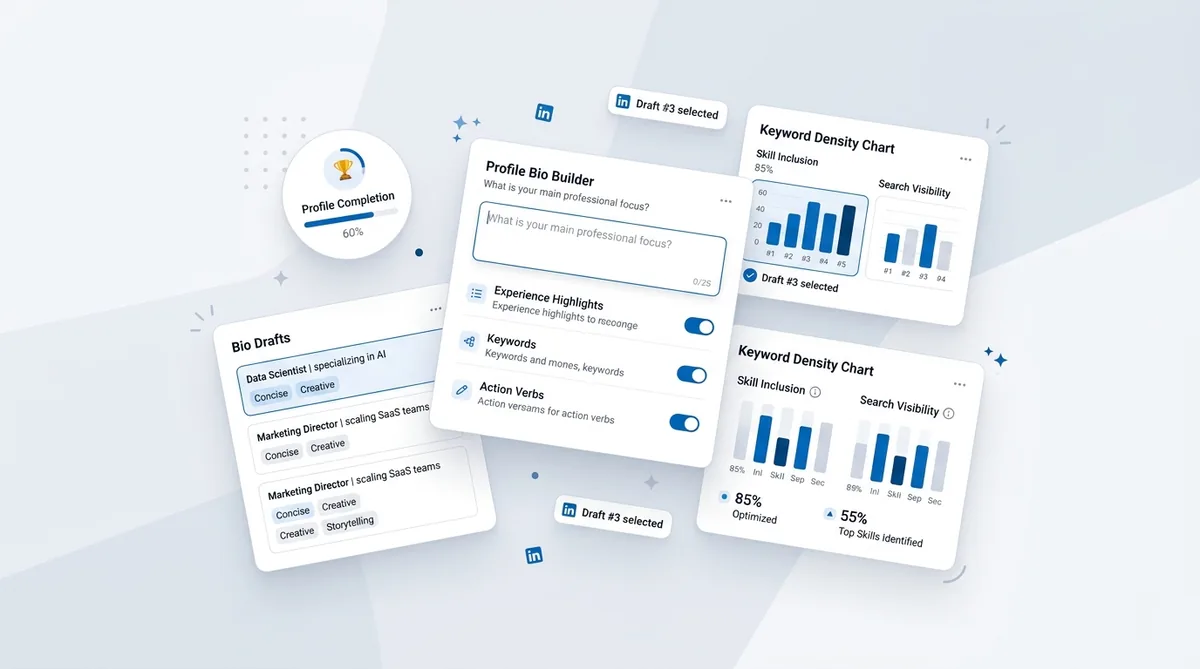
A linkedin bio generator works by formatting your raw professional credentials into proven copywriting frameworks like PAS or AIDA. By inputting your target audience, specific niche, and core achievements, the generator automatically structures your headline and summary for optimal keyword density and mobile truncation. This turns a generic resume into a searchable, conversion-focused landing page that captures high-intent leads.
The secret is iteration. You rarely nail the perfect hook on the first try, so having a system to generate multiple high-quality variations gives you the raw material to test what actually makes your audience click.
The 'Blank Page' Syndrome: Why LinkedIn Bios Are Paradoxically Difficult
Writing about yourself is agonizing.
You sit down to update your profile, and suddenly you forget everything you actually do for a living. You want to sound authoritative without crossing into obnoxious arrogance. You want to be approachable, but you still need to command premium rates.
This psychological tug-of-war is why so many smart people end up with terrible bios. We default to the safest, most generic language possible because we are afraid of alienating someone. We write "Experienced marketing professional passionate about growth" instead of "I help B2B SaaS companies scale from $1M to $5M ARR using organic social."
The paradox is that by trying to appeal to everyone, you become completely invisible to the exact people who actually want to pay you.
Leveraging Copywriting Frameworks for Psychological Authority
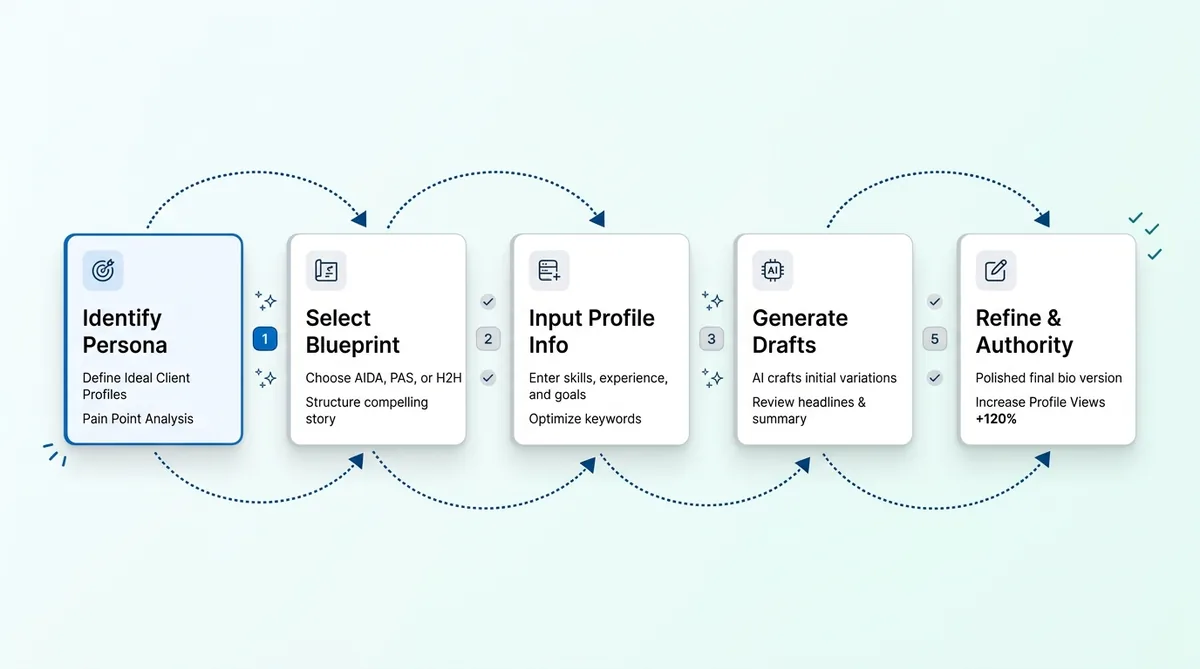
Chronological resumes force the reader to do mental math. When you list your past five jobs, the prospect has to connect the dots and figure out if your past experience translates to their current problem. High-value leads do not have time for mental math.
Copywriting frameworks flip this dynamic. They force you to translate your skills into immediate value. A solid bio is the anchor of any LinkedIn content strategy for your personal brand because it sets the exact premise for why someone should consume your content in the first place.
The PAS (Problem-Agitation-Solution) Model for Service Providers
If you sell a service, your prospects are looking for pain relief. The PAS framework connects instantly because it starts with their problem, not your title.
Here is what it looks like in practice. Instead of opening with "I am a freelance copywriter," you start with the problem: "Most B2B email sequences have a 1% conversion rate." Then you agitate: "You are burning thousands of dollars sending traffic to a leaky funnel." Finally, you offer the solution: "I write conversion-focused email flows that turn dead leads into booked calls."
This works because human attention is wired to recognize threats and problems first. By naming their pain immediately, you borrow their attention.
The Value-Proposition-First Approach for SaaS Founders
Founders love to talk about features. Prospects only care about outcomes.
If you run a software company, your bio needs to lead with the specific ROI your product delivers. "We use machine learning to optimize supply chains" is a feature description. "Cut your warehouse logistics costs by 20% in 30 days" is a value proposition. State the outcome first, then briefly explain the mechanism.
Crafting the 'Hook': How to Stop the Scroll in the First 155 Characters
Here is a structural reality most people ignore. On mobile devices, LinkedIn truncates your "About" section after the first two or three lines. That means you have roughly 150 to 200 characters to convince someone to click that tiny "See More" button.
If your first two lines are "Hi, my name is John and I am a dedicated professional," your bounce rate will be astronomically high. There is no curiosity gap.
Using Specific Numbers to Trigger Immediate Curiosity
Specific numbers bypass our mental spam filters. "I help companies grow" sounds like marketing fluff. "I helped 43 B2B companies add a combined $4.2M to their pipeline last year" sounds like a highly verifiable fact.
The brain's pattern-recognition system loves specificity. Specific numbers signal credibility and make your claims feel tangible and achievable. It creates an open loop that the reader naturally wants to close by reading the rest of your bio.
The 'Anti-Niche' Hook: Differentiating from the Competitive Noise
Sometimes the best way to stand out is to boldly declare what you refuse to do.
An anti-niche hook deliberately calls out a common, annoying industry practice and positions you as the antidote. For example: "I don't do 60-page audit reports that sit in your Google Drive. I give you 3 actionable steps to fix your SEO today." It instantly differentiates you from the endless sea of consultants delivering bloated corporate busywork.
Strategic Keyword Integration for LinkedIn SEO Visibility
Your profile is not just a landing page. It is a search result.
LinkedIn operates as a massive search engine for recruiters, founders, and buyers. The algorithm heavily weights the keywords placed in your Headline and the top of your About section. According to social media behavior data, profiles optimized with specific, intent-driven keywords see dramatically higher inbound search traffic.
Identifying High-Intent Keywords for Your Specific Industry
You need to bridge the gap between what you call yourself and what your prospects actually type into the search bar.
You might consider yourself a "Digital Transformation Catalyst," but no founder has ever searched for that term in human history. They search for "HubSpot Migration Specialist" or "Fractional CTO." Find the exact, boring, pragmatic terms your buyers use when they have a budget to spend, and put those in your headline.
Natural Language Placement vs. Ineffective Keyword Stuffing
The algorithm wants keywords, but humans want a conversation.
Do not just paste a comma-separated list of buzzwords at the bottom of your bio. Weave them into your narrative. "When I work as a Fractional CMO, my first priority is..." hits the keyword perfectly while maintaining a natural, conversational flow that builds trust.
The 14-Day Bio Optimization Sprint: How to Measure What Works
You cannot set and forget your profile. You have to treat it like an active experiment.
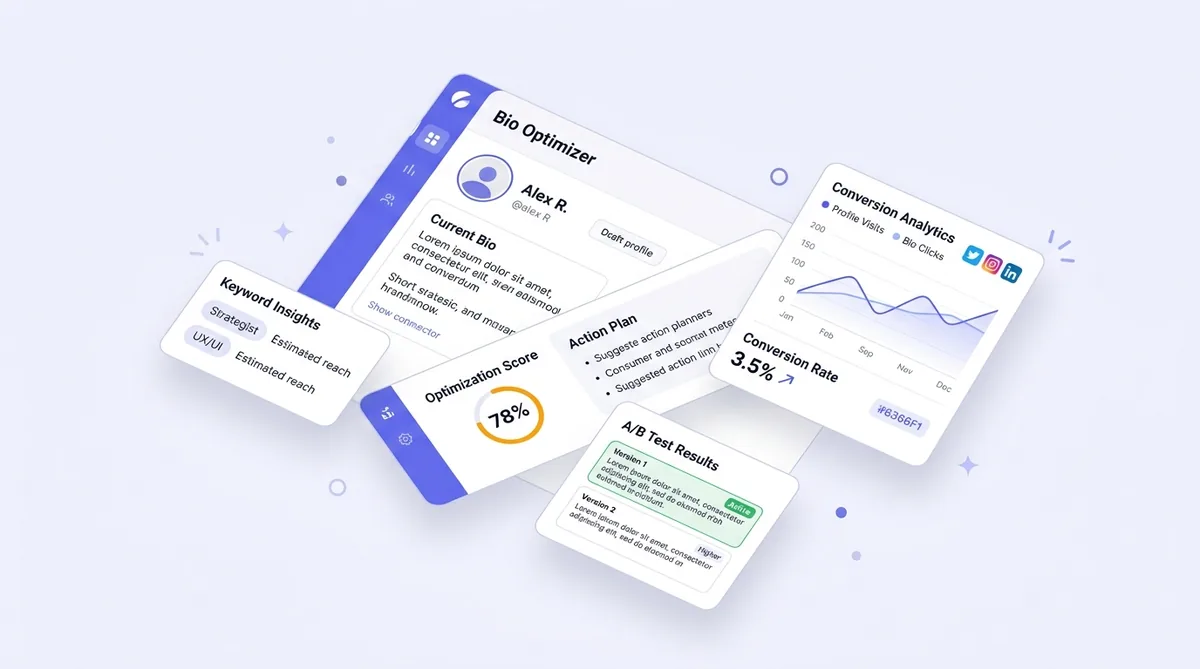
Run a 14-day sprint. Before you figure out how to repurpose blog posts into social media posts, make sure your profile is ready to catch that new traffic. Update your bio and track two specific metrics over two weeks: total profile views and total inbound connection requests with personalized notes.
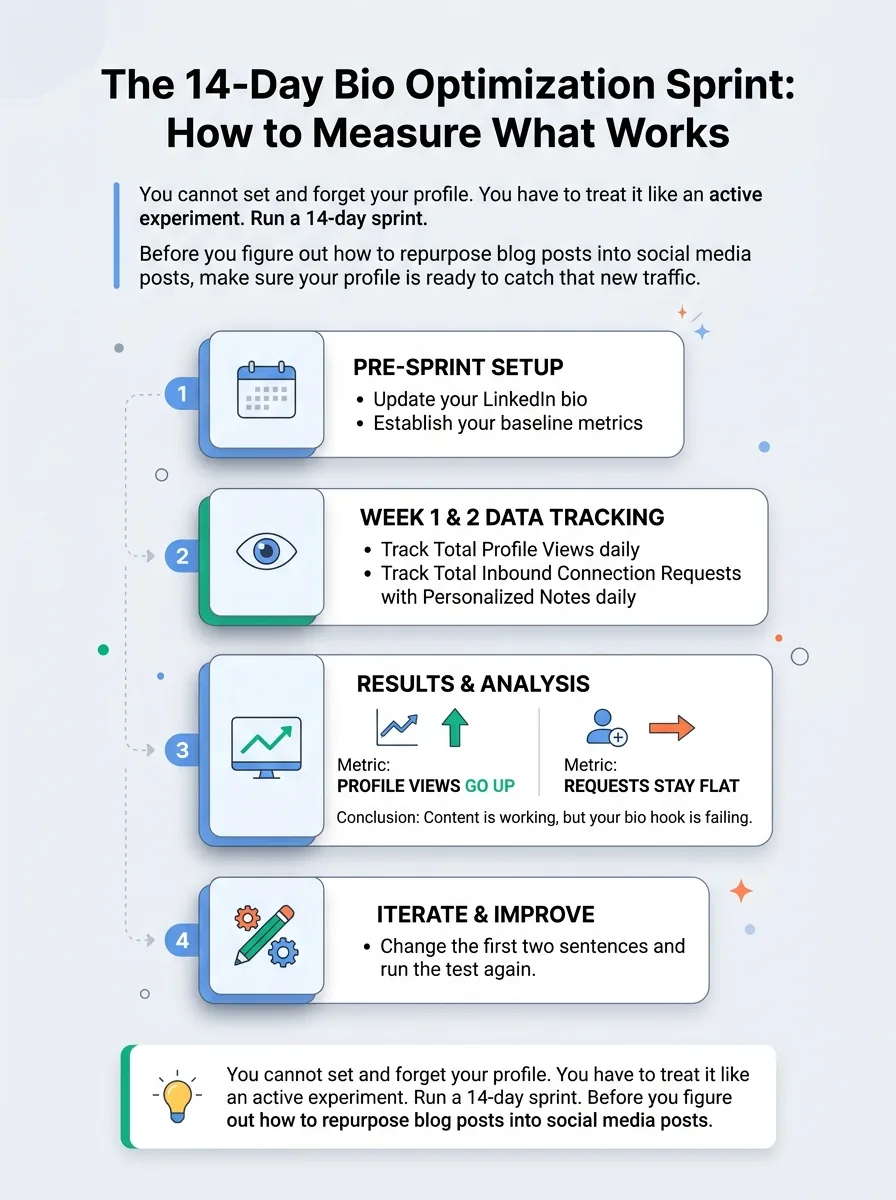
If your views go up but your requests stay flat, your content is working but your bio hook is failing. Change the first two sentences and run the test again.
5 Mistakes That Kill Your Professional Credibility
Even smart creators routinely self-sabotage their lead generation by falling into a few common traps.
- Stacking three unrelated ideas in one opening line.
Trying to be a founder, an investor, and a podcaster all in the same breath dilutes your core message.
- Writing in the third person.
You are not a historical figure. Writing "Sarah is a proven leader" just creates distance between you and the reader.
- Copying viral hooks without matching audience intent.
What works for a crypto influencer will destroy trust for a corporate lawyer.
- Using vague claims like "this changed everything."
High-value prospects have zero tolerance for clickbait.
- Treating the summary like a trophy case.
Your bio is not about you. It is about what your experience can do for the reader.
The 'Corporate Buzzword' Overload and Why It Erases Trust
Terms like "synergistic," "innovative," and "thought leader" are invisible ink. When a high-value prospect reads them, their brain literally skips over the words because they carry zero informational weight. Worse, they signal that you do not know how to clearly articulate your actual value.
Failing to Address the 'What’s In It For Me?' Factor
If your bio is just a list of places you have worked and awards you have won, you are asking the client to care about your ego. Shift the framing. Instead of "I won the Top Sales rep award," write "I learned exactly what it takes to close enterprise deals, and now I build those same sales systems for early-stage startups."
Scale vs. Precision: Moving Beyond the Manual Bio Draft
The real problem isn't knowing what a good bio looks like. The problem is the sheer amount of time it takes to draft, edit, and format multiple variations until you find the one that clicks.
If you're tired of staring at a blinking cursor, a linkedin bio generator can take your raw inputs like your niche, target audience, and key achievements, and instantly output multiple platform-optimized variations. You simply tell it who you are and who you want to reach, and it handles the copywriting frameworks and character limits for you. That way, you spend your time testing what converts instead of stressing over sentence structure.
Start creating viral content today
Join other creators who've transformed their social media presence with AI-powered content.
Start creating nowFrequently Asked Questions About LinkedIn Bios
How long should my LinkedIn bio be?
Aim for 3 to 4 short paragraphs. Keep it under 2,000 characters, but ensure the most critical value proposition is packed into the first 150 characters so it's visible before the "See More" cutoff.
Should I use emojis in my LinkedIn profile?
Yes, but use them strategically as bullet points or visual breaks. Do not substitute words for emojis. A simple checkmark or arrow helps format dense text and makes it easier for prospects to scan your core offerings.
How often should I update my LinkedIn bio?
Update it whenever your core offer or target audience shifts. Otherwise, review your bio metrics every quarter. If your inbound lead quality drops, it is time to tweak your headline and opening hook.
Your Bio is Your Digital Handshake
Craft a Bio That Converts
Create a compelling bio that turns profile visitors into followers.
Try Bio GeneratorYour content might buy a prospect's attention, but your bio is what actually earns their trust. Treat it like the high-value real estate it is, test your hooks relentlessly, and watch your profile views finally turn into actual pipeline.