The LinkedIn Loneliness: Why Your Content Strategy Isn't Working (Yet)
You know the exact feeling.
Jump to a section:
- The LinkedIn Loneliness: Why Your Content Strategy Isn't Working (Yet)
- How to Build a Content Strategy for LinkedIn Personal Brands (Quick Answer)
- Why Personal Branding on LinkedIn Feels Like a Second Full-Time Job
- Strategy 1: Defining Your Three Authority Pillars
- Strategy 2: Mastering the Scroll-Stopping Hook
- Strategy 3: The 'Dollar-Eighty' Engagement Loop
- Strategy 4: Mixing Personal Narrative with Tactical Value
- Real-World Transformations: 3 LinkedIn Case Studies
- 5 Strategic Mistakes That Kill Your LinkedIn Reach
- From Manual Grinding to Repeatable Systems
- The LinkedIn Strategy Checklist for 2024
- Frequently Asked Questions About LinkedIn Content
- Summary: Building a Brand One Post at a Time
You spend forty-five minutes crafting what you think is a brilliant insight. You check your grammar, format the line breaks perfectly, and hit publish. Then you wait. An hour goes by. Your post is sitting there with three likes—one from your mom, one from a coworker, and one from a random bot selling lead generation services.
It feels like shouting into a void.
Most creators hit this wall on LinkedIn and immediately assume they just aren't interesting enough. They think they need twenty years of executive experience or a massive existing audience to gain traction. Not true.
The truth is that random acts of posting don't build authority. If your audience can't figure out exactly what you stand for within three seconds of reading your profile, they move on. Building a true content strategy for linkedin personal brands isn't about posting more often. It's about posting with intent.
You need a repeatable system. One that turns your actual expertise into a magnetic force that pulls the right people toward your profile without burning you out in the process.
How to Build a Content Strategy for LinkedIn Personal Brands (Quick Answer)
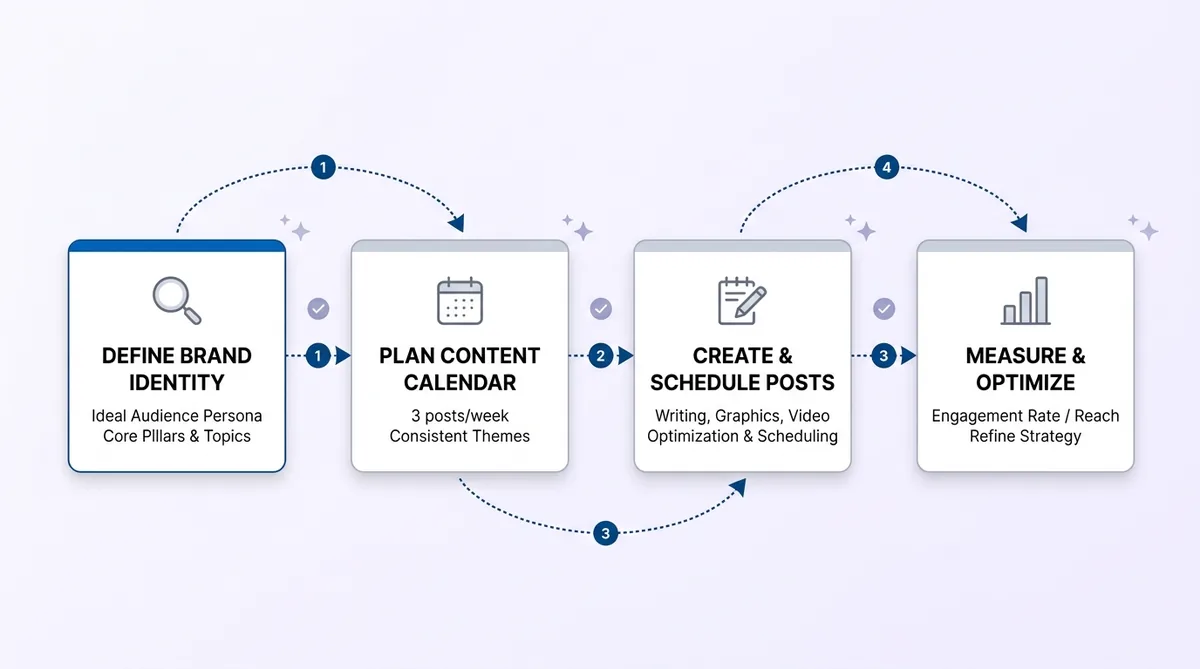
To build a successful LinkedIn personal brand content strategy, you must define three core authority pillars to reduce audience confusion. Post specific, actionable content 3-5 times per week using pattern-interrupting hooks. Dedicate 15 minutes daily to outbound engagement on top creator posts, and maintain an 80/20 balance of tactical advice to personal storytelling.
Executing this consistently turns your profile into a predictable inbound engine for your career or business.
Why Personal Branding on LinkedIn Feels Like a Second Full-Time Job
Let's be honest about the hidden cost of building an audience. It's exhausting.
Between managing your actual career, dealing with clients, and having a personal life, finding the mental bandwidth to write thought leadership content is hard. The "blank page" syndrome is real. You sit down to write, and suddenly every idea feels either too basic, too complex, or completely unoriginal.
This is where content fatigue sets in.
I've seen incredibly smart professionals give up after two weeks because they treated LinkedIn like a diary rather than a strategic asset. They wrote massive essays without formatting, ignored the algorithm's preference for scannability, and burned themselves out trying to be profound every single day. If you want to learn how to create content faster, you have to stop reinventing the wheel every time you open the app.
A strategy removes the emotional weight of posting. It gives you boundaries.
Strategy 1: Defining Your Three Authority Pillars
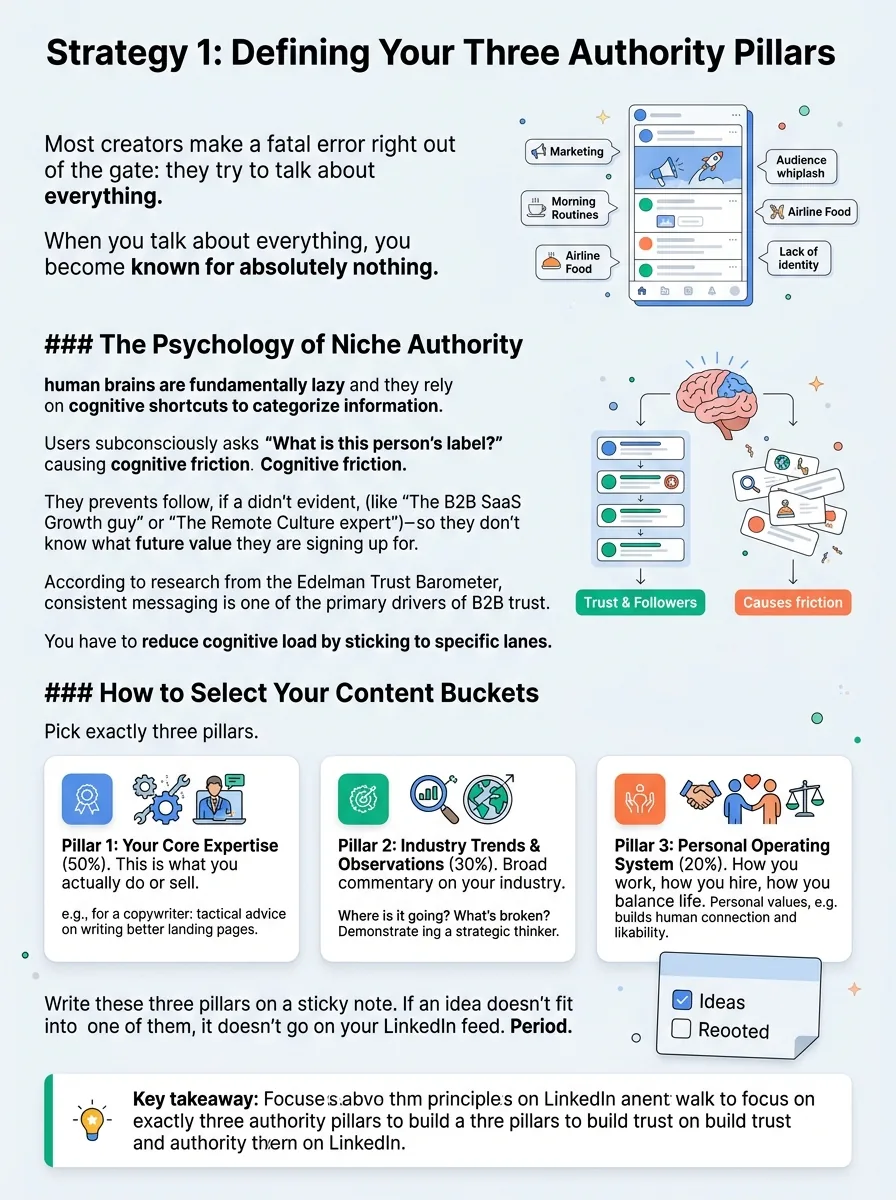
Most creators make a fatal error right out of the gate: they try to talk about everything.
Monday is a post about marketing. Tuesday is about morning routines. Wednesday is a rant about airline food. By Friday, the audience has severe whiplash. When you talk about everything, you become known for absolutely nothing.
The Psychology of Niche Authority
Here is why this matters: human brains are fundamentally lazy.
We rely on cognitive shortcuts to categorize information. When a user scrolls past your post, their brain is subconsciously asking, "What is this person's label?" If they can't assign you a clear label (e.g., "The B2B SaaS Growth guy" or "The Remote Culture expert"), they experience cognitive friction. They won't hit follow because they don't know what future value they are signing up for.
According to research from the Edelman Trust Barometer, consistent messaging is one of the primary drivers of B2B trust. You have to reduce cognitive load by sticking to specific lanes.
How to Select Your Content Buckets
Pick exactly three pillars.
- Pillar 1: Your Core Expertise (50%).
This is what you actually do or sell. If you're a copywriter, this is tactical advice on writing better landing pages.
- Pillar 2: Industry Trends & Observations (30%).
Broad commentary on your industry. Where is it going? What's broken? This shows you aren't just a tactician, but a strategic thinker.
- Pillar 3: Personal Operating System (20%).
How you work, how you hire, how you balance life. This builds human connection and likability.
Write these three pillars on a sticky note. If an idea doesn't fit into one of them, it doesn't go on your LinkedIn feed. Period.
Strategy 2: Mastering the Scroll-Stopping Hook
Your post could contain the secret to eternal youth, but if your first line is boring, nobody will read it.
LinkedIn gives you roughly three to five lines of text before hitting the user with that little "...see more" button. Those first few lines are your hook. They are the only thing that matters in the first three seconds of the scroll.
Leveraging Negative Stakes and Curiosity Gaps
Why do certain hooks grab us? It's biology.
Pattern interruption triggers the amygdala. When you make a counter-intuitive statement or point out a specific problem, the brain literally stops the scrolling thumb to assess the threat or novelty. A generic statement like "Leadership is important" gets ignored because the brain has seen it a thousand times. A statement like "Most managers accidentally punish their top performers" stops the scroll because it introduces a high-stakes problem.
Specific numbers also trigger the brain's pattern-recognition system. "7 steps to better copy" feels scannable and achievable. "Some tips for copy" feels vague and skippable. The algorithm reinforces this because specific hooks drive higher "see more" clicks, which is a massive signal of relevance.
3 Hook Templates to Use Today
Stop guessing and start using structures that are proven to work.
The Contradiction: Open by destroying a common industry belief.
Example: "Stop telling your junior developers to write clean code. Tell them to write replaceable code instead. Here is the difference:"
The Transformation: Show a clear Point A to Point B.
Example: "In 2021, my agency had a 40% churn rate. Today, it's under 5%. Here is the exact onboarding checklist that fixed it:"
The Specific Listicle: Promise high value with a precise number.
Example: "I audited 100 SaaS landing pages last week. 92 of them made the exact same mistake in their hero section. Let's fix it:"
Strategy 3: The 'Dollar-Eighty' Engagement Loop
Publishing a post and immediately closing the app is social media suicide.
LinkedIn is not a broadcasting platform; it is a networking event. If you walked into a real-life conference, grabbed a megaphone, shouted your opinions, and then ran out the door, people would think you were unhinged. You have to mingle.
Why the Algorithm Favors Commenters
When you comment thoughtfully on other people's posts, you are signaling to the algorithm that your account is an active participant in the ecosystem. More importantly, you are siphoning traffic.
Top creators already have the attention you want. When you leave a high-value, insightful comment early on a large account's post, your comment gets upvoted. It sits right below their content. Hundreds of their followers will see your face, read your headline, and click over to your profile.
This reciprocity mechanism is fundamental to network growth.
The 15-Minute Daily Engagement Protocol
Create a bookmark folder in your browser with the LinkedIn profiles of 15-20 creators in your exact niche who have a slightly larger following than you do.
Every morning, before you post your own content, spend 15 minutes opening those profiles. Find who has posted recently. Leave comments that actually add to the discussion—disagree respectfully, share a micro-case study, or ask a sharp follow-up question. Never just write "Great post!" That adds zero value and won't get you noticed.
Start creating viral content today
Join other creators who've transformed their social media presence with AI-powered content.
Start creating nowStrategy 4: Mixing Personal Narrative with Tactical Value
There is a massive debate right now about whether LinkedIn has become "too personal" or "too much like Facebook."
Here is the reality: pure tactical advice makes you an authority, but personal vulnerability makes you a brand. If all you do is post sterile 'how-to' guides, you are easily replaceable by an AI. People hire, refer, and follow other human beings.
The Hero's Journey for Personal Brands
You need to document your struggles, not just your wins. When you share a failure—like losing a major client or struggling with public speaking—you build immediate trust. The key is to always tie the personal story back to a professional lesson.
Don't just post a selfie crying about a bad day. Post about the bad day, break down exactly why the failure happened, and explain the system you built to ensure it never happens again. That transforms vulnerability into immense professional credibility.
Decision Rules: When to Post Personal vs. Professional
A good rule of thumb is 80/20. Eighty percent of your content should be laser-focused on solving your target audience's problems. Twenty percent should be about your personal journey, your values, or your behind-the-scenes reality. Figuring out this rhythm is crucial if you want to know how to plan a week of social media content fast.
Real-World Transformations: 3 LinkedIn Case Studies
Theory is great, but practical application is where the magic happens. Let's look at three distinct profiles.
The Fractional Executive: Sarah spent months posting generic leadership quotes and getting zero inbound leads. She switched to the 3-pillar strategy. Her pillars: Fractional CFO tactics, cash flow horror stories, and balancing remote work as a parent. Within 60 days, she landed two retainer clients directly from DMs triggered by her specific cash flow breakdowns.
The Agency Owner: David used to post links to his company blog every Tuesday. Total crickets. He realized external links kill reach. He started pulling one key insight from his blogs, turning them into text-only storytelling posts with strong "Transformation" hooks. His profile views increased by 400%.
The Corporate Manager: Elena wanted to attract recruiters. Instead of posting "I'm looking for new opportunities," she began posting daily micro-lessons about managing neurodivergent tech teams. She dominated that highly specific niche. Nine weeks later, a VP of Engineering reached out with an unlisted Director role.
5 Strategic Mistakes That Kill Your LinkedIn Reach
Even with a good strategy, minor tactical errors can destroy your visibility. Why do most people still fail to get results? They fall into one of these traps.
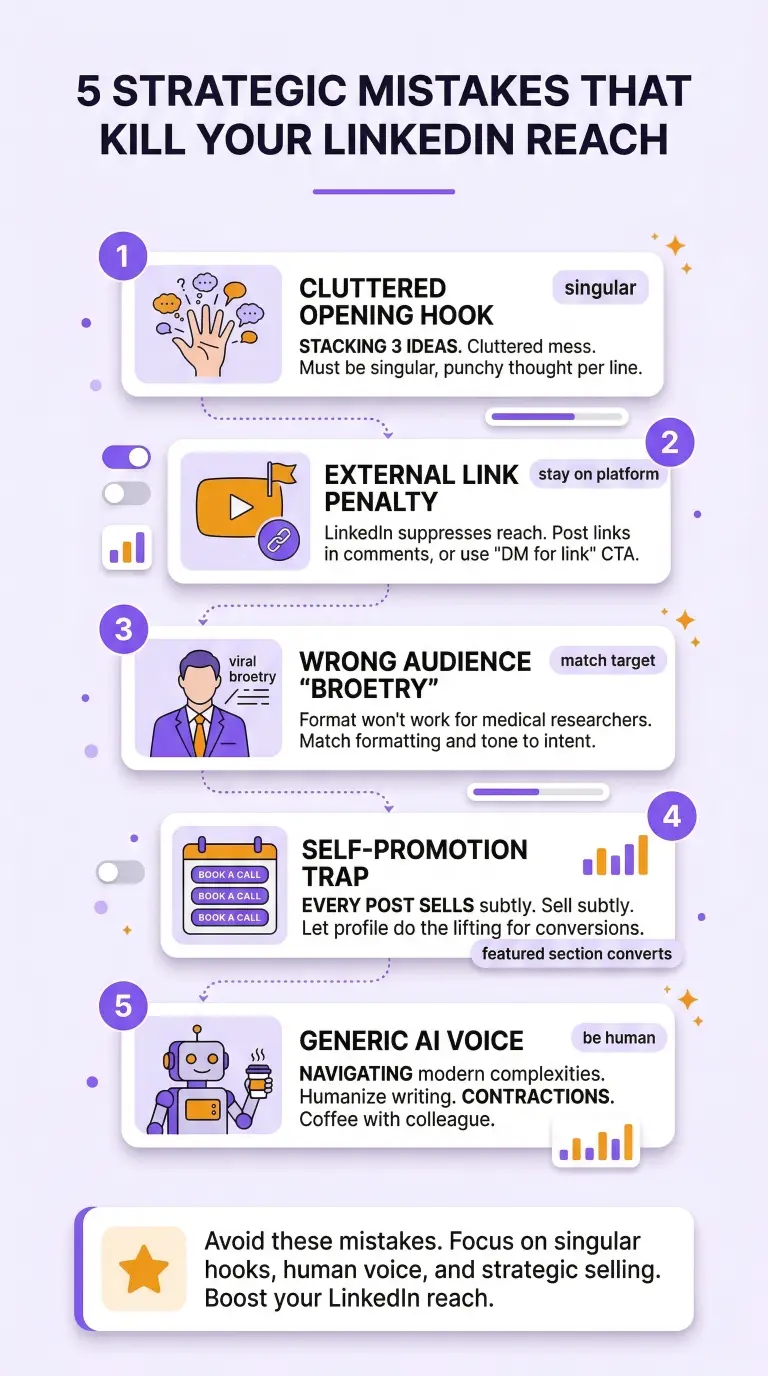
1. Stacking three ideas in one opening line.
Your hook must be singular. If your first sentence tries to introduce a problem, offer a solution, and ask a question all at once, it becomes a cluttered mess. Keep it to one punchy thought per line.
2. The External Link Penalty.
LinkedIn wants users to stay on LinkedIn. If you drop a link to your YouTube video or Substack in the main body of your post, the algorithm will heavily suppress your reach. Put the link in the comments, or use a "DM me for the link" call to action.
3. Writing generic "Broetry" for the wrong audience.
Copying the viral, single-sentence-paragraph format of sales influencers won't work if your target audience is enterprise medical researchers. Match your formatting and tone to the intent of the people you actually want to reach.
4. The "Self-Promotion Trap."
Ending every single post with "Need help with your taxes? Book a call on my Calendly!" is exhausting for your readers. Sell subtly. Let your profile banner and featured section do the heavy lifting for conversions.
5. Using a generic AI voice.
If your post starts with "Navigating the complexities of modern business..." everyone knows a robot wrote it. Humanize your writing. Use contractions. Write exactly how you speak to a colleague over coffee.
From Manual Grinding to Repeatable Systems
The real problem isn't knowing what a good LinkedIn strategy looks like. The framework is actually simple.
The core issue is execution. Producing enough quality variations, tailoring your tone, and hitting your publishing cadence consistently without spending an hour per post is where 90% of professionals fail.
You have the raw expertise in your head. The bottleneck is the physical act of translating that expertise into platform-perfect formats day after day.
That is why top creators use dedicated systems to scale their output. Imagine dropping a rough 6-word thought or a messy voice note into a content generator, selecting your target platform and tone, and instantly receiving a structured, highly-readable post. It adapts your raw idea into a native LinkedIn text post, or even a script for a Short, preserving your unique voice while handling the algorithmic formatting constraints.
You don't need to stare at a blank screen. You just generate the baseline, tweak the personal nuances, and hit publish.
The LinkedIn Strategy Checklist for 2024
Ready to execute? Follow this exact sequence to reboot your presence.
- 1. Optimize your profile
Ensure your headline tells people exactly who you help and how. Update your banner to serve as a billboard for your value proposition.
- 2. Define your 3 pillars
Write down your core expertise, your industry commentary, and your personal angle.
- 3. Batch your hooks
Spend twenty minutes writing 10 strong opening lines before you write any actual posts.
- 4. Set your cadence
Commit to 3-4 posts per week. Don't promise daily if you can't sustain it.
- 5. Schedule your outbound
Block 15 minutes on your calendar every morning purely for leaving high-value comments on other creators' posts.
Frequently Asked Questions About LinkedIn Content
What is the best time to post on LinkedIn?
The best time is generally Tuesday through Thursday between 8:00 AM and 10:00 AM in your target audience's time zone. However, consistency matters far more than timing. A great post at a bad time will always outperform a bad post at a perfect time.
Should I use hashtags?
Hashtags have lost significant power on LinkedIn recently. If you use them, stick to 3-5 highly relevant tags at the bottom of your post. Do not stuff your post with dozens of hashtags.
How long should my posts be?
Vary your lengths. Mix short, punchy text posts (under 500 characters) with longer, deep-dive carousels or storytelling posts. The algorithm favors accounts that keep users dwelling on the screen, so formatted long copy often performs exceptionally well if the hook is strong.
Do I need LinkedIn Premium to grow?
Absolutely not. Premium is a fantastic tool for outbound sales and recruiting, but it provides zero algorithmic advantage for your organic content reach.
Create 10x More Content
Transform one idea into dozens of engaging posts for every platform.
Try Content GeneratorSummary: Building a Brand One Post at a Time
Building a personal brand on LinkedIn doesn't happen overnight, and it doesn't require going viral. It requires clarity.
Pick your lanes, write hooks that respect human psychology, and show up in the comments section of your peers. Consistency beats intensity every single time in the long-term game of personal branding. Now get out there and post.