The First Three Seconds: Why Most Content Fails Before It Starts
Imagine this. You spend three hours scripting, filming, and editing a video. The lighting is perfect. The value is insane. You hit publish, wait for the algorithm to do its magic, and check back an hour later.
Jump to a section:
- The First Three Seconds: Why Most Content Fails Before It Starts
- The 'Blank Screen' Syndrome: Why Generating Hooks is the Hardest Part of Content Creation
- Strategy 1: Using Psychological Triggers to Halt the Scroll
- Strategy 2: Adapting AI Outputs for Platform-Specific Algorithms
- Strategy 3: The 'Hook-to-Value' Alignment Framework
- The 14-Day Hook Optimization and Testing Framework
- 6 Mistakes That Kill Your Hook Conversion Rates
- The Scaling Dilemma: Transitioning from Manual Effort to Repeatable Output
- Frequently Asked Questions About Viral Hook Generators
- Summary: Turning Attention into a Content Asset
12 views.
It hurts. Sound familiar? Most creators blame the algorithm, the shadowban, or the time of day they posted. But the brutal truth is usually much simpler: your audience never made it past the third second.
Start creating viral content today
Join other creators who've transformed their social media presence with AI-powered content.
Start creating nowAttention isn't given on social media. It is stolen. If your opening line doesn't immediately grab the viewer by the collar, all that high-quality content hidden at the 30-second mark practically doesn't exist. This is exactly why smart creators are turning to a viral hook generator to bridge the massive gap between the effort they put into their content and the visibility it actually gets.
How to effectively use a viral hook generator:
Input your core topic, select an emotional angle (like fear, curiosity, or desire), and generate 5 to 10 variations. Test these different openers against your audience's unique triggers. The secret is treating the generated outputs as raw materials to refine, not final drafts to blindly copy-paste.
The 'Blank Screen' Syndrome: Why Generating Hooks is the Hardest Part of Content Creation
Writing the meat of your post is usually easy. You know your subject matter. The friction happens when you have to summarize 10 minutes of nuanced value into a single, punchy, 10-word sentence.
That requires a massive amount of cognitive load. Your brain has to switch from "educator mode" to "copywriter mode." Because this switch is exhausting, creators default to safe, boring intros. They start videos with "Hey guys, today I want to talk about..." or text posts with "I was thinking recently..."
Boring intros signal low value to the brain's scanning mechanism. People swipe away. A generator removes this cognitive bottleneck entirely. It forces you out of your safe zone and presents you with aggressive, scroll-stopping angles you wouldn't have thought of on your own.
Strategy 1: Using Psychological Triggers to Halt the Scroll
A good opening line doesn't just sound catchy. It exploits fundamental human psychology. Here is how to direct your prompts to hit the hardest-hitting cognitive triggers.
The Curiosity Gap: Opening Loops the Brain Must Close
Humans are biologically wired to hate incomplete information. In psychology, this is known as the Zeigarnik Effect—our tendency to remember interrupted or incomplete tasks better than completed ones. When you create a gap between what a user knows and what they want to know, they feel a literal itch to click.
To use this, ask your generator for "Missing Piece" prompts. Don't accept a hook like "Here are 3 ways to grow your newsletter." That is a closed loop. Instead, look for outputs like "I tried 10 newsletter strategies this year. 9 failed miserably. Here is the 1 that actually doubled my list." The brain has to know what that one strategy is. You can build a highly effective social media hook system entirely around opening and closing these curiosity gaps.
Negativity Bias: Highlighting the Cost of Inaction
Here is an uncomfortable truth about human attention. We care way more about avoiding pain than gaining pleasure. The brain prioritizes threats because, evolutionarily, ignoring a threat meant death.
How does this apply to your content? "Stop making this one Instagram mistake" will almost always outperform "How to grow on Instagram." When using a viral hook generator, specify that you want angles focusing on the cost of inaction. Have the AI generate variations that highlight common mistakes, wasted time, or lost money. It immediately elevates the stakes of your content.
Strategy 2: Adapting AI Outputs for Platform-Specific Algorithms
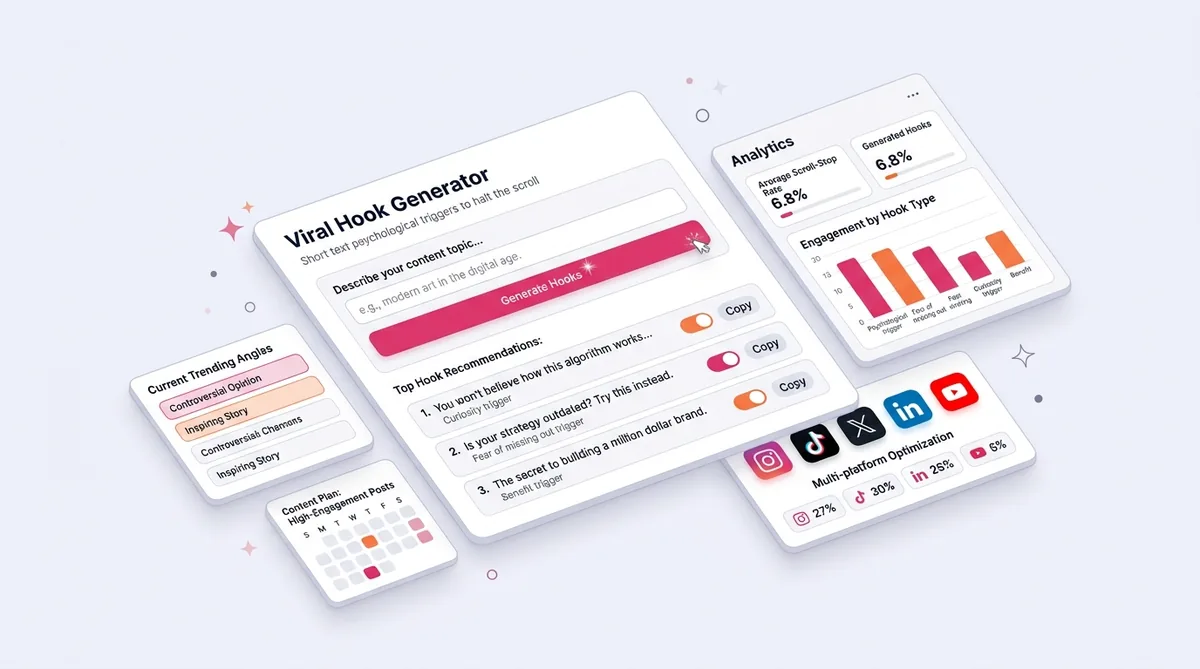
One massive mistake creators make is treating all platforms equally. A brilliant opening sentence on Twitter might tank your retention on TikTok. You have to adapt the generated text to fit the visual and temporal constraints of where you are posting.
Short-Form Video Hooks: Visual and Verbal Synchronicity
On Reels and Shorts, you don't have three seconds anymore. According to TikTok's own internal data, the most critical window for retention is the first 1.5 seconds. Your verbal hook and your visual hook must sync perfectly.
If your generated hook is "The secret to scaling your agency," you can't just stand there and say it. You need on-screen text popping up exactly as you speak, combined with a physical pattern interrupt—like taking a step forward or dropping an object on a desk. The text reinforces the spoken word, locking in the viewer's visual and auditory processing simultaneously.
Text-Based Social Hooks: The First Line vs. The 'See More' Button
LinkedIn and X (Twitter) operate on entirely different mechanics. On these platforms, the initial algorithm signal you need isn't just dwell time. It is "The Click." You want users expanding the text or opening the thread.
Whitespace is your best friend here. Use the generated hook as your very first line. Then, hit enter twice. Add a short, teasing second line. The goal is to force the juiciest part of the content right below the "See More" button. If the generator gives you a long, compound sentence, chop it in half. Make them click to finish the thought.
Strategy 3: The 'Hook-to-Value' Alignment Framework
Let's talk about the dark side of hooks: clickbait. If you use a highly aggressive opener and follow it up with mediocre advice, you destroy your trust. The algorithm tracks retention and rewatches. Pissing off your audience with a bait-and-switch hurts your account health long-term.
The Authority Anchor: Proving Why You Are the Messenger
To avoid feeling spammy, anchor your hook in specific authority. When you input your topic into a viral hook generator, include your personal data points.
Instead of generating a generic "How to get fit," prompt it with your actual achievement: "I lost 30 pounds in 6 months working a desk job." Immediate trust. Immediate authority. The audience knows why they should listen to you specifically.
The Specificity Filter: Swapping Generic Terms for High-Impact Nouns
Vague language gets scrolled past. Specificity stops thumbs. Look at the raw output from your generator and aggressively swap out generic words for highly specific nouns and numbers. Specific numbers trigger the brain's pattern-recognition system. "A few tips" feels scannable and skippable. "7 overlooked tips" feels actionable. If you need a massive database of these specific patterns, review these 47 social media hook formulas to see exactly how specificity transforms a sentence.
The 14-Day Hook Optimization and Testing Framework
In practice, nobody knows what will go viral until the market decides. This is why testing is non-negotiable.
Take one core piece of content. Use your generator to create two wildly different hooks. Let's say one is curiosity-driven and the other relies on negativity bias.
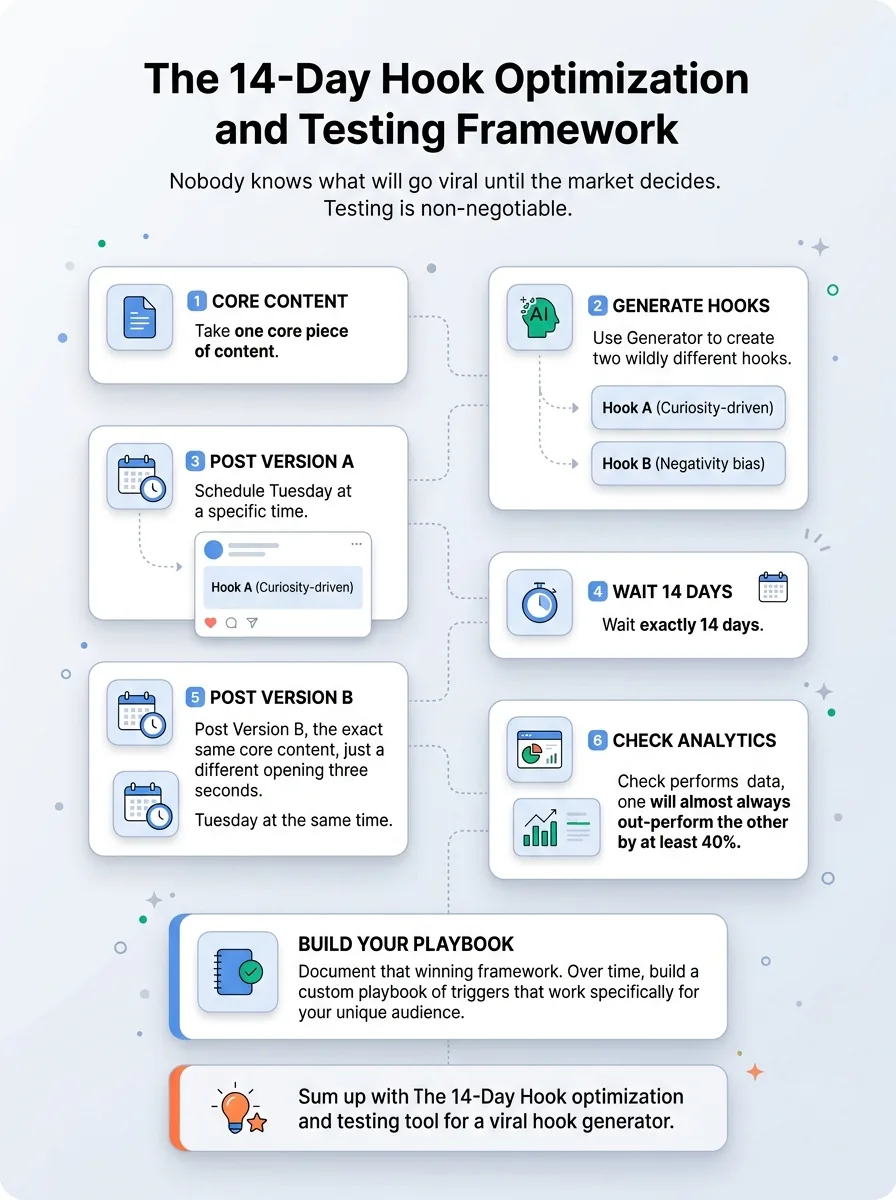
Post version A on a Tuesday. Wait exactly 14 days. Post version B (the exact same core content, just a different opening three seconds) on a Tuesday at the same time. Check your analytics. You will almost always find that one out-performs the other by at least 40%. Document that winning framework. Over time, you build a custom playbook of triggers that work specifically for your unique audience.
6 Mistakes That Kill Your Hook Conversion Rates
Why do most people still fail to get views even when using optimized openers? Because they shoot themselves in the foot with execution. Here are the specific mistakes I see constantly:
- Stacking 3 ideas in one opening line
"Here is how to grow your audience, make more money, and save time!" It's too much. Pick one core promise. One single focal point.
- Copying viral hooks without matching audience intent
Using an aggressive finance-bro intro for a soft, empathetic mental health page creates massive cognitive dissonance. Match the vibe.
- Using vague claims like "this changed everything"
Changed what? For whom? Vague claims sound like infomercials. Be specific about the transformation.
- Ignoring the visual hook entirely
You can have the best script in the world, but if you look bored, poorly lit, and static in the first two seconds, people will swipe.
- The Buried Lead
Putting the most interesting word at the end of the sentence. "If you want to scale your business, stop doing cold outreach." Reverse it. "Stop doing cold outreach if you want to scale your business." Put the punch first.
- Using "Bot-Speak"
Leaving AI-generated phrases untouched so you sound like a textbook. Real humans use contractions, slang, and casual phrasing.
The Scaling Dilemma: Transitioning from Manual Effort to Repeatable Output
The real problem isn't knowing what a good opener looks like. It is producing enough quality variations consistently without spending an hour agonizing over every single post. Brainstorming one great angle takes creative energy. Brainstorming ten takes a toll.
That is why creators eventually move from manual brainstorming to a dedicated system. The goal is to produce multiple options incredibly fast, so your only job is choosing the best one.
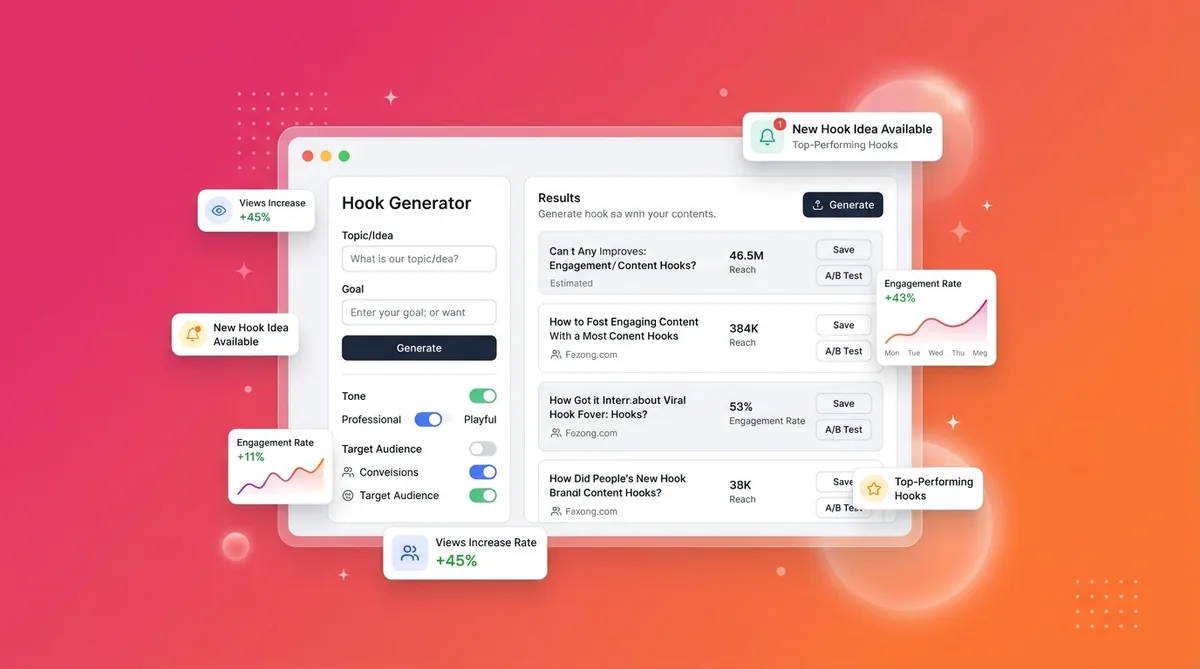
If you're tired of staring at a blank screen trying to invent the perfect first line, the SocialOrbit Hook Generator actually solves this exact bottleneck. You simply describe your topic and select a specific style preference—like "contrarian" or "data-driven." It instantly outputs multiple variations optimized for stopping the scroll. It completely removes the friction between having a great idea and actually getting people to look at it.
Start creating viral content today
Join other creators who've transformed their social media presence with AI-powered content.
Start creating nowFrequently Asked Questions About Viral Hook Generators
Do emotional hooks work for B2B and LinkedIn content?
Absolutely. B2B buyers are still humans scrolling on their phones. While you might not use hyper-aggressive clickbait, using curiosity gaps or contrarian opinions works incredibly well on LinkedIn. A hook like "Most SaaS founders measure churn completely wrong" is highly effective in B2B.
Can AI replace my unique brand voice?
Not if you use it correctly. The generator provides the structural framework and the psychological angle. Your job is to inject your personal slang, specific numbers, and tone into that framework before publishing.
How many hooks should I generate per post?
Aim to generate 5 to 10 variations for every piece of content. Pick the top two. Use the best one for your primary post, and save the runner-up for when you repurpose that content 45 days later.
Does the hook impact SEO on social platforms?
Yes. Many platforms (like TikTok and YouTube) transcribe your spoken words and use on-screen text to categorize your content for search. Using specific, keyword-rich language in your opening helps the algorithm push your content to the right "For You" pages.
Write Hooks That Stop the Scroll
Generate attention-grabbing opening lines that make people stop and read.
Try Hook GeneratorSummary: Turning Attention into a Content Asset
A hook is simply an invitation to view your hard work. By understanding psychological triggers and adapting to platform formats, you ensure your content actually gets the chance it deserves. Stop letting your best ideas die in the first three seconds.