The Exhausting Race for Viral Relevance
You spend two hours researching an idea, another hour filming it, and by the time you hit publish, the audio is dead and the joke is stale. Your comment section is a ghost town. You are officially late to the party.
Jump to a section:
- The Exhausting Race for Viral Relevance
- Quick Answer: How to Identify Trending Social Topics in Seconds
- Why Finding 'What's Next' Is Increasingly Difficult
- Strategy 1: Using Native Platform Signal Tools
- Strategy 2: Anticipating Demand via Search Data
- Strategy 3: Community-Led Trend Discovery
- The 14-Day 'Trend-Test' Framework
- 5 Mistakes That Kill Your Trend Performance
- From Manual Chasing to Scalable Systems
- Frequently Asked Questions About Social Trends
- Summary: Speed and Relevance Over Perfection
Sound familiar?
Most creators are stuck on this miserable treadmill. They consume content until they see a pattern, try to replicate it, and wonder why their version flops. But if you are waiting to see a trend dominating your For You Page before you act on it, you are not participating in a trend. You are participating in its funeral.
The secret isn't spending more hours scrolling. It is understanding the underlying mechanics of how attention moves across the internet. If you want to know how to find trending topics for social media content before they peak, you need a system that detects acceleration, not just total views.
Quick Answer: How to Identify Trending Social Topics in Seconds

If you need to find trending topics immediately, stop scrolling your feed and look at the raw data.
Filter the TikTok Creative Center by "Last 7 Days" to spot breakout hashtags and audio tracks before they hit mainstream saturation.
Check Google Trends Daily Search to find rising queries that don't have enough social video answers yet.
Look for the rising arrow icon on Instagram Reels audio to catch sounds that are currently accelerating.
Relevance always beats volume. A fast post on a rising micro-trend will perform significantly better than a highly polished video on last week's mega-trend.
Why Finding 'What's Next' Is Increasingly Difficult
Trends used to last months. Now, they barely survive the weekend.
The algorithm has become aggressively efficient at serving users exactly what they want, which means topics reach total market saturation in a matter of days. Once an idea crosses into the mainstream consciousness, it almost immediately enters its "cringe" phase. Brands get hold of it, corporate accounts make sanitized versions, and the original audience completely abandons it.
Your feed is actually your worst enemy here. The algorithm shows you content based on your historical behavior. It feeds you what is currently popular, creating a massive echo chamber. You think you are doing "trend research," but you are actually just looking at algorithmic noise from three days ago.
Strategy 1: Using Native Platform Signal Tools

Platforms don't hide what's working. They actually want you to make content about popular topics because it keeps users on their apps longer. But you have to know where to look, and more importantly, you have to understand the mechanism of velocity.
Velocity is the rate of growth over a specific time period. The algorithm doesn't care if a sound has two million total videos if 1.9 million of them were made last month. It cares about what went from 1,000 to 10,000 videos in the last 24 hours.
Monitor the TikTok Creative Center
Most people ignore the TikTok Creative Center because they think it's only for advertisers. That is a massive mistake.
The Creative Center gives you raw, unfiltered access to what is spiking right now. But you have to adjust the filters. Change the timeframe to the "Last 7 Days" or even the "Last 24 Hours." Look for hashtags or sounds that show a sharp, vertical growth curve but still have a relatively low total post count. That specific combination—high growth rate, low overall competition—is exactly where you want to position your content.
Spot Instagram's Trending Audio Icon
Instagram makes this slightly easier, but creators still misuse it. When you scroll through Reels, you'll sometimes see a small diagonal arrow pointing up next to the audio track name. This is Instagram literally telling you, "We are currently pushing videos that use this sound."
The moment you spot that arrow, save the audio. But don't just use it blindly. Once you secure the sound, you need to find content ideas for social media that actually fit your specific niche. A trending sound paired with an irrelevant, off-brand message will still tank because the viewer retention will be terrible.
Strategy 2: Anticipating Demand via Search Data
Here is what nobody tells you about social media trends: they almost always start as search queries.
When news breaks or a new concept enters the cultural zeitgeist, people immediately turn to search engines to understand it. There is a 24 to 48-hour window where millions of people are searching for a topic, but creators haven't made enough video content to satisfy that demand.
This is called an Information Gap. High demand plus low supply equals an algorithmic fast track for whoever fills the gap first.
Real-Time Google Trends Monitoring
Don't just look at broad topics on Google Trends. You need to look at Daily Search Trends.
If a new AI update drops, or a specific celebrity controversy sparks, you will see a massive spike in daily searches. People are trying to figure out what happened. If you can synthesize that information into a 60-second explainer video while the search curve is still pointing up, the social algorithms will aggressively push your content to interested users. You are providing the answer they are actively looking for.
Exploding Topics and Early-Stage Interest
If you want to get even further ahead, look at third-party aggregators that track niche keywords. When a term starts gaining traction in specialized forums but hasn't hit mainstream news yet, you have an opportunity to become the defining voice on that topic for your industry.
Strategy 3: Community-Led Trend Discovery
Let's talk about the reality of Sub-Culture Osmosis. Most viral social media trends do not originate on TikTok or Instagram. They start in text-based, highly concentrated communities.
Text moves faster than video. A controversial opinion forms on a niche subreddit on Monday. By Wednesday, someone turns it into a viral thread on X. By Friday, a creator adapts it into a TikTok hook. By the following Tuesday, it's a polished Instagram Reel.
If you figure out how to find trending topics for social media content at the Reddit phase, you are practically predicting the future.
Mining Reddit's 'Rising' Threads
Stop looking at the "Top" posts on Reddit. Those are already mature conversations. Go to the subreddits related to your niche and sort by "Rising."
Look for questions that keep getting asked repeatedly, or contrarian opinions that are generating massive debate in the comments. That friction is a massive signal. If a specific angle is getting people fired up in a text thread, it will absolutely crush as a polarizing hook in a short-form video.
Reverse Engineering Competitor Viral Outliers
This is my favorite purely analytical strategy. Find ten creators in your niche who have similar or slightly larger followings than you. Look at their last 30 videos.
If an account averages 2,000 views per video, but they have one random video sitting at 65,000 views, pause and analyze it. The algorithm pushed that specific video far beyond their core audience. Why? It's usually not the editing. It's almost always the topic or a highly specific curiosity gap in the hook. Extract the core concept of that outlier and put your own spin on it.
The 14-Day 'Trend-Test' Framework
You can't guarantee a trend will hit, so you have to test quickly.
Pick three emerging topics using the methods above. Create low-fidelity, minimal-edit versions for each. We are talking direct to camera, simple text overlays, no crazy transitions.
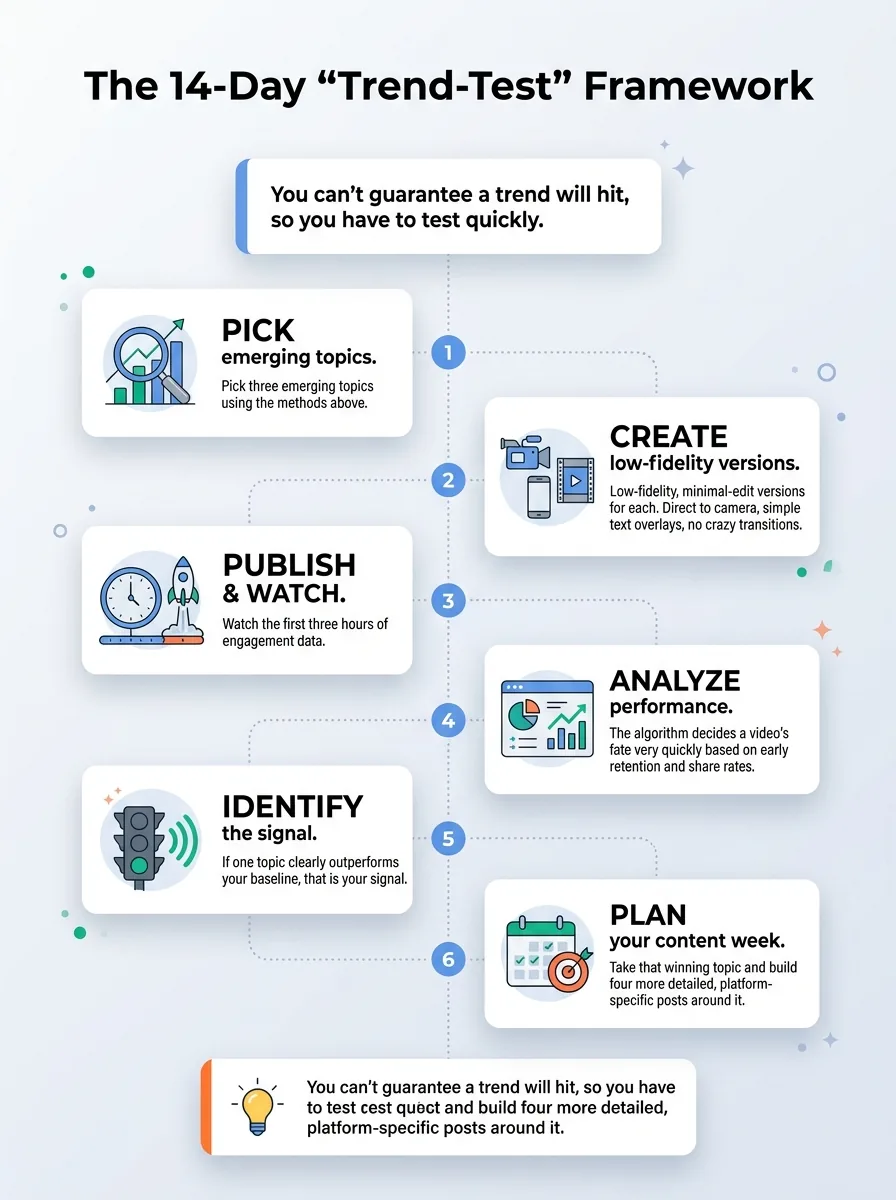
Publish them and watch the first three hours of engagement data. The algorithm decides a video's fate very quickly based on early retention and share rates. If one topic clearly outperforms your baseline, that is your signal. Now you know how to plan a week of social media content fast—you simply take that winning topic and build four more detailed, platform-specific posts around it.
5 Mistakes That Kill Your Trend Performance
Why do most people still fail even when they spot a good topic? Because they execute terribly. Here is what you are likely getting wrong.
- Using the exact same hook as everyone else.
Copying a viral video word-for-word doesn't work. The algorithm already pushed the original; it doesn't need a clone. You have to change the angle or the target audience.
- Over-editing until the trend is dead.
Taking three days to perfectly edit a video about a breaking trend is a death sentence. Speed is vastly more important than production value when answering immediate demand.
- Ignoring audience context.
Jumping on a trending dance or audio track but failing to tie it back to your specific niche just confuses your current audience and ruins your retention metrics.
- Vague text overlays on trending audio. Writing something like "POV
me on Monday" gives the viewer zero reason to keep watching.
- Stacking three ideas in one opening line.
Keep your hooks singular and specific. If you confuse the viewer in the first three seconds, they will scroll.
From Manual Chasing to Scalable Systems
The real problem isn't knowing what a good topic looks like. It's producing enough quality variations consistently without spending an hour formatting every single post.
Imagine you spot a great conversation happening on Reddit. To actually capitalize on it, you need a quick Reel script, a detailed Twitter thread, and a professional LinkedIn post. Doing that manually for every trend is exactly why creators burn out and stop posting entirely.
That's why consistent creators use a dedicated content generator to handle the formatting. You just drop your raw concept—even if it's just a six-word thought—choose your platform and tone, and it instantly builds out the platform-ready variations. You pick the best option, make a few tweaks to add your voice, and post. It turns the exhausting process of multi-platform distribution into a five-minute task.
Start creating viral content today
Join other creators who've transformed their social media presence with AI-powered content.
Start creating nowFrequently Asked Questions About Social Trends
How do you know if a trend is over?
Look at the comment section of recent videos using that trend. If the top comments are people complaining about seeing it too much, or if brand accounts are heavily using it to sell unrelated products, the trend has reached the cringe phase. Abandon it.
How long does a trend typically last?
Micro-trends (like a specific audio format or meme template) typically last 3 to 7 days before peaking. Macro-trends (like "day in the life" vlogs or raw direct-to-camera advice) can last months or even years. Always prioritize topic relevance over temporary audio trends.
Can B2B brands actually use viral trends?
Yes, but the translation is critical. A B2B brand shouldn't just do a trending dance. They should take the core framework of the trend (e.g., a specific "expectation vs reality" format) and apply it to an industry-specific pain point, like software integration failures or client management.
Why did my video fail even though I used a trending sound?
Because audio is only a delivery mechanism, not a substitute for value. The algorithm showed your video to a few hundred people, but your visual hook or text overlay wasn't compelling enough to make them stay. Low retention kills the video, regardless of the audio track.
Discover What Your Audience Wants
Find trending topics and content ideas that resonate with your followers.
Try Research GeneratorSummary: Speed and Relevance Over Perfection
Finding what's next isn't about scrolling endlessly; it's about looking at data signals like search volume, platform velocity, and niche community discussions. Stop trying to make the perfect video about a dying trend. Execute a fast, "good enough" post on a rising topic, and let the algorithmic demand do the heavy lifting for you.